Abstract
-
This article serves as a preliminary study for a broader project on developing Literary Sinitic textbooks for Anglophone learners. It examines major Literary Sinitic textbooks used in Korean universities, focusing on three aspects: the concept and scope of Literary Sinitic, pedagogical approaches, and text selection.
First, Korean university textbooks generally present Literary Sinitic as both an integral part of the Korean literary tradition and the shared classical written language of the Sinosphere. However, explicit discussions of its concept and scope appear more often in academic scholarship than in textbooks themselves, suggesting the need for a more systematic introduction to these issues.
Second, most textbooks seek to modernize Literary Sinitic pedagogy by incorporating systematic grammatical instruction. They also use strategies such as sentence diagramming and practice exercises to promote learner comprehension and engagement. Many textbooks adopt a staged approach that gradually guides learners through progressively advanced levels. In designing such an approach, it is important both to divide the process into manageable steps and to ensure meaningful connections among individual learning units.
Third, although most textbooks center on representative works of classical poetry and prose, some broaden their educational scope by including modern works, yadam, fiction, and works by women writers. Future textbooks should further diversify their selections and engage more actively with universal themes of growing scholarly interest. Such an approach would not only highlight the continuing relevance of Literary Sinitic but also foster more meaningful interaction between learners and the texts they study.
-
Keywords: Korean Literary Sinitic Textbooks, Literary Sinitic Pedagogy, Anglophone Learners, Korean Studies
Introduction
This article serves as a preliminary study for a follow-up project on the development of Literary Sinitic textbooks for Anglophone learners. As part of this broader initiative, it provides an overview of Literary Sinitic textbooks published for use in Korean universities since the twentieth century, focusing on three aspects: how they define Literary Sinitic, the pedagogical approaches they adopt, and the texts they include.
Contemporary perspectives on Literary Sinitic education may be broadly divided into internal and external contexts. Domestically, discussions concerning the necessity of Literary Sinitic education and its pedagogical approaches have continued for decades. More recently, public debates over declining literacy have renewed interest in the teaching of Sinographs and Literary Sinitic. Externally, the global expansion of Korean popular culture has generated growing international interest in the Korean language and culture. This trend has naturally led to an increasing demand for Korean Studies, particularly for advanced-level Korean language instruction. Given the close relationship between Korean and Literary Sinitic, the absence of knowledge of Sinographs forces learners at advanced levels—where lexical competence becomes increasingly important—to rely heavily on rote memorization of Sino-Korean vocabulary. From this perspective, instructors at overseas universities offering Korean Studies have recognized the need to incorporate Sinograph education into Korean language instruction in order to help learners achieve a more accurate command of Korean.
1
Existing Literary Sinitic textbooks designed for Anglophone learners have focused primarily on Chinese texts, and few, introduce Korean Sinographic Literatures a distinct subject of study. As a result, learners seeking to approach Sinographic Literature with in the broader framework of Korean Studies have little access to systematic instructional materials. Against this backdrop, the Institute for Sinographic Literatures and Philology at Korea University and the MIT Global Humanities Initiative co-hosted a workshop in October 2024 on the development of Literary Sinitic handbooks and textbooks. The present study builds upon that collaborative initiative.
Several previous studies have explored the future direction of Literary Sinitic education by examining pedagogical approaches developed in Anglophone contexts. Shim Kyŏngho (2018), for example, surveyed the state of Sinograph and Literary Sinitic education in China, Taiwan, Japan, and the United States, and reflected on whether current educational practices align with broader trends in global classical studies. He argued that, in addition to reassessing the historical characteristics of Korean Literary Sinitic, Korean scholarship should engage more actively with international developments in Sinographic studies. He also emphasized the need to expand Sinograph and Literary Sinitic education beyond Korea in response to the growing international demand for Korean Studies.
2
Yoo Jungmin (2021) investigated Literary Sinitic pedagogy in Anglophone academia through interviews with ten early-career scholars and an analysis of three representative Literary Sinitic textbooks used in the Anglophone world. Based on this examination of pedagogical approaches, particularly the methodology of “defamiliarization,” Yoo suggested its potential application to the development of Literary Sinitic teaching materials in Korea.
3
More recently, Shim Kyusik (2025) working within the same textbook development initiative as the present study, examined the organization and pedagogical direction of a textbook on Korean Sinographic Literature for Anglophone university students. Focusing primarily on distinctively Korean forms of Literary Sinitic, such as
pyŏnkyŏk hanmun and
Idu texts, he proposed a concrete curriculum for introducing the distinctive features of Korean Literary Sinitic to Anglophone learners.
4
While examining the educational landscape in Anglophone contexts is indispensable to the development of Literary Sinitic textbooks for Anglophone learners, Literary Sinitic textbooks published in Korea since the twentieth century are likewise an important source of insight. In particular, for readers approaching Sinographs and Literary Sinitic as a subfield of Korean Studies, Korean university textbooks—which aim to enhance learners’ understanding of the Korean language while incorporating a substantial body of Korean Literary Sinitic texts—provide valuable points of reference. It is therefore necessary to begin by examining how these textbooks define the concept and scope of Literary Sinitic, what pedagogical approaches they adopt, and which texts they include. Accordingly, this study seeks not only to provide an overview of the general characteristics of Korean Literary Sinitic textbooks but also to analyze them as reference points for the development of future textbooks for Anglophone learners.
Accordingly, the present study focuses on textbooks that meet the following three criteria: (1) they have been used in Literary Sinitic education at Korean universities since the twentieth century; (2) They emphasize not only sinograph education but also the teaching of literary sinitic; and (3) they include Korean literary sinitic texts alongside Chinese literary sinitic texts. Works that focus primarily on the history of sinographic literature rather than providing annotated reading materials were consulted only with respect to their discussions of the concept and scope of literary sinitic, and were not included in the methodological or textual analysis. The textbooks selected for analysis are listed below.
Drawing on the textbooks introduced above, the remainder of this article addresses three main questions. First, how do Korean Literary Sinitic textbooks define the concept and scope of Literary Sinitic? Second, what pedagogical approaches do they adopt? Third, what kinds of texts do they include? By addressing these questions, the concluding section offers several suggestions for the development of Korean Literary Sinitic textbooks for Anglophone learners.
The Concept and Scope of Literary Sinitic
In general, discussions of the concept of Literary Sinitic have been conducted primarily within the realm of academic scholarship, and most university Literary Sinitic textbooks do not address the issue in detail. Among the surveyed textbooks, relatively few provide an explicit discussion of the concept and scope of Literary Sinitic. These issues are addressed primarily in textbooks on literary history, whereas textbooks designed to develop Literary Sinitic reading proficiency rarely devote a separate chapter to them. Nevertheless, the prefaces to these textbooks generally reveal how their compilers understand the scope of Literary Sinitic. Moreover, the ways in which they define its scope are closely related to the educational objectives and rationale of Literary Sinitic education.
1) Today, the purpose of studying Literary Sinitic is not to produce poetry like Chŏng Chisang 鄭知常 or Yi Chehyŏn 李齊賢, or prose like Hŏ Kyun 許筠 or Pak Chiwŏn 朴趾源. Rather, because countless works have accumulated over several millennia, we cannot properly understand or study our national history and cultural heritage without being able to read them. Likewise, anyone wishing to trace the origins of East Asian scholarship must first acquire a knowledge of Literary Sinitic.
5
2) With China’s rapid opening in recent years, cultural exchanges among Korea, China, and Japan have become increasingly frequent, and Sinographs serve as a bridge connecting the three countries. Their practical value alone makes them indispensable. Moreover, given that the written culture of Korea’s premodern past was conducted largely through Literary Sinitic, a basic understanding of Literary Sinitic is essential for anyone seeking a proper understanding of Korea’s own cultural heritage.
6
3) What is most urgently needed is not simply the teaching of Sinographs, but an education that enables students to learn Sinographs through Literary Sinitic texts—the classical language of East Asia—while reinterpreting and appreciating the shared cultural traditions and values of the Sinosphere, including China, Japan, and Vietnam.
7
Although these prefaces do not explicitly define the concept or scope of Literary Sinitic, they reveal that their compilers understood Literary Sinitic in terms of two complementary identities: as an integral component of Korean literary tradition, and as a shared written language of East Asia. The former is reflected in the argument that Literary Sinitic is indispensable for understanding Korea’s own cultural heritage, whereas the latter appears in claims that it provides access to the intellectual foundations of East Asian scholarship or that Sinographs serve as a bridge connecting Korea, China, and Japan.
These two conceptions of Literary Sinitic have directly shaped the compilation and organization of Korean university textbooks. Their most visible manifestation is the inclusion of both Korean and Chinese texts within the same textbook. Korean university textbooks on Literary Sinitic have generally been produced either by departments of Chinese language and literature or by departments of Korean language and literature and Sinographic Literature. Without exception, textbooks belonging to the latter category combine Korean and Chinese texts. This tendency can already be observed in early university textbooks such as
Hanmun singang and
Taehak hanmun su. The editorial principles of
Taehak hanmun su state that “Korean and Chinese texts have been selected in a ratio of three to one, with particular emphasis on Korea’s cultural heritage.” Likewise, the preface to
Hanmun singang explains that “Korean and Chinese works have been arranged side by side for comparison in every chapter.” For example, it places together letters by Chŏng Yakyong 丁若鏞 and Sima Guang 司馬光, both written to admonish their sons, thereby encouraging comparative reading.
8 the continued inclusion of both Korean and Chinese texts in the majority of Literary Sinitic textbooks demonstrates that Literary Sinitic has been understood as an integral part of Korea’s literary tradition and as the shared written language of the Sinosphere.
By contrast, textbooks that focus primarily on the history of Sinographic Literature are noteworthy for their more explicit discussions of the concept and scope of Literary Sinitic. For example,
Hanhak ipmun devotes a substantial portion of its first chapter, “Sinographs and Sino-Korean Vocabulary,” to topics such as “Sinographs, Literary Sinitic, and Korean Culture,” “The Origins of Sino-Korean Vocabulary,” “The Reception of Sino-Japanese Vocabulary,” and “Basic Knowledge of Sinographs.”
9 Through this organization, the textbook encourages learners to understand not only the relationship between Korean culture and Literary Sinitic, but also the use of Sinographs in China and Japan. Similarly,
Han’guk hanmunhak ŭi ihae devotes considerable attention to explaining the concept and scope of Korean Sinographic Literature through chapters such as “What Is Korean Sinographic Literature?” (Chapter 1), “Chinese Classics as the Origins of Korean Sinographic Literature” (Chapter 2), “The Relationship between Korean Literature and Sinographic Literature” (Chapter 3), and “Korean Sinographic Literature within the Literary Sinitic Tradition of East Asia” (Chapter 5). Particularly noteworthy are the following observations.
10
1) Korean Sinographic Literature refers to literary works composed in Literary Sinitic by Korean authors and expressing Korean thought and emotion. Even when a text appears to be written in Literary Sinitic, works written in
hyangch’al 鄕札 or
Idu 吏讀 texts used as official documents by government offices are not included within Sinographic Literature. Texts written in
hyangch’al notation and
Idu texts are modified forms of vernacular Korean writing that borrow the sounds and meanings of Sinographs; they are not Literary Sinitic sentences. For this reason, documents written in these forms have generally been studied within the field of Korean literature.
11
2) Korean Sinographic Literature encompasses “various forms of writing in which prose and verse coexist, literary and utilitarian writing overlap, and the acts of literary creation, political practice, and ritual performance are inseparably intertwined.” When viewed through modern Western conceptions of literature rather than traditional perspectives, its scope differs considerably…Yet there is no need to restrict its scope according to Western literary criteria…Since both the traditional perspective and the Western literary perspective have their limitations, Korean Sinographic Literature should instead be redefined on the basis of its own historical realities. From this broader perspective, it is appropriate to extend the scope of Korean Literary Sinitic literary studies to encompass virtually all texts written in Literary Sinitic by Koreans in Korea.
12
3) When viewed from the broader perspective of East Asia, Korean Sinographic Literature, together with the Literary Sinitic traditions of China and Japan, constitutes the classical literature of the Sinosphere. Written in Sinographs, these literary traditions give expression to the ideas and emotions of their respective cultures and together form one of the foundations of East Asian civilization.
13
1) addresses the boundary between sinographic Literature and Korean literature, noting that even when texts appear on the surface to be written in Sinographs, hyangch’al 향찰 and Idu 이두 texts have generally been treated within the field of Korean literature. 2) points out that the scope of Sinographic Literature differs depending on whether it is viewed from a traditional perspective or through Western literary criteria, and argues that its scope should now be expanded and understood in closer relation to its historical realities. 3) presents a definition of Literary Sinitic from an East Asian perspective, emphasizing that Korean Sinographic Literature forms part of the “classical literature of the Sinosphere.” Such concrete definitions and categorizations reflect the multilayered nature of Korean Sinographic Literature and may help deepen learners’ understanding of the field.
As discussed above, existing textbooks for Anglophone learners have traditionally approached Literary Sinitic primarily as Chinese classical writing. More recently, however, Korean Studies programs have begun to offer Literary Sinitic courses centered on Korean texts and conducted through Korean as the language of instruction.
14 At the same time, changing perceptions of the concept and scope of Literary Sinitic are also reflected in its English terminology. Whereas the terms Chinese character and Classical Chinese were once commonly used, recent scholarship has increasingly adopted Sinograph and Literary Sinitic. These terms acknowledge Literary Sinitic as a shared written language across East Asia and recognize the Literary Sinitic traditions of Korea, China, Japan and Vietnam as constituting distinct components of the classical humanities of the Sinosphere. In light of these developments, future textbooks for learners studying Korean Literary Sinitic should provide a clear explanation of the concept and scope of Literary Sinitic.
Pedagogical Approaches
Korean university textbooks on Literary Sinitic generally pursue two principal educational objectives. The first is to improve learners’ command of everyday Korean through a foundational understanding of Sinographs and Literary Sinitic. The second is to cultivate an understanding of traditional modes of thought and cultural values through the study of Literary Sinitic classics while encouraging learners to reflect on their contemporary significance.
15 These objectives closely parallel those of the Korean high school curriculum for Literary Sinitic.
16 In short, university Literary Sinitic education shares the goals and overall orientation of the high school curriculum while facilitating learners’ transition to more advanced study of Sinographs and Literary Sinitic. Accordingly, university textbooks adopt different organizational principles and pedagogical approaches suited to the university environment and the characteristics of adult learners. The following sections examine these pedagogical features from two perspectives.
Modern Western language pedagogy has generally regarded grammar as a foundational component of language learning, whereas the traditional East Asian approach did not develop an independent discipline of grammar. In the traditional East Asian linguistic framework of
xiaoxue 小學, only graphology, exegetics, and phonology were recognized as distinct fields, while grammar was not established as a separate branch of study. A systematic treatment of Literary Sinitic grammar began only in 1898, when Ma Jianzhong 馬建忠, influenced by Western missionaries, published
Mashiwentong 馬氏文通. As Ma explains in the preface, he criticized the traditional pedagogical practice of emphasizing extensive reading alone while treating grammar as something that could be grasped only intuitively and could not be explained explicitly.
17 The central concern underlying
Mashiwentong was that traditional methods, relying primarily on memorization and repeated reading without grammatical explanation, failed to teach learners why the language functioned as it did. This concern ultimately motivated Ma to write the
Mashiwentong.
Recognition of the need for grammatical explanation in Literary Sinitic education emerged only in the modern period. In Korea, most textbooks continued to take the form of
tokpon 讀本 until the Japanese colonial rule and did not provide systematic explanations of grammar. The term
tokpon, originally referred simply to “reading materials,” but following the introduction of the modern school system in 1895 it came to denote textbooks intended primarily for reading. Its frequent appearance in the titles of Literary Sinitic textbooks reflects the fact that, from the traditional educational system into the modern school system, Literary Sinitic education remained centered on reading rather than on explicit grammatical instruction.
18
Among the textbooks examined in this study, Taehak hanmun su (1960), the earliest university textbook, was based on Chŏngsŏn kodŭng hanmun tokpon (1947), published shortly after Korea’s liberation, and thus represents a continuation of the tokpon tradition. Accordingly, it presents Literary Sinitic texts sequentially as reading materials without providing separate grammatical explanations. By contrast, Hanmun singang (1960), published in the same year, represents a markedly different pedagogical approach. Departing from the traditional emphasis on reading alone, it makes a systematic effort to explain the grammar of Literary Sinitic as an integral part of instruction.
The title
Singang 新講 “New Lectures” may suggest that this book introduces an entirely new approach to the study of Literary Sinitic, but that is not the case. Rather, its aim is to discard the outdated methods of the traditional village schools, where teachers paid little attention to time, order, or method and regarded extensive reading and composition as sufficient in themselves. Instead, the book places primary emphasis on investigating the origins of Sinographs, establishing a systematic account of Literary Sinitic grammar, examining problems of interpretation, tracing the historical development of literary styles, and selecting reliable source texts—in short, on modernizing the study of Literary Sinitic. Many people assume, even before attempting to read it, that Literary Sinitic is difficult and inaccessible. Some dismiss it as obsolete, while others claim that it has no grammar at all. Yet such criticisms are little more than empty assertions made without serious study or inquiry. What is needed, therefore, is to provide a method for addressing these misconceptions.
19
In the preface, Yi Kawŏn emphasizes that Hanmun singang was intended to break away from the traditional pedagogical model, which regarded extensive reading and composition as sufficient in themselves, by providing systematic explanations of Sinographs, grammar, literary style, and interpretation. He further explains that this approach was designed to offer a solution to the widespread misconception that Literary Sinitic lacks a grammatical system. Reflecting this pedagogical aim, Hanmun singang opens with Part I, “Grammar,” in which Chapters 1 and 2, “Parts of Speech” and “Syntax,” present a detailed and systematic account of Literary Sinitic grammar. Chapter 3 “Applications,” then enables learners to apply the grammatical knowledge acquired in the preceding chapters through punctuation and translation exercises. Given the prevailing pedagogical practices of the time, Hanmun singang is noteworthy for systematically incorporating grammatical instruction and for encouraging active interaction between learners and the text.
The emphasis on grammar has continued in more recent Literary Sinitic textbooks. Notably, a revised edition of
Hanmun singang was published in 2016. In accordance with Yi Kawŏn’s original emphasis on grammar, the revised edition was reorganized around the sections on grammar and primary texts, while preserving the overall grammatical framework of the original.
20 This revision reflects the continued recognition that a grammar-based approach remains effective for contemporary learners. The same emphasis can also be found in textbooks such as
Hanmun ŭi ihae (2004),
Yi Yihwa ŭi hanmun kongbu (2009), and
Hanmun munpŏp (2014), all of which devote independent chapters to grammar and justify the necessity of grammatical instruction in the following terms.
1) In the past,
sŏdang 書堂 “village schools” did not teach grammar, students were simply made to memorize texts. It was believed that, after reading a text ten or twenty times and committing it to memory, they would eventually understand it—that ‘wenli 文理 (the principles of the language) would naturally become clear.’ Such a method may have been possible during the Chosŏn dynasty, when students studied only Literary Sinitic, but it is not suitable for modern students, for whom Literary Sinitic is merely one subject among many.
21
2) When I was young and first learned Sinographs and Literary Sinitic, I was simply expected to learn and memorize them. I was never taught the structure of Sinographs or the grammar of Literary Sinitic. I believed that it was enough simply to read and write. Only much later did I realize that this method of learning was highly inefficient and that its results emerged only slowly… Since the modern period, however, the grammar of Literary Sinitic has been studied in a considerably systematic and coherent manner. Drawing on these achievements, I found, through my own experience teaching Literary Sinitic, that teaching its basic grammar was highly effective.
22
Both authors argue that the traditional emphasis on extensive reading and memorization is no longer appropriate for modern students, and that the achievements of modern research on Literary Sinitic grammar should be more actively incorporated into instruction. Particularly noteworthy is their observation that, unlike Chosŏn literati, modern students study Literary Sinitic as merely “one subject among many.” In other words, the traditional belief that extensive reading alone would naturally lead to
wenli is no longer applicable to students for whom Literary Sinitic occupies only a limited place in the curriculum. The revised edition of
Hanmun singang expresses a similar concern, noting that contemporary university students, as members of a generation educated primarily in Han’gŭl, have neither the time nor the opportunity to devote themselves to the prolonged process of reading and gradual self-discovery required by traditional methods.
23 In short, textbooks that devote independent chapters to grammar consistently emphasize grammatical instruction as a means of modernizing Literary Sinitic education. They further argue that this approach facilitates learning for contemporary students, many of whom encounter Literary Sinitic only as a general education subject.
At the same time, apart from the effectiveness of grammar instruction itself, textbook authors have also pointed out potential problems that arise when grammar-centered pedagogy is overemphasized. In the introduction to its grammar section,
Hanmun singang argues that although it is both natural and necessary to draw upon Western grammatical frameworks in explaining Literary Sinitic, they should not be applied so uncritically that the language’s own distinctive features and underlying principles are overlooked.
24 Likewise,
Hanmun munpŏp emphasizes the necessity of grammatical instruction while cautioning that an excessive preoccupation with grammar may cause learners to lose sight of the overall structure and meaning of a text. Accordingly, the compiler explains that the book includes only “common-sense grammatical knowledge that is genuinely helpful for reading Literary Sinitic.”
25
The foregoing discussion of grammar in Korean Literary Sinitic textbooks offers several important implications for the development of textbooks for Anglophone learners. As noted above, one of the most significant pedagogical differences between the East Asian Literary Sinitic tradition and the Anglophone educational context lies in the role assigned to grammar. The traditional approach of expecting learners to acquire
wenli through extensive reading alone is difficult to apply not only in contemporary Korean university education but also in Anglophone educational contexts, where grammatical systems occupy a central place in language instruction. Indeed, the textbooks by Dawson, Fuller, and Rouzer,
26 which are widely used in Anglophone contexts, all devote substantial attention to grammatical explanation. A systematic presentation of Literary Sinitic grammar should therefore be regarded as an essential component of textbooks for Anglophone learners. At the same time, care must be taken to ensure that grammatical explanation does not become overly detailed, thereby confusing learners or diverting attention from the primary goal of Literary Sinitic education: reading and appreciating Literary Sinitic texts.
More specifically, Korean Literary Sinitic textbooks employ two particularly noteworthy pedagogical strategies for teaching grammar: diagramming methods and practice exercises.
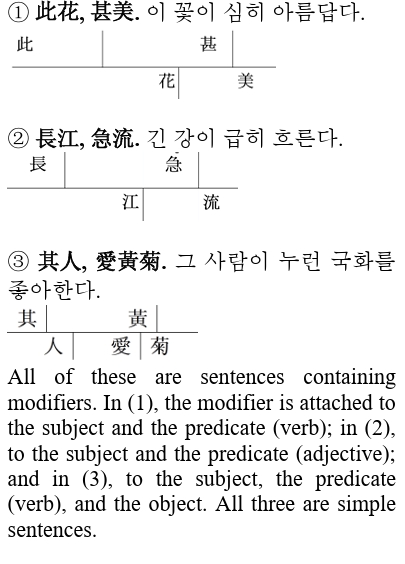
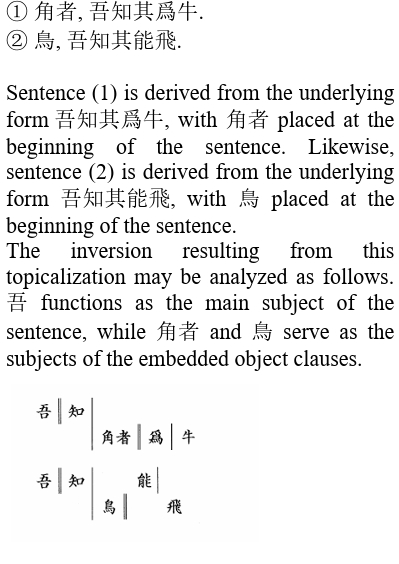
Hanmun singang, for example, helps learners understand the syntactic structure of Literary Sinitic by presenting sentences through diagramming methods similar to those employed in Western language instruction.
Example 1 illustrates the diagramming of a sentence containing modifiers, whereas Example 2 employs a diagram to explain a construction in which the main subject of the sentence and the subject of an embedded clause undergo inversion. The principal advantage of diagramming methods lies in their ability to present the functions and hierarchical relationships of sentence constituents clearly and intuitively through visual representation, without relying on lengthy theoretical explanations. In this respect, they may serve as an effective tool for both domestic and international learners who are already familiar with grammatical diagramming in English.
Nevertheless, the compiler’s analysis of this construction in terms of inversion is open to reconsideration. If 角者 and 鳥 are analyzed as “topical” subjects, there is no need to treat the construction as an instance of inversion. By analyzing it as an inversion construction, the compiler distinguishes between the ch'ong chuŏ 總主語 “main subject” (吾) and the “subject of the embedded object clause” (角者 and 鳥). However, the term ch'ong chuŏ cannot be regarded as a grammatical term in common use today. Accordingly, grammatical explanations in future textbooks should be accompanied by sufficient explanation of the terminology and analytical framework on which they are based.
Another effective strategy is to enhance learner interaction through exercises. Hanmun singang, for example, the grammar section concludes with an “Applications” section containing exercises on punctuation and grammatical analysis with translation. Because inserting punctuation into an unpunctuated Literary Sinitic text requires learners to identify sentence constituents and segment the text appropriately, punctuation exercises provide an effective means of assessing their grammatical understanding. In the translation exercises, learners are presented with excerpts from Literary Sinitic texts and asked to analyze them grammatically before producing an appropriate translation. Since the textbook provides a step-by-step explanation of the entire analytical process, learners are able to compare their own analyses with those presented in the textbook. Likewise, Yi Yihwa ŭi hanmun kongbu places practice exercises at the end of each chapter, encouraging learners to identify and apply the sentence patterns introduced in the preceding lessons.
Exercise 1
Rewrite the following sentences as inverted sentences 倒置文.
①巧言令色 仁鮮矣.
②吾衰也甚矣.
Exercise 2
Read the following examples and answer the questions.
㉠ 若此者 有益於天下
㉡ 若 行之無忽
㉢ 若冠
㉣ 若有不可諱 其如人民何
1)Identify the conditional sentence 假定文among the four examples.
2)The word 若 is used differently in each sentence. Explain its meaning in each example.
29
Through these exercises, learners not only learn to identify inverted and conditional sentences and transform sentence patterns accordingly, but also develop the ability to distinguish the various functions of grammatical particles. By treating basic grammatical knowledge as an initial tool for approaching Literary Sinitic and reinforcing it through a variety of interactive exercises, textbooks can encourage active learner participation and thereby enhance learning outcomes.
Step-by step Approach
The second major pedagogical characteristic of university Literary Sinitic textbooks is their use of a staged approach that organizes learning materials according to increasing levels of difficulty. Its primary aim is to help learners become familiar with the unfamiliar linguistic system of Literary Sinitic gradually, without overwhelming them, and it is clearly designed with beginning learners in mind. This approach is not unique to contemporary textbooks. In Chosŏn dynasty education, students typically learned individual characters through the Ch'ŏnjamun 千字文 before progressing to the Sohak 小學 and the Sasŏ 四書, a sequence that already reflected the principles of staged learning. The contemporary step-by-step approach may therefore be understood as a modern adaptation of these traditional pedagogical principles to the context of university general education courses.
What textbooks adopting a step-by-step approach have in common is the recognition that learning Literary Sinitic requires instruction to be organized into appropriate stages. Although Sinographs constitute the basic units of Literary Sinitic, familiarity with individual Sinographs does not immediately enable learners to read Literary Sinitic texts. Accordingly, these textbooks assume a sequential progression: learners first acquire Sino-Korean vocabulary at the lexical level before moving on to maxims and short sentences, and ultimately to extended prose and Literary Sinitic poetry. This approach has been adopted in various forms, by most general education textbooks on Literary Sinitic published since the 2000s. As discussed above, the practice of introducing grammar as a tool for analyzing Literary Sinitic sentence patterns before applying it to the reading of original texts may likewise be understood as another manifestation of this step-by-step approach.
In the case of Saenghwal hanja wa kyoyang hanmun, it adopts a three-step structure: “Foundations of Sinographs and Sinographic Literature” (Part 1), “Everyday Sino-Korean Vocabulary and Academic Sino-Korean Vocabulary” (Part 2), “Understanding and Appreciation of the Classics” (Part 3), and it states the intention of the textbook’s design in the preface as follows.
First, we intended to promote a foundational understanding of sinographs and sinographic literature… Since we have allowed the learner to open the main gate and step into the courtyard, this is the realm of introduction and the pathway through which a beginner must pass. Second, the learning contents were arranged so that practical help could be received in everyday language life…Focusing primarily on the studies of university students, we supplemented academic vocabulary of the university and texts rooted in the classics. As this corresponds to the actual field where Sino-Korean vocabulary is utilized, it can be compared to the stairs leading up to the main hall. Third, we allowed the learner to confront the spiritual realm achieved by the cultural sphere of sinographs through sinographic poetry and masterpieces of sinographic literature…As each and every included work harbors the essence of intellect and sensibility, Part 3 will correspond to the main inner room and the closet where treasures are kept in a mansion.
30
The sequence of spatial images—from “the main gate and courtyard” to “the stairs leading to the main hall,” and finally to “the main inner room” and the “closet”— serves as a metaphor for the progressive deepening of learning. Likewise, the progression from a basic understanding of Sinographs, through everyday and academic vocabulary, to literary works of increasing literary and intellectual sophistication constitutes a common organizational principle shared by most textbooks adopting a staged approach.
Hanmun ŭi ihae by Chŏng Min and Pak Sumil is noteworthy as it implements the step-by-step approach in a more diverse manner, adopting the following six-part structure.
It is confirmed that the learning process is organized in the order of sinographs and Sino-Korean vocabulary, short sentences, historical idioms 故事成語, prose, poetry, artistic works. In addition, the subthemes are subdivided and presented for each part, and in the case of Part 5, “The World of Sinographic Poetry,” the steps are divided even within the same chapter so that theories such as the form and rules of sinographic poetry are learned first before proceeding to appreciation. The setting of an intermediate stage called “short sentences” prior to prose is also noteworthy; in the short sentences part, short maxims and phrases such as “Wisdom is like water, if it does not flow it stagnates” 智猶水也, 不流則腐 and “Rather be a chicken’s beak than a cow’s rear” 寧爲鷄口, 勿爲牛後 are learned, and in the prose part, classical prose works of China and Korea are learned. Furthermore, Part 6, “Appreciation of Artistic Works,” represents an original feature not found in other textbooks. It extends the scope of Literary Sinitic education to material forms in which Sinographs are employed, including calligraphy, painting, and seal engraving. In doing so, it encourages learners to recognize that Literary Sinitic exists not only as a body of written texts but also as a material and visual tradition that has constituted an important dimension of Korean culture.
In addition, because instruction begins with Sinographs and Sino-Korean vocabulary, the textbook includes a number of features that are particularly helpful for international learners who first encounter Literary Sinitic while studying advanced Korean.
1)
wanbyŏk 完璧 “Flawless Perfection”
wanbyŏk means “to preserve somthing intact.” Here,
byŏk 璧 refers to that famous
hwassibyŏk 和氏璧. The
hwassibyŏk was a rare and precious treasure of the world that every country coveted, and it was in the possession of the King of the Zhao 趙 state. King Zhao 昭王 of the Qin 秦 state, which boasted mighty power at the time, wished to put that jade into his own hands somehow, so he proposed to exchange it for fifteen of his cities. When the King Zhao was in a difficult dilemma, Lin Xiangru 藺相如 stepped forward and said that he would respectfully take the jade and go, and if the Qin state did not give the cities, he would return with the jade kept whole and intact. At the end of Lin Xiangru’s speech, the phrase “keeping the jade whole and intact”—that is, the expression
wanbyŏk—appears, and it is from this that the vocabulary
wanbyŏk is derived. Lin Xiangru, who arrived in the Qin state holding the
hwassibyŏk in his bosom, noticed the trickery of King Zhao of Qin, who had no intention of giving the cities from the very beginning; he then deceived the King of Qin and returned to the Zhao state, preserving the
hwassibyŏk whole and intact.
31
2)
The examples presented fall into two categories. First, they explain the origins and etymologies of Sino-Korean vocabulary that is widely used in contemporary Korean. Second, they illustrate cases in which the pronunciation of Sino-Korean words has changed over time and become fully integrated into Korean. In the latter cases, the Sino-Korean origin of the vocabulary is often no longer readily apparent. By demonstrating that even everyday words commonly regarded as native Korean may in fact derive from Sino-Korean vocabulary, these examples help learners recognize the close historical relationship between Korean and the Sino-Korean lexicon. Through repeated exposure to such examples, learners can infer and expand the meanings of Korean vocabulary through their connections with Sinographs, rather than relying solely on rote memorization.
However, this approach requires a considerable amount of time to progress sequentially from Sinographs and Sino-Korean vocabulary to short sentences, historical idioms, prose, Literary Sinitic poetry, and artistic works. At the same time, the acquisition of foundational Sino-Korean vocabulary and the reading and appreciation of Literary Sinitic texts can effectively reinforce one another when taught in parallel. A strictly sequential organization, however, may limit the flexibility of instruction by binding it to the order of the textbook. To address this issue, Hanmun ŭi segye adopts a different organizational strategy. Instead of following a single linear sequence, it reorganizes the stages into shorter learning cycles. For example, beginning with the meaning and usage of the Sinograph ko 苦, each lesson introduces related Sino-Korean vocabulary, maxims and famous sayings, and a Literary Sinitic text on Mount Halla, followed by two historical idioms and one Literary Sinitic poem. This compact learning cycle is repeated consistently from Lesson 1 through Lesson 28. The table of contents illustrating this organization is shown below.
<Table of Contents of Lecture 5 in Hanmun ŭi segye >
· Understanding of Sinographs: ko 苦
· Sino-Korean Vocabulary Related to Nature: (unjip 雲集, musan 霧山, chŏn’gyŏk 電擊…ch’ŏngch’ŏnbyŏngnyŏk 靑天霹靂)
· Maxims, Famous Phrases, and Proverbs: (From Sohak 小學, “常以責人之心으로 責己하고 恕己之心으로 恕人하라”)
· The World of Sinographic Literature: hallasan 漢拏山 (Shinjŭngdonggukyŏjisŭngnam 新增東國輿地勝覽 and Myŏngamjip 勉菴集)
· Historical Idiom: ugongisan愚公移山
· Historical Idiom: sajok蛇足
· Appreciation of Sinographic Poetry: “Spring Dawn” 春曉 (by Meng Haoran 孟浩然)
Although Hanmun ŭi segye adopts a staged design similar to that of Hanmun ŭi ihae, its most distinctive feature is that each stage is divided into shorter learning sequences that are repeated throughout the textbook. This organization allows the acquisition of Sino-Korean vocabulary and the reading of Literary Sinitic texts to proceed in parallel within a single lesson, thereby reinforcing one another while enabling learners to engage with original texts at an earlier stage. On the other hand, the Sinographs, maxims, historical idioms, and Literary Sinitic prose and poetry presented in each lesson often lack a clear thematic connection. Because these components function independently within the same lesson, the lesson as a whole does not present a coherent thematic context. In other words, when adopting a staged approach, textbook compilers must consider not only how to divide the overall learning process into balanced stages but also how to establish meaningful connections among components that differ in length, genre, and pedagogical function.
Selection of Texts
Literary Sinitic was the shared written language of the Sinographic cultural sphere, and Korean Sinographic Literature encompasses virtually all Literary Sinitic texts composed by Koreans in Korea. Moreover, contemporary Korean university textbooks on Literary Sinitic generally include Chinese works alongside Korean ones. Consequently, the range of works that may be included in such textbooks is exceptionally broad, and the selection and organization of individual texts depend largely on the compiler’s editorial judgment. In making these selections, compilers seek to balance Korean and Chinese works, different literary forms and genres, and variations in length and difficulty, while often emphasizing particular themes. Whereas earlier textbooks tended to arrange texts without a clear organizing principle, more recent textbooks organize their selections according to a combination of criteria, including genre, literary form, difficulty, and thematic focus.
Among these, the most general tendency common to all textbooks is to include the komun古文 “classical prose” of the Pre-Qin period, the Tang and Song dynasties, and Korean authors. These are works that were considered the so-called munjangjŏnbŏm 文章典範 “models of exemplary writing” in the pre-modern era and are texts that must be encountered in the course of learning sinographic literature; they are generally excerpted appropriately and dealt with within the traditional fourfold classification of kyŏngsajajip 經史子集. Among the kyŏng 經, the Four Books and Three Classics 四書三經 —and among them, particularly the Analects論語 and Mencius 孟子—are handled as essentials. Among the sa 史, along with the Zuozhuan 左傳, Shiji 史記, and Tongjian 通鑑, excerpts are frequently included from Samguk sagi 三國史記and Samguk yusa 三國遺事. Literature belonging to the ja 子 is also handled with significant weight in textbooks, being excerpted and included from Zhuangzi 莊子, Laozi 老子, Xunzi 荀子, and Hanfeizi 韓非子, as well as from Zhanguoce 戰國策 and Guoyu 國語.
In addition, many texts are selected from anthologies such as Guwenzhenbao 古文 珍寶 as well as from the collected works of individual authors. Works by Tang and Song poets, Tang and Song prose writers and Korean authors constitute the core of the selections, whereas works by Ming and Qing writers are included much less frequently. While the writings of Han Yu 韓愈 and Su Shi 蘇軾 apear in most textbooks, those of Jin Shengtan 金聖歎, Gui Youguang 歸有光, Yuan Hongdao 袁宏道, and Gu Yanwu 顧炎武 are found only in a small number of textbooks, such as Hanmun singang or Hanmun ŭi ihae (2002).
Beyond these general tendencies, each textbook also exhibits distinctive editorial features. As a particularly noteworthy example of thematic organization,
Sin myŏngsimbogam deserves closer attention. This university Literary Sinitic textbook was designed with moral cultivation as its primary educational objective and was used in “Wisdom of the East,” a general education course introduced for all Korea University students in 1995. As revealed in the preface, in terms of content, it has absolutely no relation to Fan Liben 範立本’s
Mingxinbaojian 明心寶鑑, rather, it adopts the title solely to emphasize its orientation toward self-cultivation.
33 The guidelines for selecting works are as follows.
First, we included outstanding Korean classics regardless of their ideological affiliations. Texts were selected and arranged according to the educational objectives of the textbook and organized under major and minor thematic headings for the convenience of learners. Although the selection was intended to transcend ideological divisions and was made without preference for any particular school of thought, Confucian works came to predominate in the final selection. This was simply the natural outcome of the textbook’s educational objectives in conjunction with the intellectual landscape of East Asia.
Second, in selecting the materials, we did not confine the contents to ethical teachings in a narrow sense. Instead, the textbook sought to include as many insightful dialogues and exemplary anecdotes as possible that illuminate the major traditions of East Asian classical culture. In this way, we aimed to make the textbook not only intellectually enriching but also more engaging and appealing to learners.
Third, we were also not constrained by the stylistic forms of the materials. Therefore, the textbook incorporates a wide variety of literary forms, including maxims, analects, narratives, and rhymed writings.
34
The editorial principles of the textbook are explicitly stated as “overcoming the moral and cultural disorder facing Korean society and cultivating refined knowledge grounded in East Asian ethical traditions,” and “restoring cultural identity by drawing attention to Eastern thought and its ideals of ethical solidarity.” As the preface makes clear, this emphasis on moral cultivation resulted in a predominance of Confucian texts among the selections. At the same time, because the textbook adopts a distinct thematic orientation, the compilers appear to have sought greater diversity in other respects, particularly in terms of literary form. Generally, while focusing on the Four Books and Three Classics, it includes writings corresponding to the elaborations or expositions by Korean and Chinese writers regarding them. And these were arranged under ethical thematic divisions: “The Establishment of the Moral Subject,” “Myself as a Family Member,” “The Duty of a Person of Great Virtue,” “A Communal Life,” “The Way of a Public Official,” “For the Nation,” and “Ethics toward Nature.” Saenghwal hanja wa kyoyang hanmun (2013) and Hanmun ŭi ihae (2002) also include works through thematic divisions, but Sin myŏngsimbogam is the only case that consistently adhered to a single theme of ethical cultivation.
Although the goal of ethical cultivation feels somewhat one-sidedly emphasized,
35 the method itself of organizing a textbook around a single theme has significant implications. While it is of course important to allow learners to encounter works of various themes, since the scope of sinographic literature is vast, a textbook specialized in a single theme can raise the concentration of learning and induce a deep understanding of a specific field. However, in this case, the theme to be handled must have contemporary relevance and be able to draw empathy, and the context focusing on that theme must be persuasively explained. For instance, in the case of universal themes such as ecology, gender, aging, and death, it would carry great significance in terms of reconsidering the contemporary relevance of the classics and would also contribute to increasing the interactivity between the text and the learner.
Second, it is worth examining cases that include modern and contemporary works after the enlightenment period. Taehak hanmun su and Hanmun singang are both early sinographic literature textbooks published in the 1960s, and are noteworthy for including modern and contemporary works. In the case of Taehak hanmun su, it carries Cho Pyŏngse’s 趙秉世 (1827–1905) “kyŏlgogukchungsaminsŏ” 訣告國中士民書 as its very first included work. Cho Pyŏngse is remembered as a figure who took his own life by poisoning himself in protest against Japanese colonial rule. Given that Chŏngsŏn kodŭng hanmun tokpon, the prototype of Taehak hanmun su, was published in 1947, it is possible that the compiler intentionally placed this work at the beginning of the textbook as a symbolic expression of resistance to Japanese colonial rule. Although Cho Pyŏngse is well known as a symbol of anti-colonial resistance, he is not widely recognized as a writer of Korean Sinographic Literature. Indeed, Taehak hanmun su is exceptional in being the only textbook surveyed to include this work.
In addition, Hanmun singang included a substantial number of writings by modern authors alongside the classical prose of the Pre Qin period and the Tang and Song dynasties. According to the preface, this editorial choice was intended to correct the long-standing tendency of earlier anthologies to “revere antiquity while disparaging the present” 尙古賤今. The modern and contemporary texts included in the textbook are as follows.
China
Li Hongzhang 李鴻章 (1823–1901), “Zhiming yinfu yueshu” 致命蔭甫越書
Zhang Binglin 章炳麟 (1869–1936), “SunWen zan” 孫文贊
Liang Qichao 梁啓超 (1873–1929), “Qingdai xueshu gailun zixu” 淸代學術槪論自序
Lu Xun 魯迅 (1881–1936), “Zhongguo xiaoshuo shiliu xuyan”中國小說史略序言
Chen Duxiu 陳獨秀 (1879–1942), Wenxue geming lun 文學革命論
Xiaoheng xiangshi zhuren小橫香室主人, “Yang hanlin bushi zi” 洋翰林不識字 (Excerpted from Qingchao yeshi daguan 淸朝野史大觀, published in 1916.)
Korea
Anjunggŭn 安重根 (1879–1910), “Habibin’ga” 哈爾濱歌
Kimt’aekyŏng 金澤榮 (1850–1927), “Mun Anjunggŭn boguksusa” 聞安重根報國讎事
Kim ch’undong 金春東 (1906–1982), “Sŏ junghanshisa hu” 書中韓詩史後
Hagyŏmjin 河謙鎭 (1870–1946), “Yŏ yiyŏnsaeng nonmun sŏ” 與李淵生論文書
Pyŏnyŏngman 卞榮晩 (1889–1954), “Yŏnsaengsŏshil myŏng” 淵生書室銘
The inclusion of these works is significant not only because they reflect the rapidly changing social and historical circumstances of the modern period, but also because they remind readers of the continuity between post-enlightenment Literature and premodern Korean Sinographic Literature. Furthermore, although these modern and contemporary works generally follow the conventions of classical Literary Sinitic prose古文, they also incorporate elements of contemporary spoken language. As a result, they enable learners to appreciate the historical development of Literary Sinitic and the ways in which it evolved over time.
Third, it is necessary to pay attention to cases that include women’s works or
yadam 野談 “unofficial historical tales” and fiction 小說. In the case of women’s works, although they are included in
Hanmun singang,
Saenghwal hanja wa kyoyang hanmun,
Hanmun ŭi ihae (2002, 2004), they account for only a small proportion of the selected texts. The selected texts include works by well-known female writers such as Hwang Chin-i or Hŏ Nansŏrhŏn, as well as writings by unnamed women of
sajok 士族 families, such as Lady Nam’s “Tosonnyŏ” 悼孫女. For instance, the letter of Song Dŏkpong, the wife of Yu Hŭich’un 柳希春, included in
Miamjip 眉巖集, is introduced as an example that reveals a
sajok woman’s self-awareness and her confident attitude toward her husband, and serves as a basis for reconsidering the image of married couples in traditional Korean society.
36 Aside from this, although not written by a woman, works such as Pak Chiwŏn’s “Paegijŭng jŏngbuin bakssi myojimyŏng” 伯姊贈貞夫人朴氏墓誌銘, which depicts the life of a female relative from the perspective of a literati, are also commonly included in several textbooks.
As for yadam and fiction, although they offer abundant materials likely to engage learners—including romance, supernatural, and ghost stories—they are rarely included in existing textbooks. Hanmun ŭi ihae (2002) exceptionally includes only two anecdotes from Ŏuyadam 於寓野談, and Hanmun singang is one of the few textbooks to include works of fiction, such as “YingyingZhuan” 鶯鶯傳, “Yŏyonggukchŏn” 女容國傳, “Kuunmong”九雲夢, and “Changsaengjŏn” 蔣生傳. The inclusion of “Yingying Zhuan,” a romance story written by Yuan Zhen 元稹of the Tang dynasty, is particularly interesting. Although the relative absence of yadam and fiction from university textbooks cannot be explained with certainty, it may reflect the view that classical prose—the “orthodox” and “standard” literary form of the premodern period—provides the most effective foundation for learning Literary Sinitic. Nevertheless, yadam and fiction offer valuable insights into cultural contexts and literary imagination, and therefore deserve greater consideration in the compilation of future textbooks.
Conclusion and Suggestions
This study, conducted as a preliminary step toward the broader project of developing Literary Sinitic textbooks for Anglophone learners, has examined Korean university Literary Sinitic textbooks with particular attention to three aspects: the definition and scope of Literary Sinitic, pedagogical approaches, and text selection. Based on these findings, several suggestions may be offered.
First, future textbooks should provide a clear and systematic explanation of the concepts and scope of Literary Sinitic. As approaches to Literary Sinitic instruction continue to diversify, learners need to understand not only its place within the East Asian classical tradition but also its relationship to the Korean language and Korean literature.
Second, careful consideration should be given to the role of grammar. Since most learners are more familiar with English grammar than with traditional approaches to Literary Sinitic, grammatical explanation can serve as an effective entry point for reading Literary Sinitic texts. At the same time, grammatical explanation should not become an end in itself. Visual aids such as sentence diagramming and interactive exercises may provide effective ways of balancing grammatical instruction with practical reading.
A staged curriculum should also be considered. Because many overseas learners first encounter Sinographs through Korean language study, introductory materials should place greater emphasis on Sinographs and Sino-Korean vocabulary, while ensuring a coherent progression from elementary to advanced levels. Such a step-by-step approach is particularly effective in gradually introducing Literary Sinitic to learners who are unfamiliar with it. Since many overseas learners have a strong need to acquire foundational knowledge of Sinographs and Sino-Korean vocabulary, introductory materials should provide more substantial treatment of these areas. In designing such a curriculum, it is important both to divide the learning process into manageable stages and to ensure meaningful connections among them.
Third, as the author of Hanmun singang mentioned, even after including 140 texts, there still remained a sense of “pearls left in the vast sea” 滄海遺珠, the scope of sinographic literature is extremely wide. Consequently, decisions regarding which texts to include and which aspects of Literary Sinitic to emphasize inevitably depend on the compiler’s editorial judgment. Establishing a clear editorial objective and selecting and arranging texts in accordance with that objective are therefore essential.
With regard to text selection, greater diversity should also be pursued. Because many existing textbooks rely on a largely overlapping corpus of representative works, future textbooks should move beyond simply reproducing those selections. The inclusion of modern Literary Sinitic works, yadam, fiction, and works by women writers provides valuable models in this respect. At the same time, future textbooks may also benefit from engaging more fully with themes that have attracted increasing scholarly attention in recent years, including ecology, gender, death, among others. Such an approach would not only demonstrate the continuing relevance of Literary Sinitic to contemporary readers but also foster more meaningful interaction between learners and the texts they study.
Notes
|
Author (Year) |
Title |
Publisher |
|
Kim Chundong (1947) |
Chŏngsŏn kodŭng hanmun tokpon 精選高等漢文讀本 [Selected Readings in Literary Sinitic for Higher Education] |
Samsŏngsa 三星社版 |
|
Kim Chundong (1960) |
Taehak hanmun su 大學漢文粹 [Selected Literary Sinitic Texts for University Students] |
Korea University Press |
|
Yi Kawŏn (1960) |
Hanmun singang 漢文新講 [New Lessons in Literary Sinitic] |
Singu Munhwasa 新丘文化社 |
|
Korea University (1996) |
Sin myŏngsimbogam 新明心寶鑑 [The New Mirror of the Mind] |
Korea University Press |
|
Korea University (1996) |
Kyoyang hanmun 敎養漢文 [Literary Sinitic for General Education] |
Korea University Press |
|
Chŏng Min &Pak Sumil (2002) |
Hanmun ŭi ihae 한문의 이해 [Understanding Literary Sinitic] |
Hanyang University Press |
|
Hŏ Kyŏngjin et al. (2004) |
Hanmun ŭi ihae 한문의 이해 [Understanding Literary Sinitic] |
Yonsei University Press |
|
Yi Myŏnghak (2004) |
Hanmun ŭi segye 한문의 세계 [The World of Literary Sinitic] |
Sungkyunkwan University Press |
|
Yi Yihwa (2009) |
Yi Yihwa ŭi hanmun kongbu 이이화의 한문공부 [Yi Yihwa’s Guide to Literary Sinitic] |
Yŏksa pip'yŏngsa |
|
Ewha Womans University (2013) |
Saenghwal hanja wa kyoyang hanmun 생활한자와 교양한문 [Practical Sinographs and Literary Sinitic for General Education] |
Ewha Womans University Press |
|
Yi Sangjin (2014) |
Hanmun munpŏp 한문문법 [Grammar of Literary Sinitic] |
Chŏnt’ongmunhwayŏn’guhoe |
|
Yi Kawŏn (2016, revised edition) |
Hanmun singang 漢文新講 [New Lessons in Literary Sinitic] |
Pogosa |
|
Example127
|
Example228
|
|
|
|
Classification |
Title |
Subthemes |
|
Part 1 |
The World of Words |
1. Sinographs Learnt Through Radicals |
|
2. The Origins and Idioms of Sinographs |
|
3. Common Sense of Sinographs Necessary for Everyday Life |
|
Part 2 |
The Depth of Short Writings |
1. Teachings of Past Sages |
|
2. Short Writings, Clear Thoughts |
|
Part 3 |
The Wisdom of Historical Idioms |
(Includes twenty-eight types of historical idioms from 刻舟求劍 to 貓頭懸鈴) |
|
Part 4 |
Between the Lines of Ancient Writings |
1. Joy, Anger, Sorrow, and Pleasure of Life |
|
2. Lessons of Everyday Life |
|
3. Footsteps of History (Selects and includes related works for each item) |
|
Part 5 |
The World of Sinographic Poetry |
1. How to Read Sinographic Poetry |
|
2. Appreciation of Sinographic Poetry |
|
Part 6 |
Appreciation of Artistic Works |
1. Appreciation of Calligraphy Works |
|
2. Paintings with Stories |
|
3. The World of Seal Engraving |
|
4. How to Read Eastern Paintings |
|
諱之秘之 → 흐지부지 |
十成→ 십상 |
|
暫間 → 잠깐 |
從容 → 조용 |
|
甘頭 → 감투 |
對句 → 대꾸 |
|
櫻桃 → 앵두 |
隨從 → 시중 |
|
怪惡 → 고약 |
卷煙 → 궐련 |
|
白菜 → 배추 |
胡椒 → 후추 |
|
果實 → 과일 |
道場 → 도량 32
|
Reference List
- Chŏng Min and Pak Sumil. Hanmun ui ihae 한문의 이해 [Understanding Literary Sinitic]. Seoul: Hanyang University Press, 2002.
- Dawson, Raymond. An Introduction to Classical Chinese. Oxford: Oxford University Press, 1968. Reprint, 1984.
- Ewha Womans University. Saenghwal hanja wa kyoyang hanmun 생활 한자와 교양 한문[Practical Sinographs and Literary Sinitic for General Education]. Seoul: Ewha Womans University Press, 2013.
- Fuller, Michael. An Introduction to Literary Chinese. Cambridge, MA: Harvard University Asia Center, 1999.
- Hŏ Kyŏngjin et al. Hanmun ui iIhae 한문의 이해 [Understanding Literary Sinitic]. Seoul: Yonsei University Press, 2004.
- Kim Chun-dong. Chŏngsŏn kodŭng hanmun tokpon 精選高等漢文讀本 [Selected Readings in Literary Sinitic for Higher Education]. Seoul: Samseongsa, 1947.
- Kim Chun-dong. Taehak hanmun su大學漢文粹 [Selected Literary Sinitic Texts for University Students]. Seoul: Korea University Press, 1960.
- Kim Sŏngŭn, “Yŏnmin Hanmunsingang ŭi t’ŭkching kwa hyŏndaejŏk ŭiŭi” 연민 『한문신강』의 특징과 현대적 의의, Yŏnmin hakchi 연민학지27 (2017): 88-90.
- Korea University. Kyoyang hanmun 敎養漢文 [Literary Sinitic for General Education]. Seoul: Korea University Press, 1996.
- Korea University. Sin myŏngsimbogam 新明心寶鑑 [The New Mirror of the Mind]. Seoul: Korea University Press, 1996.
- Rouzer, Paul F. A New Practical Primer of Literary Chinese. Cambrifge, MA: Harvard University Asial Center, 2007.
- Sim, Kyŏngho. “Segye hanmun kyoyuk ŭi panghyang kwa han’guk ŭi yŏkhal.” 세계 한문교육의 방향과 한국의 역할 Tongbang hanmunhak 동방한문학 74 (2018): 7-34.
- ____. Hanhak ipmun Hanhak Ipmun 한학입문. Seoul: Hwangsojari, 2007.
- Sim Kyusik. “‘Han’guksik hanmun ŭi k’ŏrik’yullŏm e taehan tansang: Yŏngmikwŏn taehak kyojae e hwal'yonghal chŏngŭi, pŏmwi, yongŏ, munpŏp, yemun” ‘한국식’ 한문의 커리큘럼에 대한 단상: 영미권 대학 교재에 활용할 정의, 범위, 용어, 문법, 예문. Tong’a Hanhak Yŏn’gu 동아한학연구20 (2025): 377-408.
- Son Chonghŭm and An Taehoe. Hanguk hanmunhak ui ihae 한국한문학의 이해 [Understanding of Korean Sinographic Literature]. Seoul: Korea National Open University Press, 2016.
- Song Hyŏkki. “Inmun kojŏn ŭrosŏ ŭi hanmun kyoyuk e taehan kwangyŏn: Taehak kyoyang kyoyuk ŭi maengnak esŏ” 人文古典으로서의 漢文敎育에 대한 管見: 大學 敎養敎育의 맥락에서. Hanmun kyoyuk yŏn'gu 한문교육연구 48 (2017): 33-34.
- Song Hyŏkki. Kyŏnghyangsinmun. “Han’gugŏ Kyoyuk kwa Hanja Kyoyuk” 한국어 교육과 한자 교육. June 25, 2024. https://www.khan.co.kr/article/202406252048005#ENT.
- Yi Kawŏn. Hanmun singang 漢文新講 (Revised Edition). Seoul: Bogosa, 2016. ____. Hanmun singang 漢文新講 [New Lessons in Literary Sinitic]. Seoul: Singu munhwasa, 1960.
- Yi Myŏnghak. Hanmun ŭi segye 한문의 세계 [The World of Literary Sinitic]. Seoul: Sungkyunkwan University Press, 2004.
- Yi Sangjin. Hanmun munpŏp 한문문법 [Grammar of Literary Sinitic]. Seoul: Chŏnt’ong munhwa yŏn’guhoe 전통문화연구회, 2014.
- Yi Yihwa. Yi Yihwa ŭi hanmun kongbu 이이화의 한문공부 [Yi Yihwa’s Guide to Literary Sinitic]. Seoul: Yŏksapip’yŏngsa 역사비평사, 2009.
- Yoo Jamie Jungmin. “T’aja ŭi sisŏn ŭro pon koribŏ ŭi tach'ŭngsŏng: Yŏngmigwŏn hanmun munŏnmun kyoyuk ŭi pedagoji t'amgu” 타자의 시선으로 본 고립어의 다층성: 영미권 한문 문언문 교육의 페다고지 탐구. Hancha hanmun kyoyuk 漢字漢文敎育50 (2021): 115-138.


 News
News