Abstract
-
This paper aims to examine various methods of Chinese character education practiced in China and to identify their characteristics and implications. As a country that has used Chinese characters as the principal writing system for modern Chinese, China has accumulated extensive research and practical experience in Chinese character education over a long period of time. Based on this background, China has established the scope and sequence of characters to be learned at the level of the national curriculum and has developed and applied diverse instructional methods according to learners’ developmental stages and educational objectives. An analysis of these methods can provide useful insights not only for hanja education in Korea but also for the development of instructional methods for learners outside Chinesespeaking contexts.
This paper first examines the Basic Character List for Literacy and Writing Instruction (識字寫字敎學基本字表) and the Commonly Used Character List for the Chinese Language Curriculum in Compulsory Education (義務敎育語文課程 常用字表), both of which were included in the curriculum standards issued by the Chinese Ministry of Education. These lists institutionalize, at the national level, the range and sequence of Chinese characters to be learned during compulsory education and serve as important standards for textbook compilation and the organization of teaching and learning content. In particular, the Commonly Used Character List presents 3,500 characters to be mastered during compulsory education, while the Basic Character List selects 300 characters that should be taught first at the initial stage of learning. This indicates that Chinese character education in China is not dependent solely on individual teachers’ experience or textbook compilers’ judgment, but is systematically organized according to national standards.
The paper then discusses the content and characteristics of representative methods of Chinese character education used in China, including the Concentrated Character Recognition Method (集中識字法), Distributed Character Recognition Method (分 散識字法), Phonetic-Notation-Based Character Recognition Method (注音識字法), Component-Based Character Recognition Method (部件識字法), Character-Principle-Based Character Recognition Method (字理識字法), and Root-Character-Based Character Recognition Method (字根識字法). The Concentrated Character Recognition Method emphasizes intensive learning of characters before moving on to reading instruction, whereas the Distributed Character Recognition Method enables learners to acquire characters naturally through the process of reading textbook passages. The Phonetic-Notation-Based Method connects early reading ability with character recognition by using pronunciation guides. The Component-Based and Root-Character-Based Methods make use of the structural analysis of Chinese characters, while the Character-Principle-Based Method helps learners understand the relationship among character form, sound, and meaning on the basis of the principles of character formation. Although each method has its own strengths and limitations, together they demonstrate that Chinese character education can be designed in various ways by taking into account both the structural features of Chinese characters and the learners’ level.
This paper also examines cases in which digital technologies are applied to Chinese character education in China. Electronic dictionaries, digital textbooks, educational software, learning games, and video materials are widely used, contributing to greater accessibility and to the expansion of learning methods and environments. Such digital resources and platforms may also offer useful points of reference for developing new teaching and learning methods in hanja education in Korea.
However, Chinese character education in China differs from that in Korea in several respects, since it presupposes an environment in which Chinese characters are used as the native writing system, employs simplified characters, and aims primarily at developing reading and writing abilities. Therefore, when applying Chinese research findings and instructional methods to Korea, it is necessary to critically reconsider them in light of the aims and conditions of hanja education in Korea, such as the understanding of Korean vocabulary, the learning of Sino-Korean words, and education in traditional culture. Nevertheless, China’s systematic use of character lists, development of diverse character recognition methods, and active adoption of digital technologies provide significant implications for improving and expanding hanja education in Korea and other regions outside China.
-
Keywords: China, Chinese character education, Basic Character List for Literacy and Writing Instruction (識字寫字敎學基本字表), Commonly Used Character List for the Chinese Language Curriculum in Compulsory Education (義務敎育語文課程常用字表), shizi fa 識字法 “character recognition methods,” , electronic dictionaries, digital textbooks
Introduction
This paper aims to examine various methods of Chinese character education practiced in China and to identify their characteristics and implications. As a country that uses Chinese characters as the pricipal writing system for modern Chinese, China has accumulated extensive research on Chinese character education over a long period of time. As a result, it has developed a wide range of methods for Chinese character education and has applied them in various areas, including textbooks and learning materials. Identifying the characteristics and implications of these methods can serve as a useful basis for the development of new approaches to Chinese character education.
In the main body, this paper first examines the Chinese characters designated for learning by the Chinese Ministry of Education. The Basic Character List for Literacy and Writing Instruction (識字寫字敎學基本字表) and the Commonly Used Character List for the Chinese Language Curriculum in Compulsory Education (義務敎育語文課程常用字表), both promulgated by the Chinese Ministry of Education, institutionalize at the national level the scope and sequence of Chinese characters to be learned during compulsory education. This paper therefore examines which characters are included in these lists and the purposes for which they were presented.
Next, this paper examines the specific contents of Chinese character education methods in China. Since the founding of the People’s Republic of China in 1949, China has conducted extensive research on Chinese character education methods at both the national and academic levels. As a result, it has developed and utilized dozens of different methods for Chinese character education. By examining the specific contents and modes of application of these methods, this paper seeks to identify their characteristics and implications.
Finally, this paper examines the methods and cases of Chinese character education in China that make use of digital technologies. With the recent development of digital technologies, new and diverse approaches have been attempted in the field of education, and China has also actively applied such approaches to Chinese character education. An examination of these cases will also provide useful references for the development of new methods of hanjar education in Korea and elsewhere.
Selection of Chinese Characters for Learning by the Chinese Ministry of Education
The
Basic Character List for Literacy and Writing Instruction (識字寫字敎學基本字表) and the
Commonly Used Character List for the Chinese Language Curriculum in Compulsory Education (義務敎育語文課程常用字表), presented by the Chinese Ministry of Education, are representative character lists that institutionalize, at the national level, the scope and sequence of Chinese characters to be learned during compulsory education.
1 These lists may be understood not only as selected lists of characters for educational purposes, but also as curricular devices designed to regulate, to a certain extent, the content and sequence of Chinese character education, textbook compilation, classroom instruction, and assessment standards.
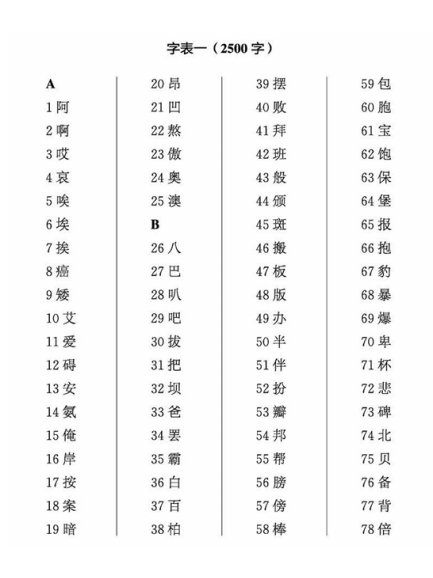
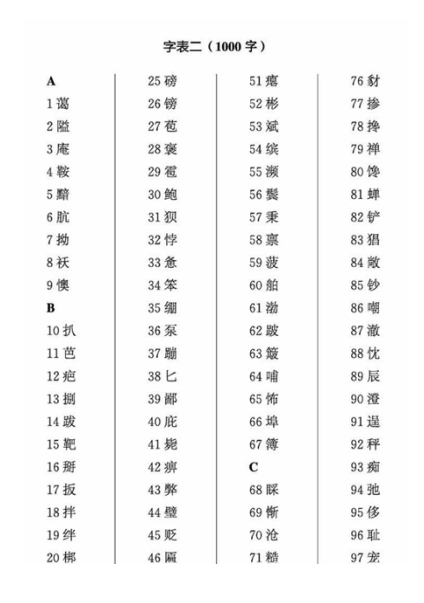
In particular, the Commonly Used Character List for the Chinese Language Curriculum in Compulsory Education contains 3,500 characters, selected in consideration of their frequency of occurrence in modern Chinese reading materials and their necessity for Chinese character education. This list is further divided into List I, consisting of 2,500 characters, and List II, consisting of 1,000 characters. This division indicates an intention to arrange Chinese character learning progressively according to learners’ developmental stages and the sequence of the curriculum, rather than requiring all characters to be learned at once during compulsory education. The Chinese Ministry of Education explains that the 3,500 characters in the Level-One Character List of the Table of General Standard Chinese Characters (通用規範漢字表) satisfy the basic needs of character use in basic education and cultural dissemination and may serve as a standard for Chinese character education at the compulsory education level.
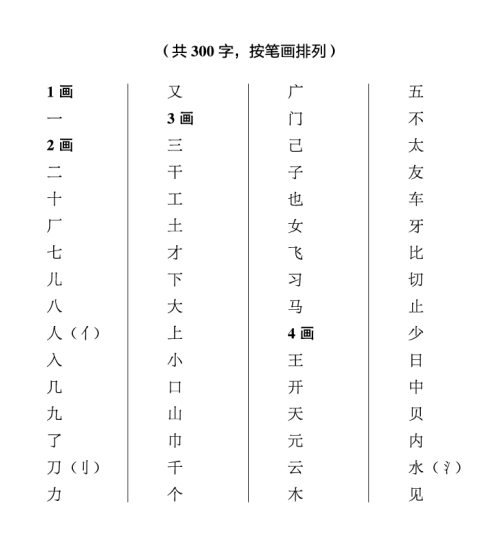
Meanwhile, the Basic Character List for Literacy and Writing Instruction (識字寫字敎學基本字表) selects 300 characters from among these 3,500 characters. These 300 characters were chosen as priority learning targets because their forms are relatively simple, they are likely to appear repeatedly in textbooks and everyday language, and many of them can function as structural components of other Chinese characters. Accordingly, the purpose of this character list is to enable beginning learners first to acquire basic character-form recognition and writing skills, and thereby to establish a structural foundation for learning more complex characters later. For this reason, the list is treated as important content in guiding character learning and writing in textbooks and learning materials for the lower grades of elementary school.
To summarize the discussion above, the Commonly Used Character List for the Chinese Language Curriculum in Compulsory Education (義務敎育語文課程常用字表) presents the overall range of Chinese characters to be mastered throughout compulsory education, while the Basic Character List for Literacy and Writing Instruction (識字寫字敎學基本字表) presents the core characters that should be dealt with first at the initial stage of learning.
These character lists may be regarded as standards for determining which characters should be presented, at what stage, and in what sequence in the process of textbook compilation, as well as how they should be taught and learned. In other words, these lists are the result of standardizing, at the level of the national curriculum, the question of “which Chinese characters should be learned and taught.” At the same time, they constitute important materials that show how knowledge of Chinese characters is arranged and institutionalized through school education. The characters presented in these lists may serve as useful references for determining which characters should be taught first and how many characters should be taught in hanja education in Korea.
Examples of the characters included in List I and List II of the
Commonly Used Character List for the Chinese Language Curriculum in Compulsory Education (義務敎育語文課程常用字表) are as follows. The complete set of 3,500 characters in the
Commonly Used Character List for the Chinese Language Curriculum in Compulsory Education is included in Appendix 5 of the
Chinese Language Curriculum Standards for Compulsory Education (2022 Edition).
Examples of the characters included in the
Basic Character List for Literacy and Writing Instruction (識字寫字敎學基本字表) are as follows. The complete set of 300 characters in the
Basic Character List for Literacy and Writing Instruction is included in Appendix 4 of the
Chinese Language Curriculum Standards for Compulsory Education (2022 Edition).
Methods of Chinese Character Education in China
This section examines the content and characteristics of several representative methods that have been widely studied and applied in Chinese character education in China since the founding of the People’s Republic of China in 1949. This examination will not only help clarify the current state of Chinese character education in China, but also provide useful reference materials for the development of new methods of Chinese character education.
1) Concentrated Character Recognition Method (集中識字法)
The Concentrated Character Recognition Method (集中識字法)
2 was first piloted in 1958 at Heishan Bei
guan Experimental School in Liaoning Province. Later, Jingshan School in Beijing and the Central Institute of Educational Science also participated in this research.
The Concentrated Character Recognition Method advocates the principle of “learning characters first and reading later” (先識字, 後閱讀). This means that students in the lower grades should engage in intensive character learning, while students in the upper grades should focus primarily on reading and writing instruction. Accordingly, in many current Chinese Language (語文) textbooks, character learning is prioritized before reading and writing.
The principle advocated by the Concentrated Character Recognition Method—namely, “character learning followed by sentence learning”—is a general approach traditionally used in classical Chinese education. However, under Western influence, character-learning methods that prioritized sentences, such as the Distributed Character Recognition Method (分散識字法), were introduced in China. In response to the problems arising from such approaches, the Concentrated Character Recognition Method may be understood as a renewed presentation of a traditional method.
2) Distributed Character Recognition Method (分散識字法)
The Distributed Character Recognition Method (分散識字法) was initiated in 1958 by Si Xia (斯霞), a teacher at the elementary school affiliated with Nanjing Normal University. Unlike the Concentrated Character Recognition Method, which advocates learning Chinese characters first and then proceeding to reading practice, this method enables learners to acquire Chinese characters naturally through reading practice, such as reading textbook passages.
In the Distributed Character Recognition Method, learners first build a foundation for character learning by studying several dozen duti zi 獨體字 “single-component characters,” as well as a small number of words and sentences, through methods such as learning the pronunciation of Chinese characters or recognizing characters with the aid of pictures. After this stage, learners are encouraged to “read more textbook passages and thereby learn more characters” (多讀課文, 多識字). In other words, the Distributed Character Recognition Method disperses the task of character learning throughout textbook passages and carries out Chinese character and vocabulary instruction with a focus on reading instruction.
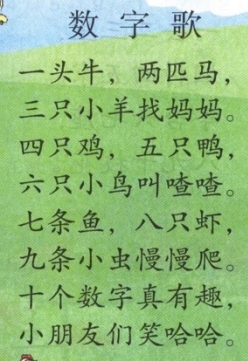
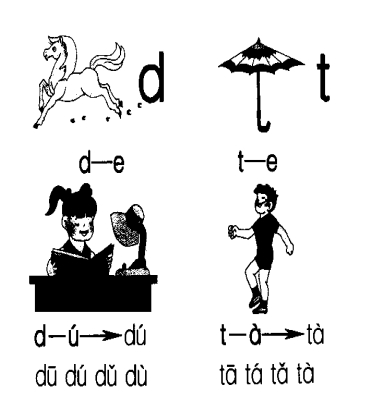
The following is a comparison of two
Chinese Language (語文) textbooks for the first semester of Grade 1 in primary school, published by two different publishers. The textbook on the left begins reading instruction as early as page 11, which appears near the very beginning of the textbook. By contrast, the textbook on the right, even on page 45, which appears around the middle of the textbook, still focuses on pronunciation instruction without yet introducing Chinese characters. As seen in the textbook on the left, conducting character learning through the process of reading textbook passages constitutes one of the main approaches of the Distributed Character Recognition Method.
In the textbook published by Beijing Normal University Press, which employs the Distributed Character Recognition Method, the target learners are newly enrolled elementary school students who do not yet have sufficient knowledge of Chinese characters. Nevertheless, as shown here, the textbook teaches basic Chinese characters through the study of simple sentences.
Some scholars argue that the Distributed Character Recognition Method is effective because Chinese children already have a basic understanding of Chinese characters, the writing system of their native language, before entering primary school. Others maintain, in line with the claims of the Concentrated Character Recognition Method, that the proper sequence of learning is to acquire a sufficient number of Chinese characters first and then proceed to reading instruction. Taking both of these perspectives into consideration, many current textbooks can be seen to use the two methods in combination.
3) Phonetic-Notation-Based Character Recognition Method (注音識字法)
The Phonetic-Notation-Based Character Recognition Method (注音識字法) was initiated in 1982 by the Heilongjiang Provincial Language Committee (黑龍江省語文委員會). This method is characterized by the principle that learners acquire characters through pronunciation before receiving instruction in reading and writing.
Students first learn the pronunciation of Chinese characters. Then, on the assumption that they have become familiar with these pronunciations, they proceed to reading practice using texts marked with phonetic notation. In other words, students are asked either to read texts composed entirely of phonetic symbols or to read texts in which Chinese characters and phonetic notation are presented together.
Although this method is intended for students who do not yet know many characters, it begins with a large amount of reading practice, thereby enabling learners to become familiar with written language from an early stage and to develop spoken and written language in a balanced manner.
When students read texts in which Chinese characters and phonetic symbols appear together, they tend at first to focus mainly on the phonetic symbols. However, as the amount of reading increases, learners increasingly attend to the accompanying character forms. Through repeated practice using this method, students gradually come to recognize the written forms corresponding to particular pronunciations and to understand the meanings represented by those forms.
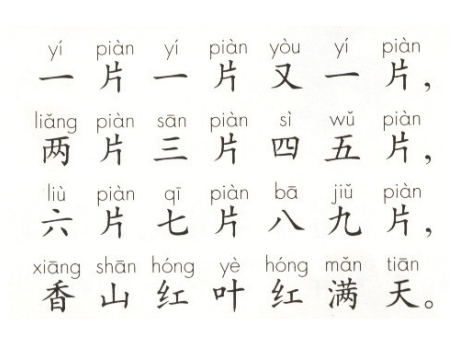
As can be seen here, phonetic notation is provided for the sentences in the text, enabling children to read the passage aloud through the phonetic symbols and grasp its meaning, even if they do not yet know the characters well. At present, most Chinese Language (語文) textbooks for the lower grades, namely Grades 1 and 2, provide phonetic notation for textbook passages in this manner. In addition, most beginninglevel Chinese language textbooks for foreign learners also employ this method.
4) Component-Based Character Recognition Method (部件識字法)
The Component-Based Character Recognition Method (部件識字法) is a method that applies the components of Chinese characters, obtained through the analysis of character forms, to Chinese character education on the basis of theories concerning the structural form of Chinese characters. This method began with Bai Haibin 百海濱 in 1965 and was further studied by Su Jingbai 蘇靜白 and others in 1980. It may be understood as an application of the philological methodology of analyzing Chinese character forms to Chinese character education.
The term “component” (部件) is a concept used in the analysis of Chinese character forms and refers to the basic units that constitute the form of a Chinese character. For example, the character guan 冠 is composed of the parts mi 冖, yuan 元, and cun 寸; in this case, mi 冖, yuan 元, and cun 寸 are regarded as the components of guan 冠. The term bujian 部件 is also referred to by other terms such as ziyuan 字元, zujian 組件, xingwei 形位, goujian 構件, and zisu 字素.
In the Component-Based Character Recognition Method, the formal structure of a Chinese character is analyzed step by step according to the procedure of “whole character → component → stroke” (zhengzi 整字→ bujian 部件→ bihua 筆劃), through synchronic analysis of the character's graphic form. On the basis of an understanding of the form and meaning of the components, learners then study complete characters composed of those components. In other words, this method first proceeds through the stages of “analysis of character form → identification of components → understanding of components,” and then organizes learning in the order of “single-component characters → simple compound characters → complex compound characters.” In this process, the learning of single-component characters is regarded as especially important, because the method is based on the principle that the components of Chinese characters are combined in stages. That is, single-component characters not only function as components that form simple compound characters, but also provide a foundation for learning the strokes, stroke forms, and stroke order of Chinese characters.
5) Character-Principle-Based Character Recognition Method (字理識字法)
The Character-Principle-Based Character Recognition Method (字理識字法) is a method of Chinese character education developed in 1991 by Jia Guojun 賈國均 of the Yueyang Institute of Educational Science in Hunan Province. Here, the term “character principle” (字理) refers to the rules governing the structural formation of Chinese characters and the principles of character creation. In other words, the Character-Principle-Based Character Recognition Method is a method of Chinese character education that begins with an understanding of character forms and, on the basis of the rules and characteristics of Chinese character formation as well as the principles of character creation, enables learners to acquire character form, sound, and meaning.
Chinese characters originated from pictographic writing and constitute a writing system with strong pictographic and semantic features. Although the pictographic quality of the character forms used today has been considerably weakened through a long process of change and development, Chinese characters still contain components that may provide semantic or phonetic information. In addition, during this process of change and development, the ways in which character forms are constructed and organized came to possess their own principles and rules. Therefore, an accurate understanding of the principles of Chinese character formation is regarded as most important for learning the relationship among the form, sound, and meaning of Chinese characters.
Since the Character-Principle-Based Character Recognition Method gives priority to understanding the rules of character formation and the principles of character creation, it is grounded in the basic knowledge and theories of Chinese character studies. For this reason, unlike existing character recognition methods that emphasize learning characters through sentences or those centered on phonetic notation, this method is characterized by its foundation in the scholarly principles of Chinese character studies.
The basic way of explaining Chinese characters in the Character-Principle-Based Character Recognition Method is to explain the principles by which characters were created. For example, in the case of pictographic characters, the method clarifies what the character originally depicted. In the case of phonetic-semantic compound characters or associative compound characters, it explains the principles by which two or more elements combine to form such characters, and guides learners’ study of Chinese characters on that basis.
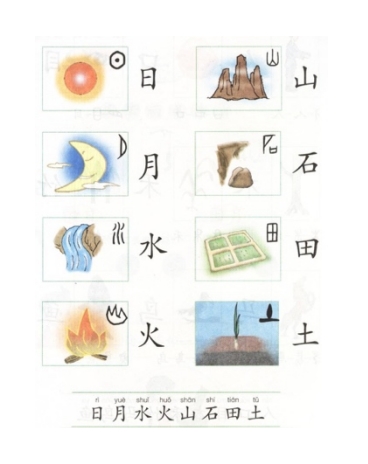
The following example is taken from the first-semester Grade 1 volume of the
Chinese Language (語文) textbook published by Beijing Normal University Press. It illustrates the Character-Principle-Based Character Recognition Method as applied to the learning of basic pictographic characters.
As can be seen here, in the case of basic pictographic characters such as ri 日, yue 月, and shui 水, illustrations of the characters’ origins are presented in order to help learners understand the principles by which the characters were created. Character learning is thus carried out through this process.
In this way, the Character-Principle-Based Character Recognition Method is characterized as a method of Chinese character education grounded in the principles of Chinese character studies. However, questions have also been raised as to whether an instructional method based on the principles and theories of Chinese character studies is pedagogically effective for students in the lower grades of elementary school. In other words, it has been pointed out that, when learning characters other than basic pictographs, such as phonetic-semantic compound characters or associative compound characters, explanations of character-formation principles may in fact make learning more difficult for students.
6) Root-Character-Based Character Recognition Method (字根識字法)
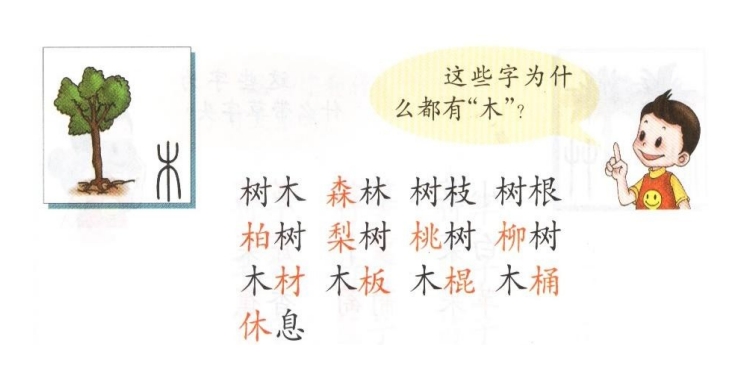
The term “root character” (字根) refers to the most basic part that constitutes a Chinese character. For example, the root character of characters such as da 大, tai 太, quan 犬, tian 天, and fu 夫 is ren 人. That is, da 大 is formed by adding yi 一 to ren 人, and da 太 is formed by adding yi 一 and zhu 丶 to ren 人. In this sense, ren 人 is regarded as the most basic part of da 大 and tai 太, and this is called the root character.
Although the concept of root character (字根) is similar in meaning to that of “component” (部件), the two are somewhat different. For example, if the root character of tai 太 is ren 人, then the components of tai 太 are ren 人, yi 一, and zhu 丶. In other words, component (部件) refers to all the basic units that constitute the form of a Chinese character, whereas root character (字根) refers to the single most basic unit in terms of meaning.
A root character is a character that can independently form a character, that is, a single-component character; pictographic characters mainly fall into this category. Compound characters are formed by adding radicals and strokes to such root characters. The Root-Character-Based Character Recognition Method therefore argues that learning should first prioritize single-component characters corresponding to root characters, and that the learning of compound characters should proceed on this basis.
The Root-Character-Based Character Recognition Method focuses on the structural form of Chinese characters and proceeds on the assumption that a character consists of a root character and other elements. It is therefore a method that organizes learning around root characters. According to this method, a large number of Chinese characters can be reclassified according to their root characters, and learning characters classified in this way enables learners to acquire a more systematic understanding of the forms and structures of Chinese characters.
An example of its application in a
Chinese Language (語文) textbook is as follows.
In this way, the root character mu 木 is first presented and learned. Learners then study characters such as sen 森, lin 林, zhi 枝, gen 根, bai 柏, and li 梨, which are formed by adding radicals and strokes to mu 木.
Chinese Character Education Using Digital Technologies in China
In China, where Chinese characters are used as the writing system of the native language, Chinese character education for children is necessarily regarded as important. In particular, intensive Chinese character education is provided for students in the lower grades of elementary school and for preschool children. Recently, various educational methods using digital technologies have also been employed in this field. A representative example is the electronic dictionary. The following are electronic Chinese character dictionaries commonly used in China:
Hanzi Dictionary 漢典 provides not only the functions of a Chinese character dictionary, but also information on words, character origins, changes in character forms, the Kangxi Dictionary 康熙字典, and the Annotated Shuowen Jiezi 說文解字注. It can therefore be used for a wide range of purposes, from lower-grade elementary school students to adult researchers.
Cha Zidian 査字典 and Cidian Wang 詞典網 each contain multiple dictionaries. For example, Cha Zidian includes a Chinese character dictionary, a word dictionary, and an idiom dictionary, while Cidian Wang contains a total of twenty-one dictionaries, including the Xinhua Dictionary, Kangxi Dictionary, Shuowen Jiezi, classical Chinese dictionaries, idiom dictionaries, historical dictionaries, and calligraphy dictionaries. They therefore support different kinds of lookup and study.
Baidu Hanyu 百度漢語 may be regarded as both a Chinese character dictionary and a vocabulary dictionary. It provides a wide range of information, including “basic definitions” and “detailed definitions,” as well as related words, synonyms, and antonyms. In addition, the connected Baidu Baike百度百科 offers rich information on examples and meanings from classical texts, entries from character dictionaries such as the Shuowen Jiezi and the Kangxi Dictionary, character origins, character forms, calligraphy, and phonology.
Meanwhile, textbooks used in elementary, middle, and high schools have also been produced as digital textbooks, allowing students and teachers to use them conveniently.
Representative websites where digital textbooks used in Chinese elementary and secondary schools can be accessed are as follows.
On these websites, one can find textbooks for almost all subjects published by approximately fifty publishers, including the People’s Education Press edition, which is the most widely used in China, as well as the Jiangsu Education Press edition, the Beijing Normal University Press edition, and the Educational Science Press edition. These textbooks can also be downloaded.
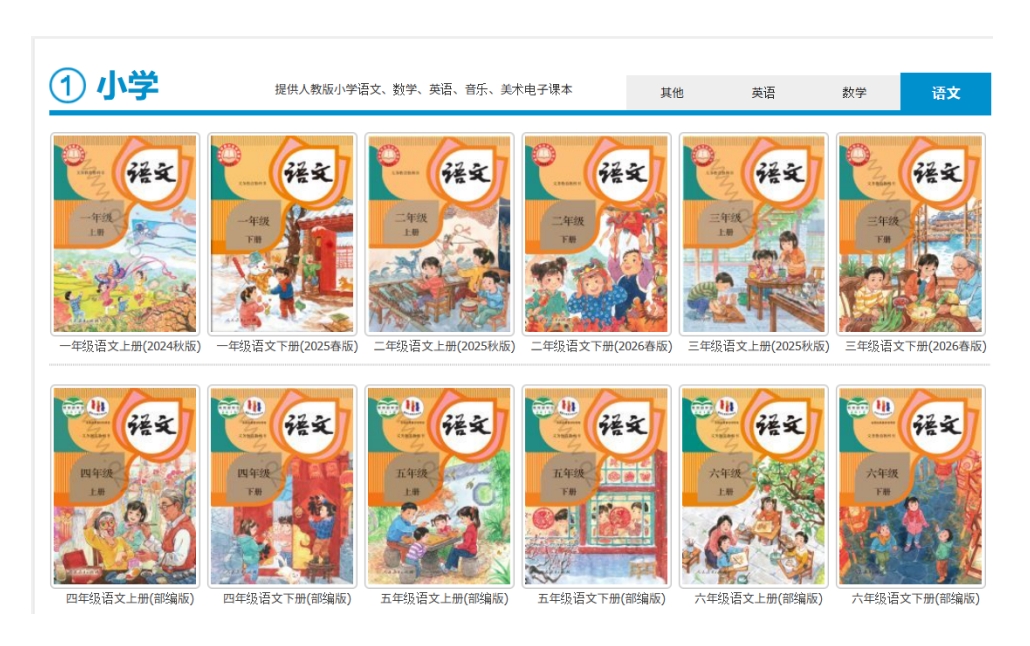
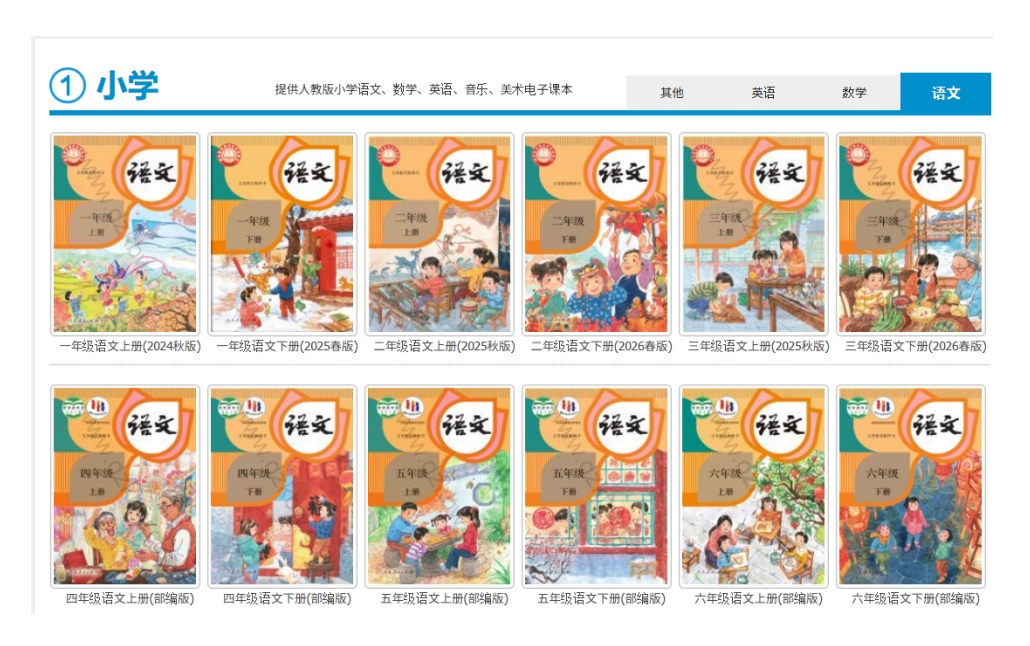
For example, the list of People’s Education Press elementary school
Chinese Language (語文) textbooks provided on
Dianzi Keben Wang 電子課本網 is as follows. By selecting and clicking the
Chinese Language textbook for the desired grade and semester, users can directly view the contents of the corresponding textbook.
In addition to the electronic dictionaries and digital textbooks examined above, a variety of Chinese character education software programs, educational games, and instructional videos have also been produced and used in China. This may be regarded as a natural trend accompanying the development of science and technology. Therefore, when developing methods of hanja education in Korea and elsewhere, it will be necessary to take these developments into active consideration.
Conclusion
The purpose of this paper is to examine various methods of Chinese character education practiced in China and to identify their characteristics and implications. As a country that has used Chinese characters as the principal writing system for modern Chinese, China has accumulated research on Chinese character education over a long period of time and, on this basis, has utilized a variety of educational methods. An analysis of these methods of Chinese character education in China can provide meaningful implications for the development of new methods of Chinese character education in regions outside China, including Korea. The main points discussed in this paper may be summarized as follows.
First, through an examination of the Basic Character List for Literacy and Writing Instruction (識字寫字敎學基本字表) and the Commonly Used Character List for the Chinese Language Curriculum in Compulsory Education (義務敎育語文課程常用字 表) presented by the Chinese Ministry of Education, this paper confirmed that these character lists institutionalize, at the national level, the scope and sequence of Chinese characters to be learned during compulsory education in China. Next, it examined the specific contents and characteristics of Chinese character education methods in China, namely the Concentrated Character Recognition Method (集中識字法), Distributed Character Recognition Method (分散識字法), Phonetic-Notation-Based Character Recognition Method (注音識字法), Component-Based Character Recognition Method (部件識字法), Character-Principle-Based Character Recognition Method (字 理識字法), and Root-Character-Based Character Recognition Method (字根識字法). Finally, it considered methods and cases of Chinese character education using digital technologies in China, particularly electronic dictionaries and digital textbooks.
As discussed above, the characteristics of Chinese character education in China include the establishment, at the national level, of the Chinese characters to be taught and learned; the exploration and use of various methods of Chinese character education, such as the Character-Principle-Based Character Recognition Method (字理識字法) and the Root-Character-Based Character Recognition Method (字根識字法); and the development of Chinese character education methods that make use of digital technologies.
Research on these methods of Chinese character education in China offers a comparative basis for developing new methodologies for Chinese character education in regions outside China. However, considering that China uses Chinese characters as the principal writing system for modern Chinese, employs simplified characters, and sets reading and writing as the main goals of Chinese character education, its educational context inevitably differs from that of hanja education in Korea, which is conducted with the aim of promoting a proper understanding of the Korean language. Therefore, when adopting research findings on Chinese character education in China, it is necessary to reexamine and critically evaluate them in light of Korean circumstances in order to adapt them appropriately to hanja education in Korea.
Notes
Figure 1.List I of the Commonly Used Character List for the Chinese Language Curriculum in Compulsory Education (義務敎育語文課程常用字表)
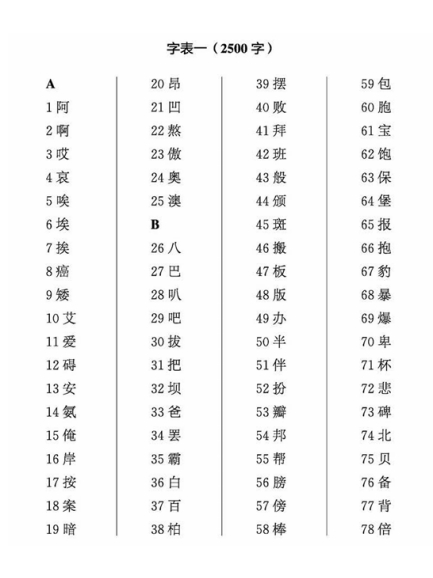
Figure 2.List II of the Commonly Used Character List for the Chinese Language Curriculum in Compulsory Education (義務敎育語文課程常用字表)
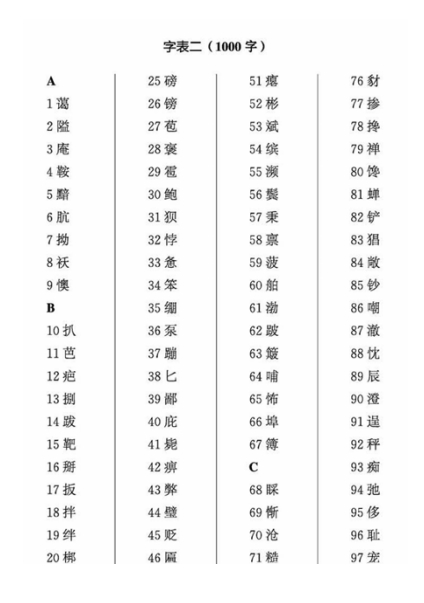
Figure 3.
Basic Character List for Literacy and Writing Instruction (識字寫字敎學基本字表
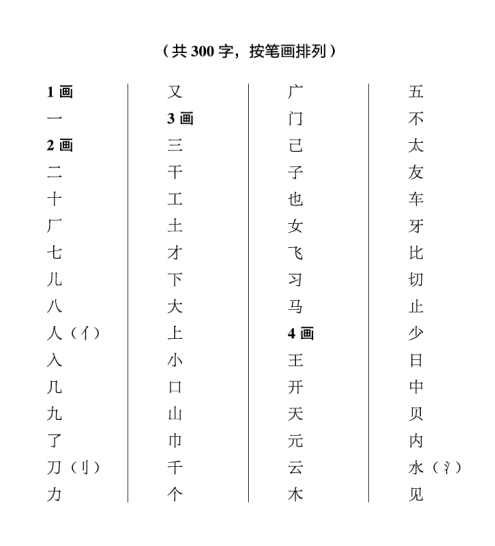
Figure 4.
Chinese Language (語文), Book 1 for Grade 1, p. 11, Beijing Normal University Press
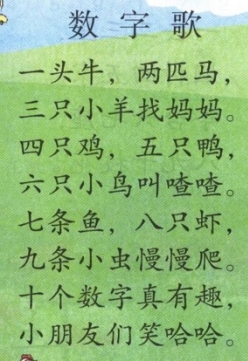
Figure 5.
Chinese Language (語文), Book 1, p. 45, Beijing Publishing House
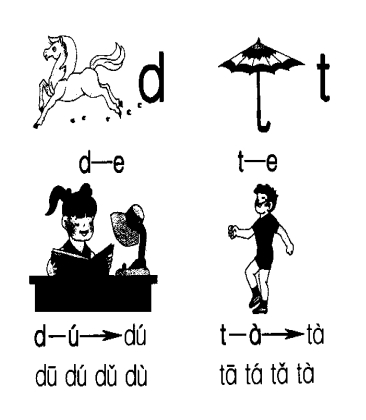
Figure 6.
Chinese Language (語文), Book 1, p. 48, People’s Education Press
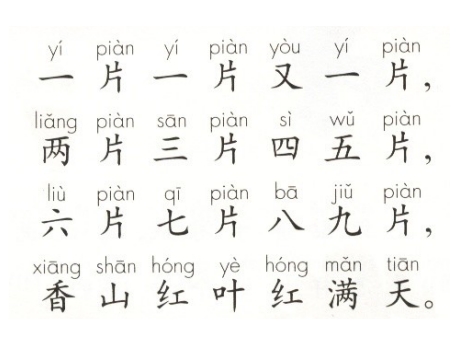
Figure 7.
Chinese Language (語文), Grade 1, First Semester Volume, p. 5, Beijing Normal University Press
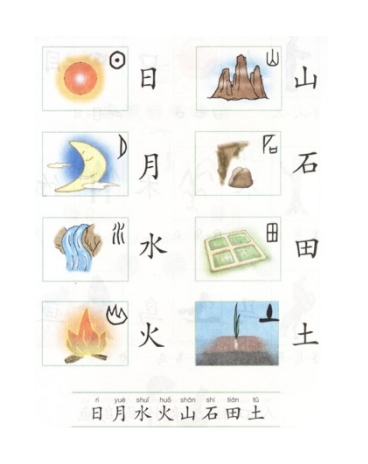
Figure 8.
Chinese Language (語文), Grade 1, Second Semester Volume, p. 83, Beijing Normal University Press
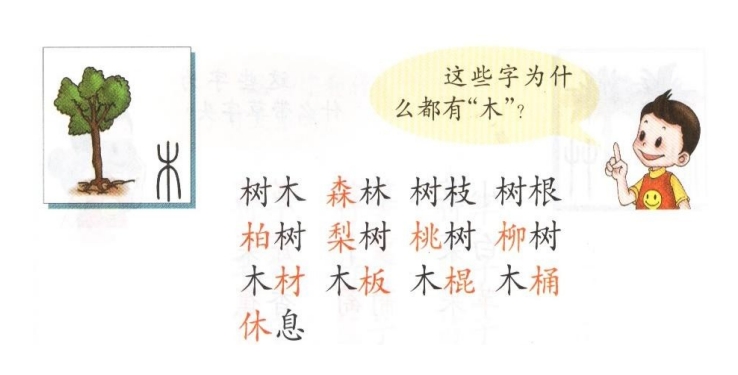
Figure 9.
Reference List
- Dai Ruqian 戴汝潛, ed. Teaching and Learning Chinese Characters. Jinan: Shandong Education Press, 1999.
- Hŏ Ch’ŏl 허철. “The Concept and Research Scope of Modern Chinese Character Studies.” Journal of Classical Chinese Literature 10. Uri Society of Classical Chinese Literature, 2004.
- ____. “A View on the Utility of Digital Character Dictionaries for Classical Chinese Learning and Considerations in Database Design.” Studies in Classical Chinese Education 41. Korean Society of Classical Chinese Education, 2013.
- Jia Guojun 賈國均. Teaching Method of Character-Principle-Based Literacy. Beijing: China Light Industry Press, 1998.
- Kim Young-ok 김영옥. “The Current State of Chinese Character Education in China.” Studies in Classical Chinese Education 21. Korean Society of Classical Chinese Education, 2003.
- Su Peicheng 蘇培成. Outline of Modern Chinese Character Studies. Beijing: Peking University Press, 2001.
- Su Peicheng 蘇培成, ed. Reference Materials for Modern Chinese Character Studies. Beijing: Peking University Press, 2001.
- Wang Ning 王寧. Introduction to Chinese Character Studies. Beijing: Beijing Normal University Press, 2001.
- Yang Wonseok 양원석. “Chinese Character Education in China: Focusing on an Examination of the Chinese Language Curriculum Standards and the Method Using Root Characters.” Chinese Character and Classical Chinese Education 15. Korean Society of Chinese Character and Classical Chinese Education, 2005.
- _____. “The Current State and Significance of the Digitization of Classical Chinese Texts in Taiwan.” Collected Papers in Classical Chinese Literature 49. Kŭnyŏk Society of Classical Chinese Literature, 2018.
- _____. “Future Curricula and the Direction of Chinese Character Education.” Studies in Classical Chinese Education 53. Korean Society of Classical Chinese Education, 2019.



 News
News