Abstract
Tangut culture, the knowledge of which seemed almost completely lost a little more than a century ago, is now widely available for study thanks to unbelievable finds of Petr Kozlov in the so-called “dead city” of Khara-Khoto, located in the plain Alashan Gobi Desert. A question of investigating the level of influence on Tangut by the neighboring cultures, especially Chinese is one the key importance. This paper looks into what place the Confucian canons occupied in Tangut culture, specifically that of Xiao jing 孝經 (Canon of [Descendants’] Piety).
-
Keywords: Tangut, Western Xia, moral, translation, cultural contact
Tangut civilization is rather poorly known even among the specialists in East or Central Asia’s history. Tangut state (
Phɔ⊥ʕ¹ mbɪn² lhi̭ə² li̭e²1 
, The Great State of Elevated Whiteness, in Chinese sources – Xi Xia 西夏 [Western Xia]) existed
de facto from 1038 to 1227, mainly in nowadays Ningxia, Gansu and Shaanxi provinces. People who formed that state called themselves
mi –
mi² ndzɪ̭wo² 
or
mɪ² nɪ̭aɯ² 
, sometimes
lhi̭we¹ 
, Tanguts as a word being an Turc exonym which we firstly met in the eighth century, Chinese form of the same name (its original is sadly unknown) is
danxiang 党項, which is known from the sixth century. Around that time Tangut’s ancestors, spoke a Tibeto-Burman/Himalayan language (or languages) of Qiang group and lived to the East of Kukunor lake; in seventh and eighth centuries they left their homeland for neighboring areas of Tang 唐 (618-907) empire to avoid an absorption by Tibetan empire (618-842/848), which in that time was on its peak. In that new lands some groups of migrants quickly formed a people, which from 881 had its own quasi-state
dingnan jiedushi 定難軍節度使 “extraordinary commissariat of fixing of difficulties” in nowadays northern Shaanxi under the rule of a Tangut Toba 拓拔
2 clan. During many wars with neighbors Tangut state became one of the strongest states of the East and Central Asia, maintaining under his control almost all the eastern part of transeurasian trade routes from Dunhuang 敦煌 eastwards. In 1038 its independency was officially proclaimed (and recognized in 1044 by China, with some limitations, and by Khitan empire). Destruction of Tangut state by Genghis Khan (ca. 1162-1227, great khan after 1206), who died two weeks before Tangut capital’s fall, was not the end of Tanguts – educated part of that people was highly prized in Mongol empire, especially in its Yuan 元 (1271-1368) part. Sadly, after Tangut intellectuals left their land to make career, common people clearly felt themselves abandoned, and assimilation processes between them were very quick – as between higher classes who left for China. The last dated text in Tangut is dated by 1502 – around that time last islets of Tanguts were consumed by “Chinese sea,” their language and writing seemed forgotten forever.
Fortunately, in 1908 Russian expedition of Petr Kozlov (Пётр Кузьмич Козлов, 1863-1935) arrived to the ruins of the city of Khara-khoto (ᠬᠠᠷᠠ ᠬᠣᠲᠠ, Black city) in the middle of Alashan desert (now it’s Ejina 額濟納 khoshun of Inner Mongolia). Centuries before it was a Tangut city, named
z̀i̭ẹ² nɪ̭a¹ 
“Black water” after local river (still called in Mongol as Edzin-gol ᠡᠵᠡᠨᠡ ᠭᠣᠣᠯ, conserving original Tangut name). City was found in 1032 as a fortress on Tangut State’s northern border and was destroyed in 1372 by Ming 明 empire (1368-1644) forces. Surprisingly that relatively small and remote city was a place of the find of an enormous Tangut library, kept in the
suburgan, which was built as a tomb of an unknown monk (or nun).
3 Suddenly a corpus of Tangut texts, before only represented by one Lotus sutra, one stele, one inscription on Juyongguan 居庸關 gate of the Great Wall, and a bunch of coins, was replenished by around nine thousand texts – translations, glossaries, laws, poems etc. Decoding of Tangut script and revival of Tangut language became possible.
4
From the very beginning of the study of Tangut texts (may be even a little bit before) it was clear that Tangut state and culture, at least the elite one, was under deep influence of China. Chinese sources provide various information about that – for example, speaking about reforms of state administration, realized by the first Tangut emperor, which name in Chinese texts is Yuan-hao元昊 (1003-1048, ruled from 1032, emperor after 1038; his name in Tangut sources is
li̭ə¹ khwə̂¹ 
, “the Horned Wind”)
Song shi 宋史 (History of Song) does not call the system he introduced “Chinese,” but names of all departments listed are clearly Chinese and even the same as in Song empire (Tuo-tuo et al., ch. 484, p. 13993).
Kozlov’s collection provides many proofs for that idea. Except many sutras, who were translated in Tangut from Chinese (as we see from introductions or colophons; probably Chinese Tripitaka was the main source for Tangut Buddhist canon, the second language was Tibetan, some texts may be were translated from Uyghur), between Tangut books we also see secular texts, translated from Chinese.
5 Some of them are Confucian classics like
Lun yu論語 (in Tangut
ldɪ̭ə̣¹ nda² 
“Discussed Speeches”) or
Meng zi孟子 (Tang.
mêi² tsə¹ 
, so just a phonetic transcription of Chinese was used for the title). We also possess a Tangut translations of military classics
Sun zi 孫子 (Tang.
swen¹ tsə¹ 
) and
Liu tao 六韜 (Six secret [strategies], Tang.
tśi̭eɯ¹ ndwu² 
“Six secrets”) and
Huang-shigong sanlüe 黃石公三略 (Three strategies of Sir Yellow Stone, Tang.
tə̣² ꞏi̭ə¹ ꞏo¹ sọ¹ nɔ⊥ʕ² 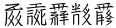
“Three plans of Yellow Stone Senior”); translation of a historical work
Zhenguan zheng yao貞觀政要 (Essentials about Politics from the Zhenguan reign), Tang.
tśhi̭a² ndạ² tshi¹ ꞏi̭wə̣² 
“Desired Writings on Services of ‘Virtious’ [reign]”
6).
Some Chinese texts, survived in Tangut version, were last in China.
A² nɪ̭əʕ¹ lhi̭ə² 
(Twelve States), historical account on the history of Springs and Autumns (春秋, 770–453 BC) period, may be compiled around at the turn of the eras, is not known in Chinese at all, just like a Chinese original of Taoist edifying text
Ngọ¹ no² wa¹ wa² la¹ 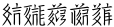
(Notes on Conciliation near the Altar of the Man-Son
7) probably initially compiled in China around the third and fourth centuries CE. The
Lei lin 類林 (Tang.
Ndɪ̭ẹ¹ mbo¹ 
, both variants meaning “Forest of Categories”), a
leishu 類書 (writings, [organized by] categories) of the third and fourth centuries, is known in Chinese only by some fragments from Mogao 莫高caves. For the Jiang yuan 將苑 (General’s garden, Tang.
Nga¹ mbɪ̭u² rẹi² mbo¹ tśhi̭e² 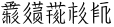
“Commandant’s forest’ volume”), a military treaty compiled, according to tradition, by famous Zhuge Liang 諸葛亮 (181–234), but known only from the Northern Song (960–1127), the oldest Chinese edition we have is dated by 1517, so Tangut translation is three centuries older.
Song shi notes translation of some Chinese books between main reforms of Yuan-hao, who ordered to translate them in Tangut Xiao jing 孝經 (Canon of [Descendants] Piety), canonical glossary Er ya 爾雅 (Approaching to the elegance) and a Northern Song-time schoolbook Si-yan za-zi 四言雜字 (Miscellaneous characters of four words) [Tuo-tuo et al., ch. 484, p. 13995]. That short list clearly draws for us an image Chinese author wanted to make – a barbarian king, full of enthusiasm to bring his people to the light of a real culture, begin its way by translating of Chinese primers.
We have to note that two books from this list for now isn’t known in Tangut version – even in fragments. The only text, mentioned by
Song shi, which we actually have in Tangut version is
Xiao jing 孝經 (Canon of [Descendants] Piety, Tang.
wəʕ¹ ngɪn² 
, “Jing
8 of Kindness”). This text is not only one between translations we have – it’s a Confucian canon of the best preservation – for
Lun yu we have fragments of the ch. 5, 11, 15, 19, 20; for
Meng zi – chapters 4, 5, 6, fragments of chapter 8.
And Tangut translation of
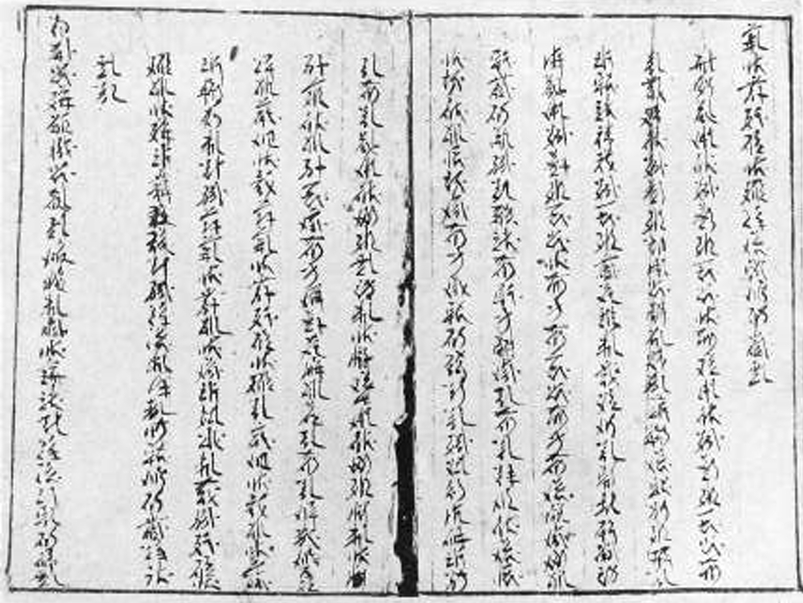
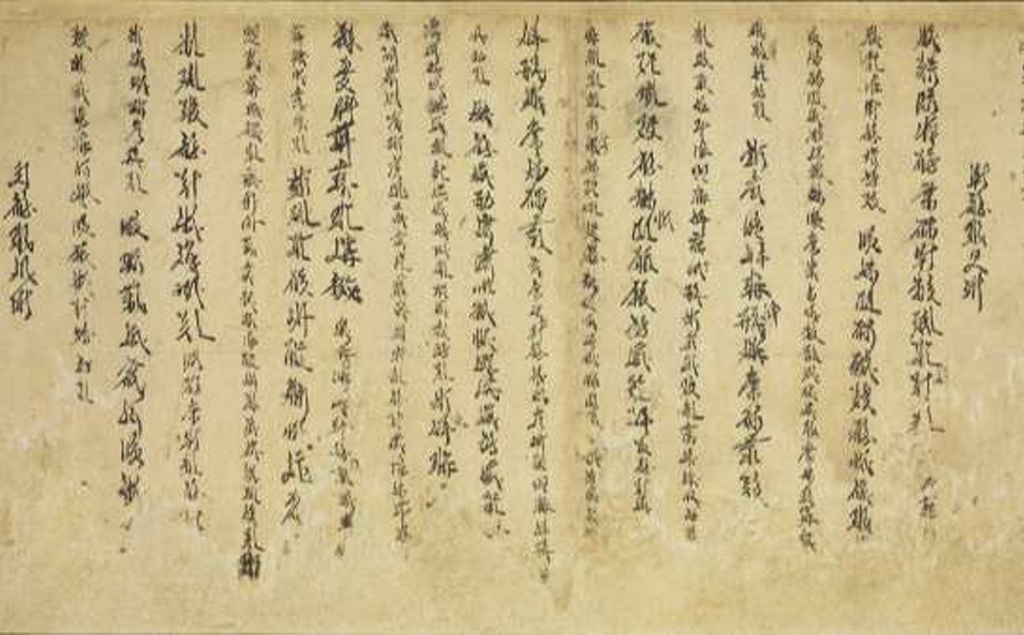
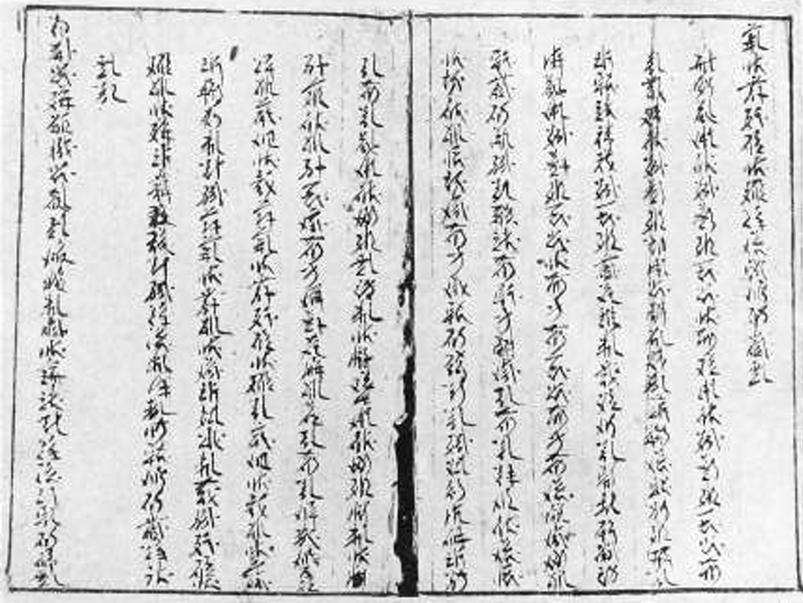
Xiao jing survived almost in its entity – only the end of chapter 18 is lost. That’s a 77 pages manuscript (Танг. Инв. № 2627 in the collection of the Institute of Oriental Manuscripts of Russian Academy of Sciences in Saint-Petersburg), written in a rather fast cursive which is quite a challenge to read. Manuscript was identified by “father of Tangut deciphering” Nikolaï Nevskiï (Николай Александрович Невский, 1892-1937), who published its description and a photo of one page in 1936 [Nevskiï 1936, p. 70; tabl. III].
9 Worth to note that Nevskiï didn’t have time to put this manuscript to the inventory – it was made by Aleksandr Dragunov (Александр Александрович Драгунов, 1900–1955), who succeeded him after his execution in 1937, during Stalin purges.
Xiao jing’s translation photocopies were published in the first volume of Soviet publications of Tangut texts in 1966 [Kitaïskaӓ, p. 133-211 (texts)]. Russian manuscript’s photos are also published in the eleventh volume of E-cang Heishuicheng wenxian 俄藏黑水城文献 [E-cang, vol. 11, p. 2-46].
Nevskiï was a person who find out that Tangut translation we have was made from
jinwen 今文 version; from the preface he understood that Chinese original was dated by 1095 and contained commentary by Lü Hui-qing 呂惠卿 (1032-1111) [Nevskiï 1936, p. 70], important adherent of famous reformer Wang Anshi 王安石 (1021-1086). His biography could be found in
Song shi (ch. 471);
inter alia in 1081 he was one of main Chinese commanders during the Song-Tangut war but was much more known as an author of exemplary commentaries used by reformers (we know that existed his commentaries for
Lun yu,
Xiao jing,
Dao de jing 道德經 and
Zhuang zi 莊子, he participated in the work on commentaries to
Shi jing 詩經,
Shang shu 尚書 and
Zhou li 周禮, authored by Wang himself). As we know, reformers didn’t make a good memory in China, so all Lü Hui-qing were all last long ago, so
Xiao jing Tangut translation which contents Lü commentary, is a precious find not only for Tangut studies, but for Sinology too.
10
As we already told, manuscript is hard to read (Nevskiï, who could read Tangut cursive – that a rare ability between Tagutologists – notes its difficulty too). Vsevolod Kolokolov (Всеволод Сергеевич Колоколов, 1896-1979) managed to read the 4 chapter and make its character-to-character transcription by regular script [Kitaïskaӓ, p. 134-135] and parallel Chinese text (to note that Tangut translator tried his best to make a character-by-character translation of Chinese original, even if it wasn’t comfortable to the rules of Tangut grammar – that’s the case for most Tangut translations).
More was made by Eric Grinstedt (1921-2008), who consecrated to the study of Xiao jing a big part of his main book “Analysis of the Tangut Script.” He succeeded to read all the text and propose regular forms for almost all the characters; he also translated Lü Hui-qing preface and proposed a variant of reconstruction of its last Chinese original [Grinstedt, p. 300-376; 282-296]. Grinstedt also remarked, that the manuscript we have isn’t a final version of the translation – we see many corrections made by red ink, often some characters in a raw are crossed out and replaced by another ones – reader clearly wasn’t satisfied by translation he had and tried to make it better. On the final ten pages corrections weren’t made – we don’t the reason. Text of commentaries was corrected more often, than main text.
Unfortunately, Grinstedt’s study, which is truly impressive indeed, wasn’t made to the end – his transcription was published only in facsimile, without English translation and almost without any analysis of text and commentary.
Besides the “Russian” manuscript, some fragments of
Xiao jing was tracked in Khara-khoto collection preserved in London (formed by Stein’s findings): the end of Lü Hui-qing’s preface and the beginning of the first chapter (Or.12380/3576), of a very good calligraphy [Ying-cang, vol. 4, p. 261]
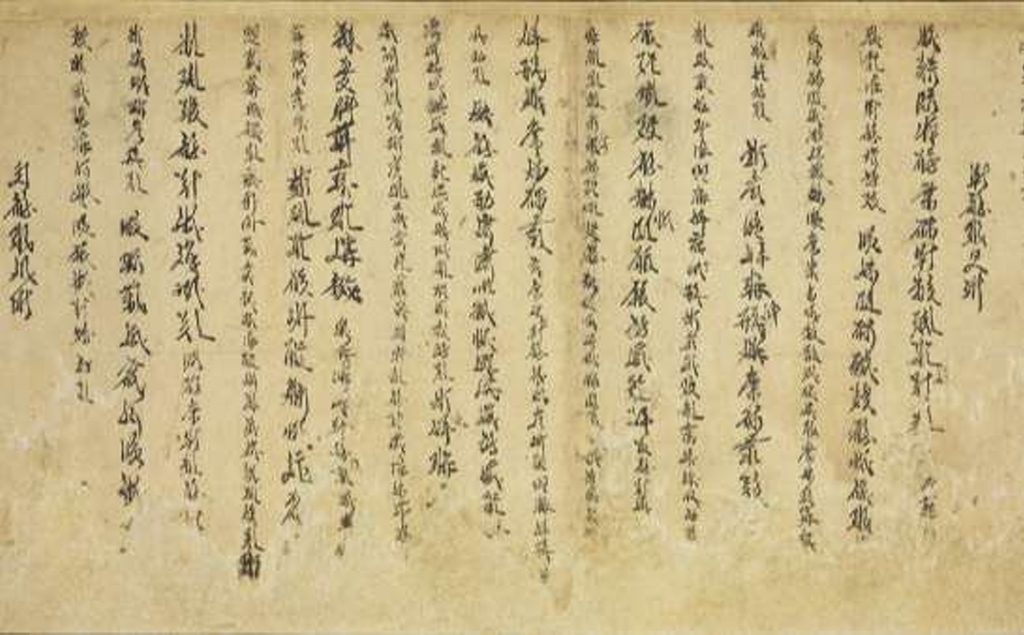
11 and a manuscript roll of 160 cursive lines, which low part was last – that’s the end of the canon from the begin of the 7 chapter, with a much more popular commentary of Tang emperor Li Long-ji李隆基 (Xiao zong 玄宗, 682-762, emperor from 712 to 756) [Ying-cang, vol. 5, p. 180-186] – so, at least two variants of commented
Xiao jing existed in Tangut translation – as far as we know, that’s a unique situation for Tangut translations of any Chinese text, for another we only have one variant of translation for each.
To note that all variants of Tangut translations of Xiao jing are manuscripts (“Russian” version was not even a clean copy) – so we do not know how did look an “officially approved” translation of Xiao jing – and even don’t know if that official translation even existed, despite an information from Song shi about an august commission to make it.
Han Xiao-mang [Han Xiao-mang, vol. 9, p. 128] lists nine recent Chinese publications on Tangut Xiao jing. To note a paper of Hu Ruofei 胡若飛, where is presented a character-by-character Chinese translation of Tangut text of Xiao jing from the Khara-khoto collection preserved in St. Petersburg [Hu Ruo-fei 2006], a reconstruction of Chinese commentary of five chapters (2, 3, 4, 5, 11), made by Nie Hongyin 聂鴻音 [Nie Hong-yin, 2007] and a paper by Duan Yuquan 段玉泉 with a comparative study of two variants of Tangut translations [Duan Yu-quan 2018].
But all before are just well-known facts. What new can we add on the topic?
Between Tangut texts, firstly found during “unpacking” of Kozlov collection, the very special place has a glossary, titled in two languages as
Mi² źạ¹ ngwuʕ¹ ndzi̯e¹ mbi̯u¹ pi̯ạ¹ ngu² nje² 
(A Moment-based
Pearl in the Palm of the Tangut and Chinese Languages) and
Fan-Han he-shi zhang-zhong zhu 番漢合時掌中珠 (Foreigner [and] Chinese Time-corresponding
Pearl in the Palm), compiled by a Tangut literati Kwə̣¹ lde² rɨ ² phu
ʕ²

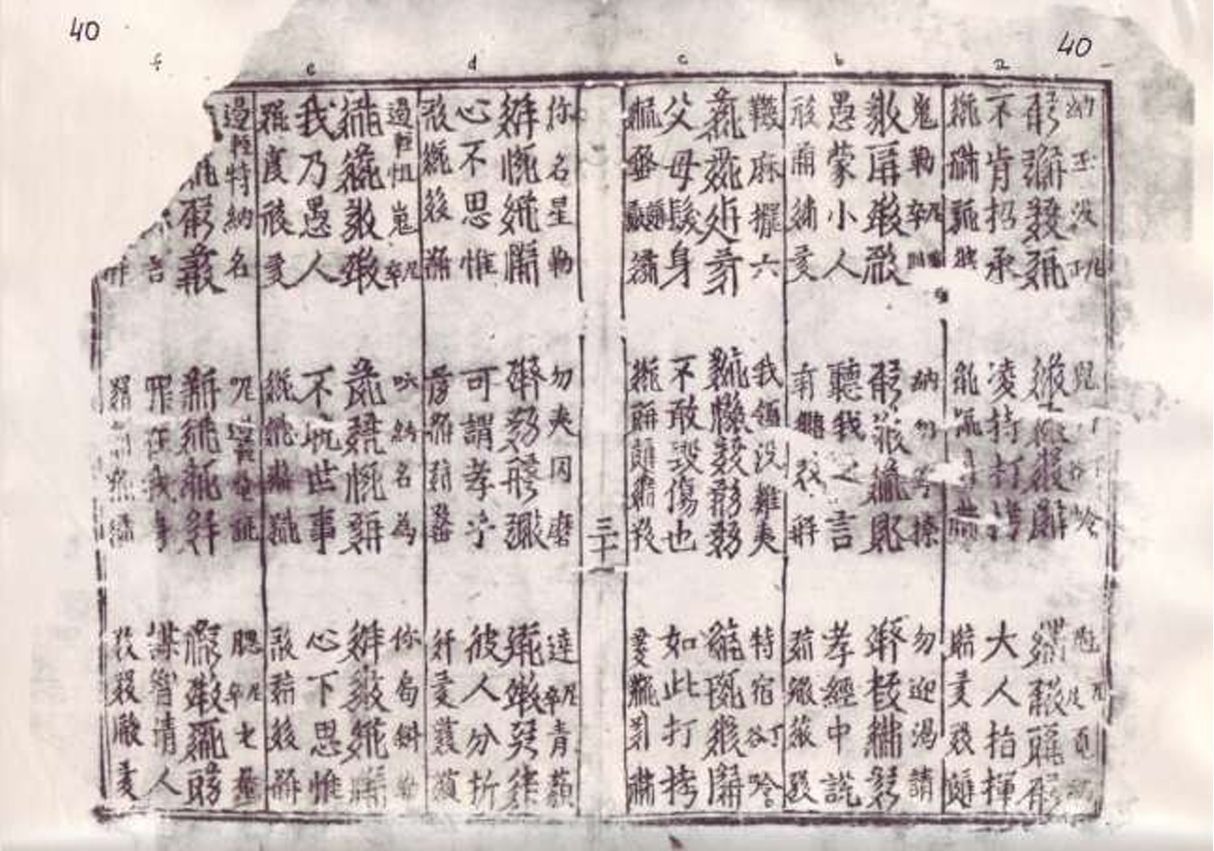
. That Tangut-Chinese glossary, almost one of a kind between Tangut books we know, was firstly published in 1190. At least three xylographic editions are known, besides Khara-Khoto, some pages of the glossary were found in quite opposite corner of Tangut state – in Mogao 莫高caves near Dunhuang, so that book clearly enjoyed quite a popularity and influence. Glossary contains around thousand entries which are organized semantically; Tangut entries are translated in Chinese, every Tangut characters bear a notation of its phonetic by Chinese character/characters, and every Chinese character is also transcribed phonetically by corresponding Tangut character. Naturally, the
Pearl became a kind of Rosetta stone for Tangut decoding, it is still one of our main corner stones for all dictionaries we have, but (may be for that reason) are sadly scarcely studied as is, as a text. And it’s quite worth to be studied – (h)Kwelde-ryp’hu making his glossary didn’t tried to collect as many words as it’s possible for each subject (we have that kind of glossaries between Tangut glossaries, to see, for example, [Dmitriev 2024]), his main goal was to make a kind of thesaurus, of a clear mirror, which reflects the most typical sides of Tangut culture and life. So any entrie of the
Pearl is not random – quite opposite, every word (and its place in the paragraph) has a deep sense, even if we cannot often understand it. So every information from the
Pearl isn’t just a word or a phrase – it should be analyzed as an important message from Tangut intellectual, who was sure that’s it adds some important touch to the portrait of Tangut civilization.
So, do we have there something about
Xiao jing? Indeed. On ff. 30-32 of the
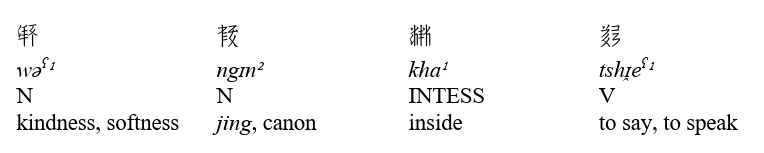
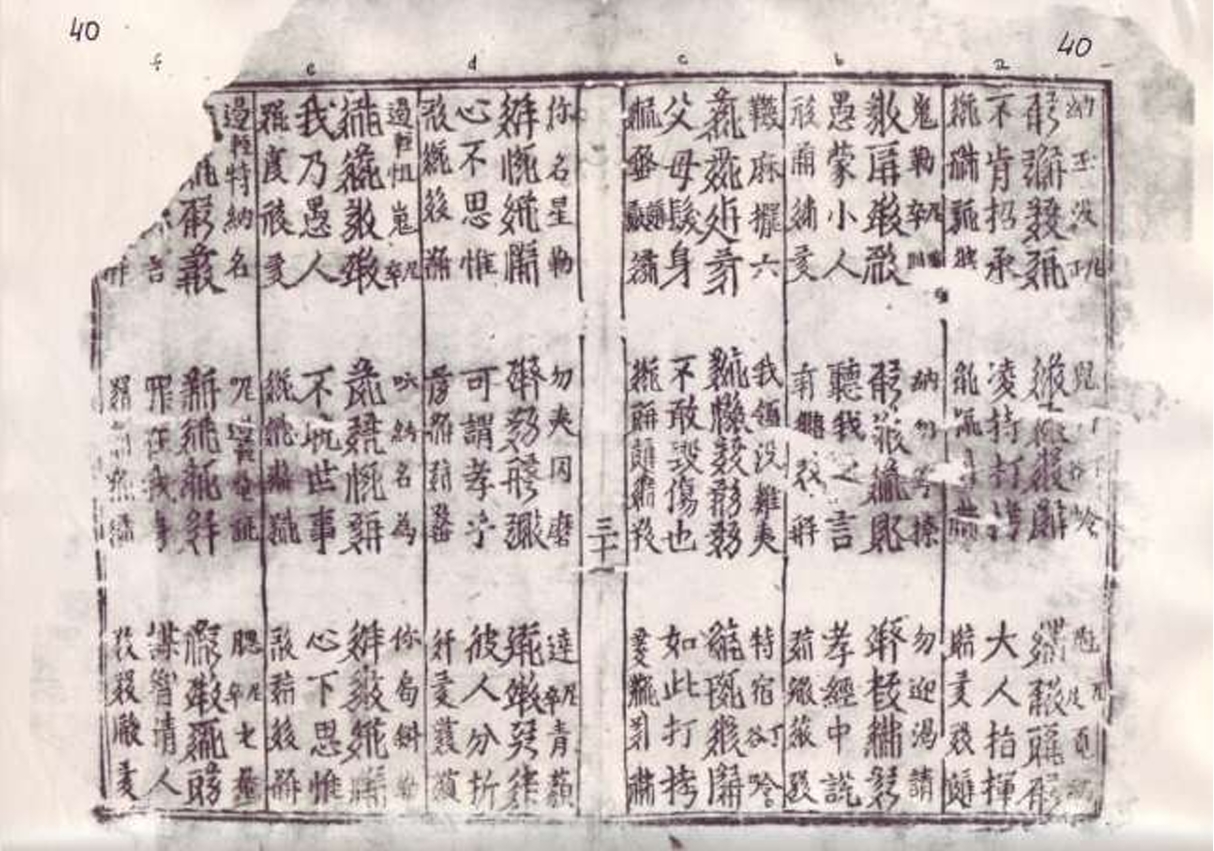
Pearl, we read a short story (in some places this glossary is organized more like a textbook) about a proper resolving process of a crime. It is stated that suspect should be questioned, and if he does not confess – to be detained and, after an upper-level administration request, beaten and tortured. In that situation (see f. 31).
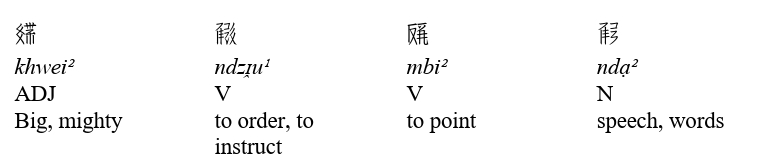
The big [boss] instructs and designates [by following] speech:
Chinese: Da ren zhi jun 大人指揮 Big man points [and] commands:
“Foolish, stupid little man!
12
Chinese: Yu meng xiao ren 愚蒙小人 “Fool, ignorant little man!
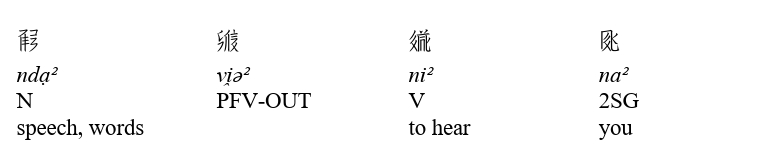
[My] speech you did heard.
Chinese: Ting wo zhi yan 聽我之言 Hear the words by me
In Jing of [Filial] Kindness [it is] said:
Chinese: Xiao jing zhong shuo 孝經中說 In ‘Canon of [Descendants] Piety’ [is] said:
‘Father’s and mother’s hair [and] body
Chinese: Fu mu fa shen 父母身 “Hairs and body [of] father [and] mother
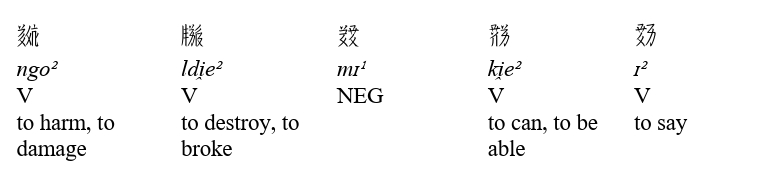
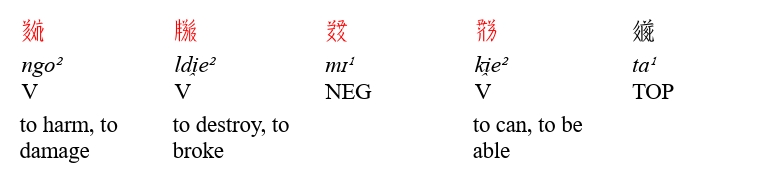
[you] can’t harm or destroy’ [is] said.
Chinese: bu gan hui shang ye 不敢毀傷也 don’t dare to destroy [or] injure.”
[To be] beaten and batten like that
Chinese: ru ci da kao 如此打拷 Like that [be] beaten [and] tortured
[and] heart don’t think a thought
Chinese: xin bu si wei 心不思惟 [and] heart don’t think [or] consider
should [it] be said [as] ‘[filial] kindness’?
Chinese: ke wei xiao hu 可謂孝乎 could [it be] called a [descendants] piety?
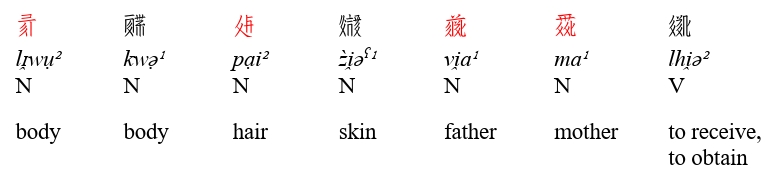
After that the wrongdoer, of cause, cannot have any choices but to understand his guilt and to confess. We would not waste our reader’s time to discuss the reality of the described situation – let’s look closer to the quotation from the Xiao jing we just saw. It is easy to locate – that’s a quotation from the first chapter. But if we find that phrase in the translation we have in Khara-khoto collection preserved in Saint-Petersburg, we will find out that a variant from the Pearl looks quite different (red characters are the same we met in the Pearl quotation):
Body, hair [and] skin - [it’s from] father [and] mother received
Chinese: Shenti fa fu shou zhi fu mu 身體髮膚受之父母 “Body, hair, skin – [we] receive it [from] father [and] mother;
It’s what [we] can’t harm [or] destroy.
Chinese: bu gan hui shang 不敢毀傷 don’t dare to destroy [or] injure.
is a beginning of [filial] kindness.
Chinese: xiao zhi shi ye 孝之始也 [That’s] the beginning of a [descendants] piety!
We can see that Tangut translation is correct and close to Chinese original (sometimes even too close – for example, a binominal structure of Chinese word shenti is imitated by two synonyms in Tangut without any real need). What is intriguing is that the quotation we saw in the Pearl (mostly its first part) surprisingly does not match with manuscript’s variant. How it could be explained? Probably, author of the Pearl used different variant of translation (may be a “British” one – we cannot check, because its first half is lost – or it is a different translation). Or, what is even more intriguing, the Pearl formula, even being presented as a quotation, in reality is not a real one – it could be a popular saying, a paraphrase from the original, transformed to be more comfortable for Tangut speaker. Unfortunately, we do not have enough date to say which hypothesis is more probable.
Possibly, Xiao jing, which is clearly the most universally moral (and the least specifically Confucian) between Confucian canons, had actually a rather warm reception among Tangut intellectuals. Despite the Song shi’s perspective, for now we do not know anything about state participation in Xiao jing translation or diffuse – quite opposite, we see traces of personal interests to that text between Tangut intellectuals, which did translations of the text with different commentaries and tried to make better versions of the translation.
Role of Confucianism in Tangut state is one of the most disputable questions among the specialists (for more see [Solonin 2019, Solonin 2020]) – some of them see arguments of high level of sinicization of Tangut elite and suppose that Confucian ideas were between the main bases of Tangut state and culture, but other doubt that, by pointing out that most narratives on Chinese influence on Tangut culture are taken from Chinese sources, which had many reasons to exaggerate the level of imitation of Chinese norms by the Tangut. Confucian texts and moral values were indeed known among the Tangut, who were also well aware of Chinese philology or administration. But looks like the Tangut’s interest toward Confucianism in reality was very limited – they valued moral bases of Confucian texts, which are very close to the bases of any traditional society, but we do not know any cases of interest of Tangut describing more specific and complicated sides of its philosophy – Confucian religion or, for example, complicated and fine Song neo-confucianism, as far as we know, did not attract Tanguts at all.
13
For that reason, it seems that Xiao jing was the most understandable and accepted Chinese texts. Its ideas of respect and care towards elders were of cause quite familiar to Tanguts (as to any human being), and they liked this relatively short and easy text, probably more than other texts in the Confucian canon. We cannot know it for sure, because we are very dependent of the choice of Tangut texts which survived – and that choice easily can be far from being representative. But after looking into the question, Xiao jing is the only Chinese text for which we we have at least two translations in Tangut. Second argument is based on the Pearl – Xiao jing is the only quotation of any texts which we meet in that glossary – so, from the point of view of (h)Kwelde-ryp’hu, Xiao jing was in full harmony with Tangut culture and his ideas are choosen between concepts which are important to be noted in that Tangut thesaurus. To note that any mentions of Confucian ideas or concepts in the Pearl are quite scarce (see [Dmitriev 2026]).
Looks like Xiao jing and its ideas were deeply adopted (may be even appropriated) by Tangut intellectuals not as one of Confucian canons, but as valuable text by himself, full of familiar and understandable ideas. For them it was first of all a text about human’s life, not a canon of Chinese wisdom.
One of arguments (rather weak, though) it is the character chosen by Tanguts to translate the concept of
xiao. This character is not a phonetical or graphic borrowing of any kind – which is often a case for borrowed Chinese terms (for example,
ngɪn² 
for
jing 經, which we met in the same title’s translation). Tangut character
 wəʕ¹
, as we know from Tangut etymological dictionaries, was formed from graphic parts of two characters:
nɪ̭eʕ¹ 
“heart, mind” and homophonic
wəʕ¹ 
“soft” (explaines as “like cotton or cannabis wool”) (see [Han Xiao-mang, vol. 7, p. 624]) – so etymology does not point directly that this quality is related with parents or elders. That character is between very popular words (examples of use see [Han Xiao-mang, vol. 7, p. 624–629]) and can be seen in translated from Chinese and in original Tangut texts, so we have enough data to understand its uses. In most cases it’s used indeed in the context of care towards elders, especially parents, but we also can notice a difference with Chinese term – firstly, we cannot see in Tangut uses any trace of sacrificial semantics, which is so important for Chinese corpus. It looks like that it was mostly Confucius, who “profaned” the term, making it primary as an appeal to be kind to parents and to care about them in their old age than a system of sacrifices to ancestors, which is the main sense of the
xiao word in oracle bones or inscriptions on Zhou bronzes). That is of course should be explained by relatively late acquaintance of Tanguts with Chinese concepts – so this archaic part of
xiao’s semantics was “lost in translation.”
Most probably that word was not designed especially to translate the Chinese concept of xiao – in that case it would be noticeable in the word or character made to write it. So something very alike to Chinese xiao – love and caring toward elders – existed in Tangut culture before they became aware of this Chinese concept. And it seems like it should be, since this sentiment is the most basic for humankind, just like to love and protect children – one of biological bases of our existence. Probably, that’s also a cause of popularity of the text between Tanguts – when we read a text, situated as a neighbor of a great civilization, it is especially nice when we meet there something which we do agree upon, something with which we are, something, which is important to us too. Some of our resemblances are much stronger, than our differences – and that is nice.
Notes
Reference list
- E-cang Heishucheng wenxian俄藏黑水城文献 (Written monuments of the Heishuicheng, collected in Russia). Vol. 1-32. Shanghai: Shanghai gu-ji chuban-she, 1997-2005.
- Dmitriev, Sergey. “Le vocabulaire de la première enfance: les folios 15-16 d’un thesaurus tangoute du dernier quart du XIIe siècle, les «Caractères mixtes des trois matières.»” Enfance et jeunesse dans les sociétés d’Asie. Paris: AIBL, 2024: 269-290.
- ____. “Konfucianskie dobrodeteli v tangutsko-kitaïskom glossarii «Sootvetstvuüšiï momentu perl v ladoni tangutskogo [i] kitaïskogo ӓzykov» (1190 g.)” [Confucian Virtues in the Tangut-Chinese Glossary “A Time-based Pearl in the Palm of the Tangut and Chinese Languages (1190)”]. Voprosy filosofii, Vol. 8 (2026): 143-150.
- Duan Yuquan 段玉泉. “‘Xiao jing’ liang zhong Xi xia wen yi ben de bijiao yanjiu” “孝经”两种西夏文译本的比较研究 [Comparative study of two kinds of Tangut translation of the “Canon of [Descendants] Piety”]. Zhonghua wenshi luncong 中華文史論叢 [Chinese collection of discourses on letters and history]. 2018, vol. 1: 341-372.
- Grinstedt E. Analysis of the Tangut Script. Lund: Studentiliteratur, 1972.
- Han Xiao-mang韓小忙. Xi xia wen cidian (Shi-su wenxian bufen) 西夏文词典 (世俗文献部分)[Western Xia language dictionary (A part of secular written monuments)]. Vol. 1-9. Beijing: Zhongguo shehui kexue chuban-she, 2021.
- Hu Ruofei 胡若飞. “E-cang Xi xia wen cao shu ‘Xiao jing zhuan’ zheng-wen yi kao”俄藏西夏文草书“孝经传”正文译考 [Original text of the commentary of cursive “Canon of [Descendants] Piety” in Tangut script, collected in Russia: translation and study]. Ningxia daxue xuebao (Renwen shehui kexue ban) 宁夏大学学报(人文社会科学版)[Bulletin of Ningxia university (Humanitarian and social sciences edition)]. 2006, vol. 5 (28): 14-17.
- Kolokolov V. S., Kyčanov E. I., eds. Kitaïskaӓ klassika v tangutskom perevode (Lun üï, Mən czy, Sӓo czin) [Chinese classic in Tangut translation (Lun yu, Meng zi, Xiao jing)]. Moscow: Nauka - Glavnoe izdatelstvo naučnoï literatury, 1966.
- Nevskiï N. A. “Tangutskaӓ pismennost’ i eё fondy [Tangut writing and its funds].” Doklady gruppy vostokovedov na sessii Akademii nauk SSSR 20 marta 1935 g. Trudy Instituta vostokovedeniӓ XVII [Reports of the group of orientalists on the Academy of Sciences session, 20 march 1935. Proceedings of the Institute of Oriental Studies XVII]. Leningrad: Izdatelstvo Akademii nauk SSSR, 1936, pp. 57-80.
- Nevsky N. A. “Yaxiya bowuguan Xi ia shu-ji mulu” 亞細亞博物館西夏書籍目錄 [A Catalogue of Tangut books of Asiatic Museum]. Guo-li beiping tushuguan guan-kan xi xia wen zhuan-hao 國立北平圖書館館刊 西夏文專號 Vol. 4, no.3 (May-June 1930, issued in January 1932): 385-388 (2889-2892).
- Nie Hongyin 聂鸿音. “Lü zhu ‘Xiao jing’ kao” 呂注《孝經》考 [Study of “Canon of [Descendants] Piety” with Lü commentary]. Zhonghua wenshi luncong 中華文史論叢 [Chinese Collection of Discourses on Letters and History], vol. 2(2007): 285-306.
- Sofronov M.V. Grammatika tangutskogo ӓzyka [Grammar of Tangut Language]. Moscow: Nauka, 1968.
- ____. “Lociӓ ‘Morӓ pismen’ [Nautical Guide for the ‘Sea of Writing’]” in Tanguty v Centralnoï Azii. Sbornik stateï v čest’ 80-letiӓ professor E. I. Kyčanova [Tanguts in the Central Asia. Collection of papers for the 80th anniversary of professor E. I. Kychanov]. Moscow: Vostochnaya literatura, 2012, pp. 412-436.
- ____. “Fonetičeskaӓ rekontrukciӓ M. V. Sofronova dlӓ istorikov [Phonetic reconstruction of M. V. Sofronov for historians]” in Tangutskaӓ i kitaïskaӓ filologiӓ. K übileü M. V. Sofronova [Tangut and chinese philology. To the anniversary of M. V. Sofronov]. Moscow: Institut vostokovedeniya RAN, 2024, pp. 509-516.
- Solonin K. “Buddhism and Confucianism in the Tangut State.” Entangled Religions 8 (2019). https://doi.org/10.13154/er.8.2019.8472.
- ____. “The Formation of Tangut Ideology: Buddhism and Confucianism” in Buddhism in Central Asia I: Patronage, Legitimation, Sacred Space, and Pilgrimage. Leiden: Brill, 2020, pp. 123-148.
- Tuo-tuo 脫脫 et al. Song shi 宋史 [History of Song] vol. 1-40. Beijing: Zhonghua shujü, 1977.
- Ying-cang Heishucheng wenxian 英藏黑水城文獻 [Documents from Khara-Khoto in the British Library] Vol. 1-4. Shanghai: Shanghai gu-ji chuban-she, 2005.








 serves here as an abbreviation of tśhi̭a² mbɪ̭oʕ ¹
 , “To observe virtuosly” (clear calque of Zhen-guan 貞觀), which is used as a short variant of book’s title on page’s hekou.
 was specifically designed by Tangut to explain the Chinese word jing 經 in its semantic area of Confucian canon.

 News


 (or z̀i̭ẹ¹ ndzɪ̭wo²
 ) is a common Tangut variant for Confucian xiaoren 小人.