Abstract
The aim of this study was to establish the origin of Korean books from the so-called “Brosset Collection” kept at the Institute of Oriental Manuscripts of the Russian Academy of Sciences (Asiatic Museum). The “Brosset Collection” is a conventional name for the books which are mentioned in the handwritten catalogue of the Asiatic Museum’s Far Eastern collection compiled by Academician Marie-Félicité Brosset (1802–1880). This catalogue lists nine identifiable Korean texts, eight of which are written entirely or partially in
Hanmun.
1 Judging by the date of their cataloguing (1840 and 1842), they are most likely the first Korean books to appear in Russia and are among the earliest surviving Korean-printed books held in European scholarly institutions. The study includes analysis of the various archival documents and marginalia in the books themselves. As a result, it was proven that most of these books form a single collection that originally came from the library of Baron Paul Schilling (1786–1837), who probably received them from the sinologist Nikita Iakovlevich Bichurin (Archimandrite Hyacinth; 1777–1853), head of the Ninth Russian Spiritual Mission in Beijing, and one book originated from the collection of Manchu studies scholar Stepan Vasil’evich Lipovtsov (1770–1841)
-
Keywords: IOM RAS (Asiatic Museum), Russian Orthodox Mission in Beijing, studying Korean and Hanmun in Russia, Korean manuscripts and xylographs in Russia
Introduction
The Institute of Oriental Manuscripts of the Russian Academy of Sciences (IOM RAS), founded in 1818 as the Asiatic Museum, is the oldest Oriental studies institution in Russia and one of the largest repositories of Oriental manuscripts, xylographs, and early movable type editions in the world. Among other treasures, it houses a large collection of Korean books dating from the 18th and 19th centuries (174 titles, over 900 items).
The first description of the Korean books in the holdings of the Asiatic Museum was made by Academician Marie-Félicité Brosset (Rus: Марий Иванович Броссе, Marii Ivanovich Brosse; 1802–1880). A graduate of the Collège de France, he studied several Oriental languages (including Chinese) at his alma mater, but eventually focused on Caucasian studies. His handwritten
Catalogue des livres et manuscrits Chinois, Mandchous, polyglottes, Japonnais et Coréens, de la bibliothèque du Musée Asiatique, de l’Académie Impériale des Sciences [
Catalogue of Chinese, Manchu, Polyglot, Japanese and Korean Books and Manuscripts from the Library of the Asiatic Museum, Imperial Academy of Sciences]
2 dates from 1840. The catalogue contains numerous later corrections and additions
3, because it remained in use until at least the late 1920s4. It lists nine Korean texts, all of which, except one (No. 84), are written in literary Chinese or are bilingual (Chinese and Korean). Eight of them were catalogued in 1840, and one more in 1842.
There are two modern printed catalogues of the Korean collection of the IOM RAS, the first of which was published by Ol’ga Petrovna Petrova (1900–1993).
5 In addition to Korean books (manuscripts, xylographs, and early movable type editions), it included Japanese books about Korea. This description included 236 titles.
Half a century later, Adelaida Fedorovna Trotsevich and Anastasiia Aleksandrovna Gur’eva published a revised catalogue of the Korean collection of the IOM RAS
6. This description included 169 titles.
Those two catalogues, however, do not provide any information about the origin of the books first listed by Brosset, though judging by the date of their cataloguing (1840 and 1842), they are
most likely the first Korean books to appear in Russia7 and among the earliest surviving Korean-printed books held in European scholarly institutions. In subsequent publications they were referred to simply as the “Brosset collection,” so their provenance remained unclear
8, because this collection was named after the cataloguer, not the original owner. Thus, we have tried to find out the real origin of this collection.
The Korean Texts Included in Brosset Catalogue
To establish the provenance of those books, we had first to establish the exact number and titles of texts catalogued by Brosset. The list of Korean books which is placed in Section XVIII (Classe XVIII) of the Brosset catalogue is as follows:
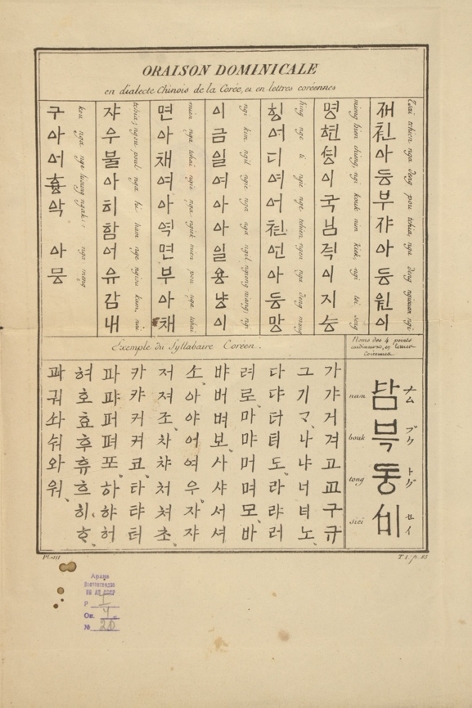
No. 78. Alphabet coréen, avec le Pater en coréen et transcription [The Korean alphabet and the Lord’s Prayer in Korean with transcription].
No. 79. Le livre de Mille mots en caract. chinois et coréens. Cf. cl. V. No. 13, 14
9 [
Thousand Character Classic, written in Chinese and Korean script. Cf. sec. V, Nos. 13, 14] (1 volume).
No. 80. Le Même
10 [Ditto] (1 volume).
No. 81. Le Même livre Sian-Tseu Wen
11 [The same book—
Qian zi wen /
Ch’ŏnjamun] (1 volume).
No. 82. Loui-ho en chin. et coréen
12 [
Lei he /
Yuhap in Chinese and Korean] (1 volume).
No. 83.
Tong Meng Tsian13 [
Tong meng xian xi /
Tongmong sŏnsŭp] (1 volume).
No. 84. Livre tout en caractéres coréenns [A book written entirely in Korean script].
No. 85. Mte chinois, avec qq. transcriptions en coréen au commencement [Chinese manuscript with some Korean transcriptions at the beginning] (1 volume).
[Unnumbered] 6 articles japonnais et coréens non déterminés [6 unidentified Japanese and Korean books] (6 volumes).
Furthermore, between entry No. 85 and the unnumbered entry there is a later addition written in a different handwriting and darker ink:
No. 86. E 128
Kou Kin Tchi i .....
Tсhu Tсhin ‘ou Sse lo song14 [
Gu jin li dai biao ti zhu shi shi jiu shi lue tong kao juan zhi yi /
Kogŭm yŏktae p’yoje chusŏk sipku saryak t’onggo kwŏn chi il] (1 volume).
To identify the entries of Brosset’s catalogue with texts currently held in the IOM RAS, we first consulted the catalogues of the Korean collection by Ol’ga P. Petrova and Adelaida F. Trotsevich – Anastasiia A. Gur’eva and found that these authors attribute eight books to the “Brosset Collection.”
For five of these books, the provenance is beyond doubt, because the covers of these books have paper stickers with their numbers according to the Brosset catalogue
15, and the titles of the books correspond to those listed by Brosset:
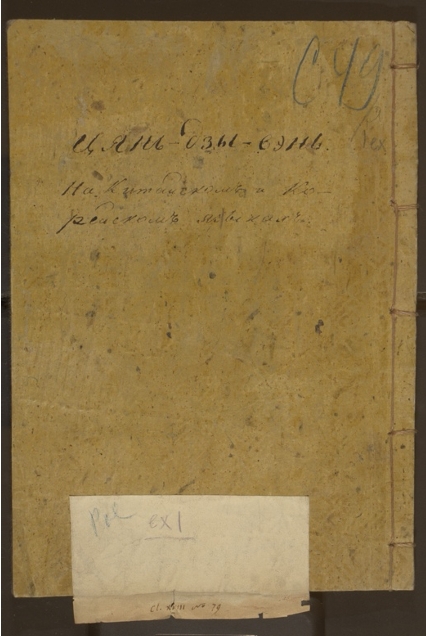
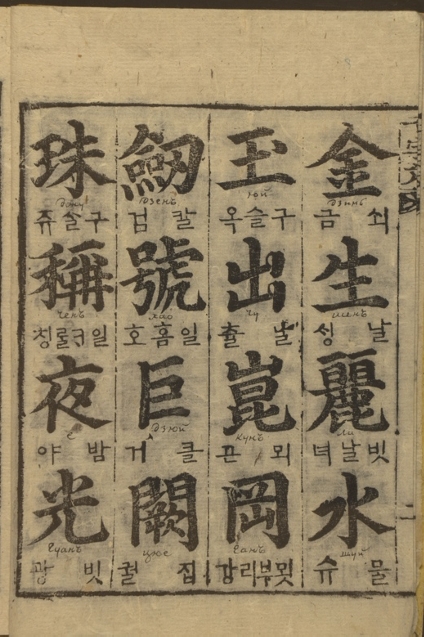
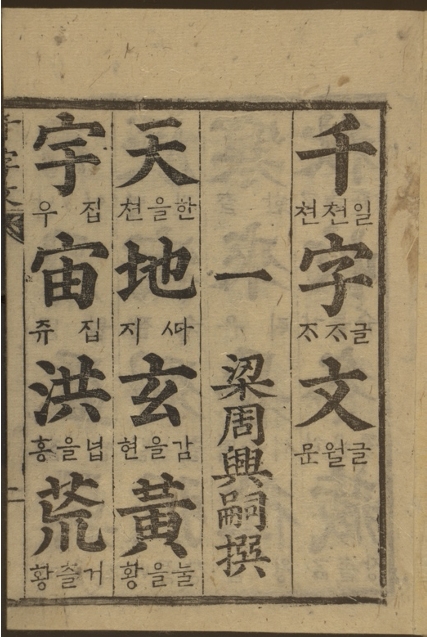
C 49/1ex Ch’ŏnjamun 千字文 “Thousand Character Classic”16 is a popular Chinese primer composed of a thousand unique characters. Xylograph; 26,3´18,5 cm; 32 ff.; Korean paper and binding; Chinese and Korean (
han’gŭl) language; no colophon; no date. Printed from the same blocks as C 49
/2ex and C 49
/3ex. The embossed pattern (large single lotus flowers enclosed in thin rounded vignettes against a background of a diagonal grid of small diamonds) is completely identical to the pattern on the cover of xylographs C 49
/2ex, C 49
/3ex and C 50. There are marginalia in the text (some Chinese characters are accompanied with their Cyrillic transcriptions written in black ink according to the pre-1918 Russian orthography).
The cover bears the Russian inscription “Цянь-дзы-вэнь. На Китайскомъ и Корейскомъ языкахъ [
Tsian’-dzy-ven’. Na Kitaiskom i Koreiskom iazykakh =
Qianzi-wen. In Chinese and Korean language]” and has a paper sticker indicating the number of this book in the Brosset catalogue (Cl. XVIII, No. 79).
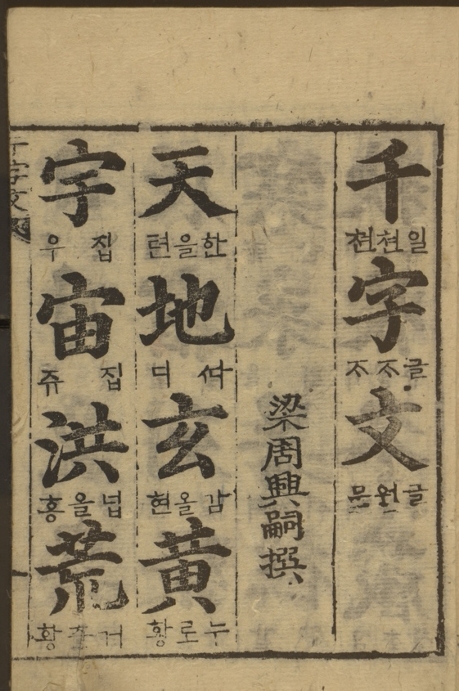
C 49a Ch’ŏnjamun 千字文 “Thousand Character Classic”17. Xylograph; 25,8´18,5 cm; 32 ff.; Korean paper and binding; Chinese and Korean (
han’gŭl) language; no colophon; no date. This edition is identical in content to C 49
/1ex, C 49
/2ex, and C 49
/3ex, but printed from different blocks and with a different cover design (a pattern of alternating four-petal flowers and meanders against a diagonal grid on the front, and a pattern of billowing clouds (?) on the back). The cover bears a paper sticker indicating the number of this book in the Brosset catalogue (Cl. XVIII, No. 80).
C 49/2ex Ch’ŏnjamun 千字文 “Thousand Character Classic”18. Xylograph; 26,8´18,6 cm; 32 ff.; Korean paper and binding; Chinese and Korean (
han’gŭl) language; no colophon; no date. Printed from the same blocks as C 49
/1ex and C 49
/3ex. The pattern on the cover is completely identical to the pattern on the cover of xylographs C 49
/1ex, C 49
/3ex, and C 50. The cover bears a paper sticker indicating the number of this book in the Brosset catalogue (Cl. XVIII, No. 81).
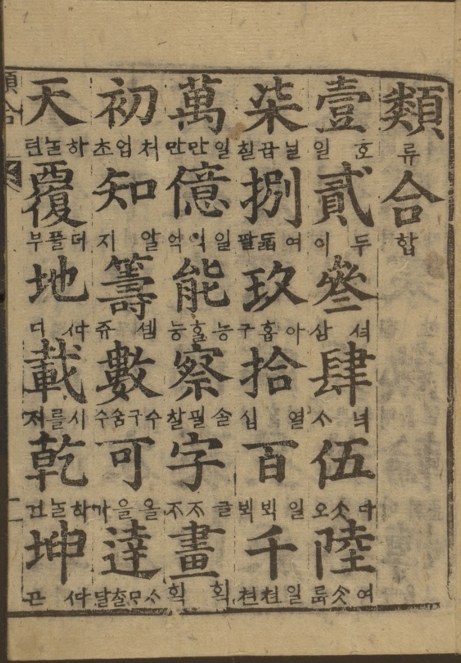
C 50 Yuhap 類合 “Combined Categories”19 is a
hanmun primer for Korean children. Xylograph; 26,3´19,3 cm; 22 ff.; Korean paper and binding; Chinese and Korean (
han’gŭl) language; no colophon; no date. The pattern on the cover is completely identical to the pattern on the cover of xylographs C 49
/1ex, C 49
/2ex, and C 49
/3ex. The cover bears a paper sticker indicating the number of this book in the Brosset catalogue (Cl. XVIII, No. 82).
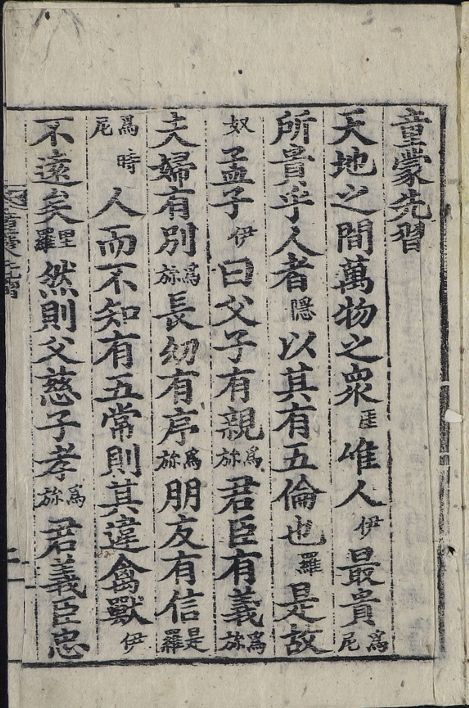
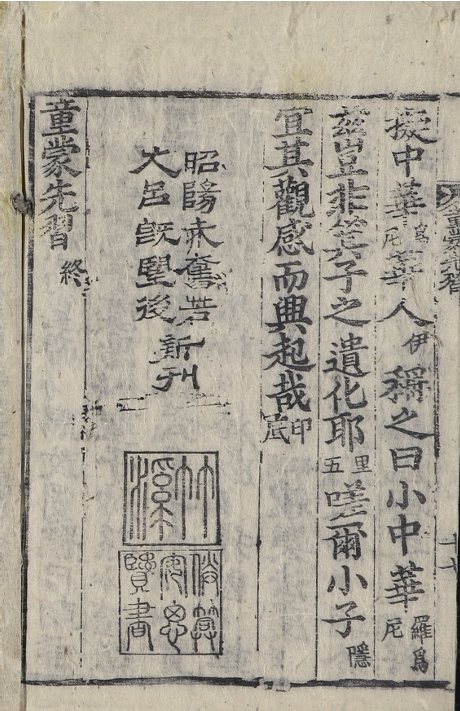
C 64 Tongmong sŏnsŭp 童蒙先習 “Primer for Children”20 is a popular Korean primer containing an exposition of the fundamentals of Confucian ethics, as well as basic information on the history of China and Korea. Xylograph; 27,8´19,2 cm; 17 ff.; Korean paper and binding; Chinese and Korean (
kugyŏl21 glosses) language; printed seals on the last page:
Chuk kye 竹溪 “Bamboo Stream” and
Ing’am An Sahyŏn sŏ 㑞 葊安思賢書 “Written by Ing’am An Sahyŏn;” colophon on the last page:
Soyang chŏkpunyak taeryŏ kimang hu sinp’an 昭陽赤奮若大呂旣望後新判 “Newly published after the sixteenth day of the twelfth month of
kyech’uk year.”
22 The cover design features four-petal flowers in a diagonal grid of meander lines. There are marginalia in the text: some Chinese characters are accompanied with their Cyrillic transcriptions written in black ink according to the pre-1918 Russian orthography, as well as Latin translations. The cover bears a paper sticker indicating the number of this book in the Brosset catalogue (Cl. XVIII, No. 83).
For one more text, the provenance by Ol’ga P. Petrova and Adelaida F. Trotsevich – Anastasiia A. Gur’eva is quite probable, although not documented:
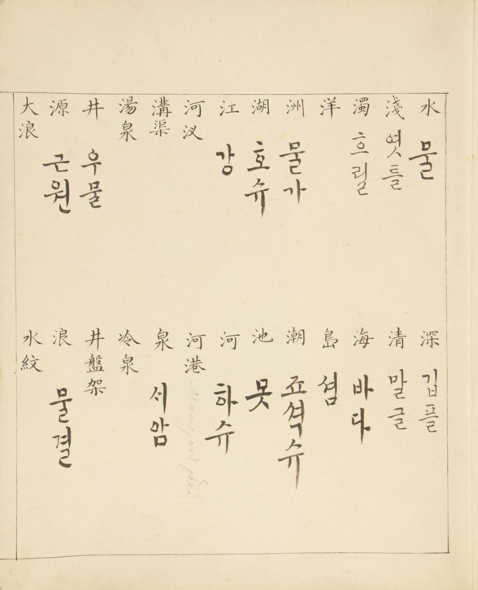
D 75 [untitled]23 : a list of Chinese words and phrases by categories. Manuscript; 30´26,2 cm; 65 ff.; Chinese paper and binding; Chinese and Korean (
han’gŭl) language; no colophon; no date. The thin grey paper cover has no design. There are marginalia in the text (some Chinese words are accompanied by their Korean translations in ink and Russian translations in pencil, written according to the pre-1918 Russian orthography). The bottom edge of the front cover (where other books would have the Brosset catalogue number sticker) is torn off and lost
24. However, it is highly probable that this book belongs to the “Brosset Collection,” as the contents and technical characteristics of this book match the description in Cl. XVIII, No. 85 of the Brosset catalogue (“Chinese manuscript with some Korean transcriptions at the beginning”),
25 and there are no other books matching this description in the Korean collection of the IOM RAS.
One more text from the collection of the IOM RAS does not have a paper sticker indicating its number in the Brosset catalogue, and there is no entry in this catalogue corresponding to this book, but Ol’ga P. Petrova and Adelaida F. Trotsevich – Anastasiia A. Gur’eva still attribute it to the “Brosset collection:”
C 49/3ex Ch’ŏnjamun 千字文 “Thousand Character Classic”26. Xylograph; 26,8´18,3 cm; 32 ff.; Korean paper and binding; Chinese and Korean (
han’gŭl) language; no colophon; no date. Printed from the same blocks as C 49
/1ex and C 49
/2ex.; the pattern on the cover is completely identical to the pattern on the cover of xylographs C 49
/1ex, C 49
/2ex, and C 50. There are marginalia in the text (some Chinese characters are accompanied with their Cyrillic transcriptions written in black ink according to the pre-1918 Russian orthography). On the first page there is a note in black ink “1922 No. 608” (on C 49
/1ex, C 49
/2ex and other books there is no such note). This book was attributed by Ol’ga P. Petrova to the “Brosset collection” for the reason that this xylograph, as already mentioned, was printed from the same blocks as C 49
/1ex and C 49
/2ex and has the same design on the cover as C 49
/1ex, C 49
/2ex and C 50. However, the marginalia in its text do not look like the marginalia in C 49
/1ex, because they are written in a more careless handwriting, and the transcription system used in it is different: for example, the same Chinese voiced affricate
zh in C 49
/1ex is regularly transcribed as
дж [
dzh], and in C 49
/3ex—as чж [
chzh]. Incidentally, the transcription systems in the marginalia of C 49
/1ex and C 49
/3ex differ from both currently accepted Cyrillic systems (Palladius system and Bichurin’s system
27), which may indicate that these notes were made before 1835. It can be assumed that the xylograph C 49
/3ex entered the collection of the Asiatic Museum together with C 49
/1ex, C 49
/2ex and C 50, but for some reason (since it was the third copy of the same book?) this book was not catalogued by Brosset and continued its “autonomous existence” at least until 1922 (mentioned in the note on its first page). However, since this book is absent from Brosset’s catalogue, we will nevertheless exclude it from our further study, with the caveat that this xylograph does not yield any information that could contradict our conclusions on the “Brosset collection” as a whole.
One book, unfortunately, is mistakenly identified in both printed catalogues of the Korean collection of the IOM RAS—namely, a text entitled
Kogŭm yŏktae p’yoje chusŏk sipku saryak t’onggo 古今歷代標題註釋十九史略通攷 “A General Overview of the Nineteen Histories in Brief, [Covering] the Main Topics of the Historical Eras of Ancient and Modern Times with Explanation and Commentary”. This is a historical work in nine volumes, featuring a condensed account of the events of Chinese history by “topics” (periods of the reigns of emperors). The Korean collection of the IOM RAS has two incomplete copies of this book, printed from different blocks: one with the call number D 73 (only the first volume), and the other with the call number C 43 (only the first and second volumes). Their covers bear the stamp of the Asiatic Museum of the Russian Academy of Sciences probably affixed in the early 1920s.
28 In the “Из колл. [
Iz koll. = From the Collection]” section of this stamp, there is the handwritten mark “Bross [Brosset]” on D 73 and “Астон [Aston]”
29 on C 43. This provenance is reproduced by Ol’ga P. Petrova and Adelaida F. Trotsevich – Anastasiia A. Gur’eva in their publications
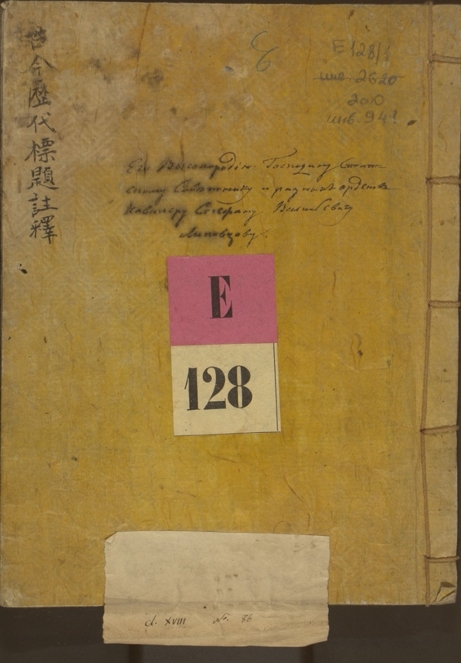
30. However, in Brosset’s catalogue the title of this book has the note “E 128.” This call number refers to another edition of this text until recently kept in the collection of the Chinese xylographs at the IOM RAS
31 with the call number E 128 (xylograph; 26,8´19,3 cm; 59 ff; Korean paper and binding; Chinese language; no colophon; no date). The cover design features circles with flowers inside them against a background of complex diagonal grid. The copy is incomplete (only the first volume). There are marginalia in the text written in black ink (a Cyrillic transcription of one name and a Manchu translation of one passage). The cover bears the inscription: “Его Высокородiю Господину Статскому Совѣтнику и разныхъ орденовъ Кавалеру Стефану Васильевичу Липовцову [
Ego Vysokorodiiu Gospodinu Statskomu Sovetniku i raznykh ordenov Kavaleru Stefanu Vasil’evichu Lipovtsovu = To His High Born the Lord State Councilor and Chevalier of Various Orders Stefan Vasil’evich Lipovtsov].” There is the stamp of the Asiatic Museum of the Russian Academy of Sciences (in the “Из колл. [
Iz koll. = From the Collection]” section, “Br [Brosset]” is indicated, and below it is written the old call number —XVIII 86). The cover bears a paper sticker indicating the number of this book in the Brosset catalogue (Cl. XVIII, No. 86). Thus, we can conclude that the entry in Brosset’s catalogue, No. 86, refers to this copy of this work. Following our research, this xylograph was transferred to the Korean collection of the IOM RAS with the call number
E 128/1.
Thus, only three entries from Brosset’s catalogue remain unidentified:
Cl. XVIII, No. 78: “The Korean alphabet and the Lord’s Prayer in Korean with transcription;”
Cl. XVIII, No. 84: “A book written entirely in Korean script;”
[Unnumbered]: “6 unidentified Japanese and Korean books.”
The “unidentified Japanese and Korean books,” unfortunately, truly cannot be identified, as Brosset did not assign them individual numbers in his catalogue. Consequently, these books do not have stickers that would allow them to be identified among the Korean texts in the collection of the IOM RAS. It can be only assumed that these books were written exclusively in the Korean script (without the use of Chinese characters); otherwise, Brosset would have been able to translate or at least transcribe their titles according to Chinese pronunciation and create individual entries for them in his catalogue.
The other two books, by contrast, should have had numbered stickers, making them identifiable. Having checked
de visu the entire Korean collection of the IOM RAS, we noticed on the cover of one of the books a characteristic sticker with the number according to the Brosset catalogue (Cl. XVIII, No. 84) clearly proving that this is the very same “book written entirely in Koreanscript” which is mentioned in the catalogue as Cl. XVIII, No. 84. This is
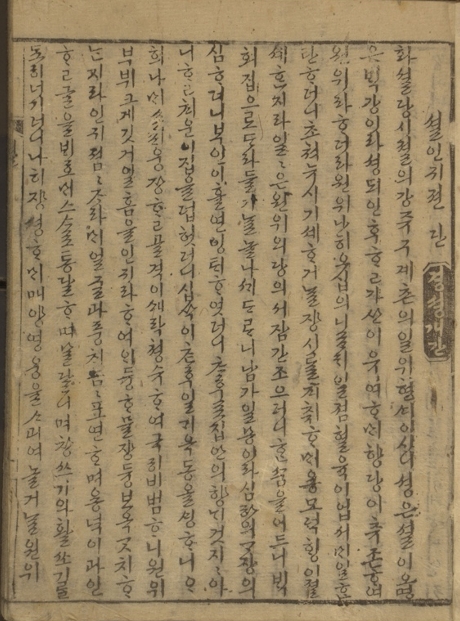
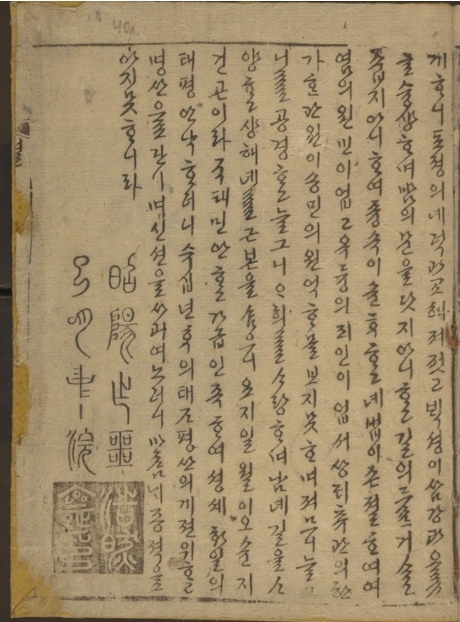
C 52 Syŏl In’gwi chyŏn tan 셜인귀젼단 “The Tale of Xue Rengui. In one [volume]”32—a cheap woodblock edition of the Korean story about Tang general Xue Rengui 薛仁貴 (614–683).
Xylograph; 26,8´20 cm; 40 ff.; Korean paper and binding; Korean (
han’gŭl) language; printed seal on the last page:
Hwaryŏnje in 浩然齋印 “Seal of Hwaryŏnje”; colophon on the first page:
Kyŏngsyŏng kaegan “Reprinted in the capital;” colophon on the last page:
Soyang chakkang sawŏl chungwan 昭陽作畺 巳月中浣 “Second decade of the fourth month of
kyehae year.”
33 The cover design features a braided pattern of double diagonal lines.
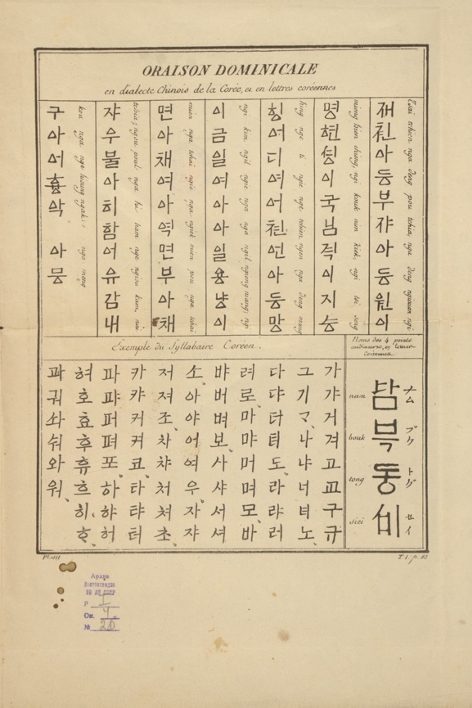
Furthermore, in the Archives of the Orientalists of the IOM RAS, we found a document which bears a sticker with the Brosset catalogue number (Cl. XVIII, No. 78). This is
r. 1, op. 4, ed. khr. 20: a sheet of paper with five tables containing examples of Korean writing (lithography; 35´54 cm; 1 f.; European paper, no binding; Chinese (in
han’gŭl transcription) and Korean (
han’gŭl) language; no colophon; no date). The tables contain: (1) a list of Korean vowels and consonants; (2) a transcription table of the Japanese syllabary in Korean letters; (3) a Chinese translation of the Lord’s Prayer in Korean pronunciation; (4) examples of consonant-vowel combinations; (5) and the Chinese names of the cardinal directions in Korean pronunciation. Whoever produced these tables clearly didn’t know Korean, as the letters in some tables are distorted beyond recognition (for example, the letter ㄹ
l/r often appears as 区). At the bottom of the first page are the technical notes “Pl. II” and “T. 1 p. 84,” and at the bottom of the second page are notes “Pl. III” and “T. 1 p. 85.”
To summarize, let us present the aforementioned data as a
table:
Commenting on this table, we can note that the five woodblock editions of Korean primers listed successively in Brosset’s catalogue (Cl. XVIII, nos. 79–83) likely form a single subcollection with a common history, because:
1) most of these xylographs were printed in the same place at approximately the same time (C 49/1ex and C 49/2ex were printed from the same blocks, and C 49/1ex, C 49/2ex, and C 50 have completely identical cover designs);
2) this small subcollection is homogeneous (all the manuscripts are bilingual Chinese-Korean elementary-level primers).
Furthermore, manuscript D 75, containing Chinese vocabulary with selected Korean translations (if its identification with Cl. XVIII, No. 85 is correct), is thematically and functionally very close to this “educational” subcollection.
The Original Russian Owners of These Books
Having identified the texts mentioned in Brosset’s catalogue with the books presently kept in the IOM RAS collection, we can now try to ascertain out the names of their original owners.
Some information about them is contained within Brosset’s catalogue itself:
— entry Cl. XVIII, No. 84 (relating to xylograph C 52) has the note “Sch. II,” indicating that this book originated from the second Schilling’s collection, which entered the Asiatic Museum in 1838;
— a later entry Cl. XVIII, No. 86 (relating to xylograph E 128/1) has the note “Lip,” indicating that this book originated from the Lipovtsov’s library, which entered the Asiatic Museum in 1842 (the provenance of this book is further confirmed by the dedicatory inscription on the cover).
At this point, it is necessary to say at least a few words about the two collectors mentioned. Baron Paul Schilling von Cannstatt (Rus: Павел Львович Шиллинг, Pavel L’vovich Shilling; 1786–1837) was a renowned diplomat, natural scientist
35, and orientalist. His scholarly interests were formed during his diplomatic service in Munich (1803–1812) and his stay in Paris with the Russian army in 1814–1815, when he established contacts with European scholars. After being discharged from the army, he joined the Asian Department of the Ministry of Foreign Affairs and in 1828 was elected a corresponding member of the Imperial Academy of Sciences. In 1830, he sold his first book collection to the state, and those books entered the Asiatic Museum in 1835. In 1830–1832 Schilling organized a scientific expedition to Transbaikalia. Among its members was the distinguished Russian sinologist Nikita Iakovlevich Bichurin (Archimandrite Hyacinth, or Iakinf; 1777–1853), a close friend of Schilling. The second book collection assembled by Schilling in Siberia was sold to the state after his death and entered the Asiatic Museum in 1838.
36
Stepan Vasil’evich Lipovtsov (1770–1841) was a graduate of the Kazan Theological Seminary and a student of the Eighth Spiritual Mission in Beijing (1794–1807).
37 After returning from China in 1808, he entered service in the Asian Department. Lipovtsov was a distinguished scholar of Manchu and Chinese, a translator from and into Manchu, the author of the
Manchu Dictionary and the compiler of a catalogue of Chinese and Japanese books at the library of the Academy of Sciences (the latter publication was co-authored with his colleague and fellow student on the Eighth Mission, Pavel Ivanovich Kamenskii, 1765–1845). Lipovtsov’s scholarly achievements were recognized by his election to the Academy of Sciences. After his death, his book collection was transferred to the Asiatic Museum in 1842.
38
In addition to the references in the catalogue, some information about the books from the “Brosset collection” can be found in the documents in the Archives of Orientalists of the IOM RAS. The chronological interval of our archival search was defined within the boundaries of 1803–1842, because the last identifiable Korean book from the Brosset catalogue (xylograph E 128/1 from the collection of Lipovtsov) entered the Asiatic Museum in 1842, and the earliest possible date of the appearance of these books in Russia can be considered 1803 (the colophon of the latest dated xylograph in this collection, C 52, mentions the year kyehae 癸亥, that is, 1803/1804). As a result of our research, we found several references to books whose titles match those of Korean books from the “Brosset Collection:”
1. Cards from the handwritten card index of the Schilling collection:
39
— Card No. 213: 童蒙先習 [Tongmong sŏnsŭp] The identification with the Korean xylograph C 64 is indisputable, as this is the only book with this title in the IOM RAS;
— Card No. 205: “千字文 Тысячу литеръ [Qian zi wen; Tysiachu liter = Thousand Characters]” (the upper right corner of the card bears the note: “Цзины [Jing = Classics]”). Identification with one of the Korean xylographs of this name (C 49/1ex, C 49/2ex, or C 49a) is quite probable, although it cannot be ruled out that this refers to some Chinese edition of this book;
— Card No. 209: “古今歷代 Хронологiя [Kogŭm yŏktae; Khronologiia = Chronology]” (the upper right corner of the card bears the note: “Исторiя [Istoriia = History]”). As already mentioned, in the collection of the IOM RAS are three Korean xylographs of this name (D 73, C 43, and E 128/1), all incomplete and all undated. Of these, E 128/1 belongs to the “Brosset collection,” but it undoubtedly entered the Asiatic Museum from the library of Lipovtsov, not Schilling. It is possible that this card refers to another copy of the same text (perhaps D 73, the origin of which is unknown), but it is unlikely that two different editions of the same Chinese historical book entered the Asiatic Museum almost simultaneously, both from Korea—a country that at the time maintained virtually no contact with the outside world. Likely we’re dealing here with a simple technical error on the part of the cataloguer, but this is, of course, just a hypothesis.
2. Entry No. 3 in the section “Дефекты [
Defekty = Defects]” of the handwritten catalogue of Chinese, Manchu, Mongolian, and Japanese books from the library of Schilling:
40 “Цянь цзы вынь. Тысяча буквъ [
Tsian’ tszy vyn’. Tysiacha bukv =
Qian zi wen. A thousand letters]”. Identification with any of the Korean editions of this book (C 49
/1ex, C 49
/2ex or C 49
a) is possible, but questionable, since this book is listed in the “Defects” section, but the state of preservation of those Korean xylographs is very good even nowadays.
1) Cl. XVIII, No. 82 (C 50: Yuhap). Considering that this book (1) belongs to a subcollection of woodblock editions of bilingual (Chinese-Korean) primers printed in Korea; and (2) one xylograph from this subcollection undoubtedly originates from the library of Schilling, it can be assumed that this book also belonged to this scholar;
2) Cl. XVIII, No. 78 (R. I, op. 4, ed. khr. 20: five lithographed tables containing examples of Korean writing). Since Schilling devoted much attention to the study of Eastern writing systems and technical developments in lithography, it seems highly likely that this lithographed sheet with samples of Korean inscriptions also belonged to him (and may even have been printed by him);
3) Cl. XVIII, No. 85 (probably D 75: Chinese words and phrases with Korean translations). Given the functional similarity of this manuscript to the bilingual Chinese-Korean primers from Schilling’s collection, it can be assumed that it also originated from that collection.
Therefore, we can conclude that the texts catalogued by Brosset likely came to the Asiatic Museum from just two collectors: eight texts from Schilling (Nos. 83, 84—certainly; Nos. 78–82, 85—presumably) and one more from Lipovtsov (No. 86—certainly).
The Journey of These Books from Korea to Russia
Having identified the previous owners of the “Brosset collection,” now we need to figure out how these books could have come into their possession. Starting with Schilling’s collection, we will first attempt to reconstruct the history of a group of bilingual Sino-Korean primers published in Korea (Nos. 79–83 according to the Brosset catalogue, i.e., C 49/1ex, C 49a, C 49/2ex, C 50, and C 64). As already mentioned, these books likely form a single subcollection, and some of them undoubtedly (and others presumably) originate from Schilling’s library.
The easiest way to solve this problem is to start from the very end, that is, to find out where these books could have been originally acquired. We can assume that these xylographs most likely have been purchased in Korea, as they were printed there and, judging by their content (bilingual Chinese-Korean elementary primers), were clearly not intended for export.
Who could have been the original buyer of these books? Most probably it was Korean, as the country at that time (the early 19th century) was completely closed to foreigners.
How did these xylographs leave the country? At that time Korea maintained close diplomatic contacts with China, and the majority of Koreans who were allowed to leave the country were members of embassies to Beijing. Therefore, we can assume that the route of these xylographs from Korea to the Asiatic Museum passed through China, and these books were probably brought to Beijing by a Korean diplomat.
This assumption prompts the following question: why did this Korean official purchase these books in his homeland and take them to China? Given their contents, he clearly had no need for them himself (in that era, diplomats did not bring their families with them), and so he likely purchased them and brought them to China as a commission from someone else.
Who could this commissioner have been? It could not have been Schilling himself, as he had never been to China. Therefore, there must have been some intermediary between the Korean diplomat and Schilling. It is highly likely that the intermediate owner of these xylographs was one of the staff members of the Russian Spiritual Mission in Beijing, as they were the only ones who had direct contact with both Schilling and the Korean diplomats. It is known that during his Siberian expedition, Schilling, “making advantage of a change of the staff of the Spiritual Mission, was intending to order from Beijing many scholarly books in Chinese, Manchu, Mongolian, and Tibetan.”
41 This proves that he had direct contact with members of the Spiritual Mission, which allowed him to order the required books from China through them. On the other hand, there is also ample documentary evidence that in the 17
th –19
th centuries Russian Spiritual Mission staff were in constant contact with Korean diplomats stationed in Beijing
42.
Why did the intermediate owner of these books order them from Korea? He could, of course, have done so at the request of Schilling, having little interest in the contents of the books. Another possibility, however, is that this person was interested in Korea and the Korean language and needed these books for himself (perhaps as teaching aids), and only later passed this small collection on to Schilling. This latter supposition is proved by the fact that two of the collection’s xylographs (C 64 and C 49/1ex) have Cyrillic marginalia written in ink, which could not have been made by visitors to the Asiatic Museum (since it is unlikely that any of them would have used ink to write in library books) or by Schilling (who, as far as we can judge from the archival materials available to us, used a Latin-based transcription). Therefore, we can conclude that the author of these marginalia was the original owner of the books, who acquired them for himself in order to study Korean. Furthermore, manuscript D 75 (a Chinese vocabulary, written in a Chinese-made notebook with selected Korean translations and Russian marginalia), which is probably part of this subcollection, is visible evidence that a certain Russian in China took lessons from native Chinese and Korean speakers there.
If these primers were indeed originally ordered from Korea by a member of the Spiritual Mission who was attempting to learn Korean, then who could have been this first Korean studies scholar in Russia? Summarizing the facts and conclusions we have listed above, we can say that this scholar:
—stayed in Beijing between 1803/1804 and 1837 (that is, between the year of publication of xylograph C 52 and the year of Schilling’s death);
—interacted with Korean diplomats there;
—ordered books from Korea through them;
—knew literary Chinese and attempted to studied Korean;
—was acquainted with Schilling.
This can be only one person—the aforementioned Nikita Iakovlevich Bichurin, head of the Ninth Spiritual Mission in Beijing (1808–1821) and a close friend of Schilling. Bichurin graduated from the Kazan Theological Academy in 1799 and was appointed to Beijing in 1808. During his stay in China, he mastered the Chinese language, collected an excellent library, and devoted himself to the study and translation of Chinese sources on the geography, history, and political situation of China and neighboring countries. Upon his return to Russia in 1821, he was put on trial for neglect of missionary affairs and spent 1823–1826 in exile at a monastery on Valaam Island, where, however, he continued his scholarly work. With the assistance of Schilling, he was transferred to the Saint Alexander Nevsky Lavra in St. Petersburg and joined the staff of the Asian Department. In the following years, also with the support of Schilling, he began publishing his numerous translations and research papers. In 1828, simultaneously with Schilling, Bichurin was elected to the Academy of Sciences. In 1830, Schilling secured Bichurin’s inclusion in his Siberian expedition, which allowed Bichurin to visit the Russian-Chinese border in Kyakhta. In 1835, also with the assistance of Schilling, Bichurin received permission for another trip to Kyakhta
43.
There is indirect documentary evidence that Bichurin was indeed the original owner of these books and ordered them from Korea for the purpose of studying the Korean language. First of all, there is the correspondence between Bichurin and Korean diplomats, kept at the IOM RAS, which was recently identified and studied by the Chinese researcher Yan Minxiang
44. These documents include handwritten copies of a written conversation (1 text) and personal correspondence (19 texts) between He Zhi’an 和直庵 (Bichurin) and the Korean envoys Cho Inyŏng 趙寅永, Yi Insu 李麟秀, Yi Pŏnsu 李藩秀, Yi Haksu 李鶴秀, and Yi Chowŏn 李肇源
45, as well as the originals of 5 those letters
46. Some of the letters (Nova C 56, Nos. 2, 4, 6, 7, 11, 13) have dates corresponding to 1817–1821
47. It should be noted that in one of these letters (Nova C 56, No. 16), Bichurin directly asks his Korean correspondent, Yi Insu, to show him the famous Korean medical encyclopedia,
Tongŭi pogam 東醫寶鑒 “
The Precious Mirror of Eastern Medicine” (. In his reply (Nova C 56, No. 6), Yi Insu apologizes for not having brought this book from Korea, since, as far as he knows, it had already been printed in China. Thus, Bichurin not only maintained close friendly relations with Korean diplomats, but also ordered literature from Korea through them.
Moreover, in the letter from Bichurin to the Most Holy Synod (1810), there is a direct mention that he is studying the Korean language: “Time allows me to study, in addition to Chinese and Manchu, also Mungal [Mongolian], Tibetan and Korean.”
48
Finally, we have direct evidence that Bichurin once owned one of those xylographs—namely, C 49
/1ex, the cover of which bears an inscription in the Bichurin’s handwriting. In addition, there are marginalia in this book, which are Cyrillic transcriptions of Chinese characters in Mandarin pronunciation. These notes were made in an unsettled
49 transcription system and have obvious errors
50. This transcription does not comply not only with the modern Palladius system, but also with Bichurin’s system published in 1835
51—the first standard system of Cyrillic transcription of the Chinese language. Therefore, we can assume that these marginalia were added to the text by a Russian-speaking sinologist, likely before 1835. The small volume of these notes makes it impossible to identify their author, but the handwriting does not clearly differ from Bichurin’s. These notes may well be evidence of Bichurin’s work with this book early in his scholarly career.
If our hypothesis that the original owner of xylograph C 49/1ex was Bichurin is correct, then we can assume that not only this book but also the entire subcollection of bilingual Sino-Korean textbooks (Cl. XVIII, Nos. 79–83, i.e., C 49/1ex, C 49a, C 49/2ex, C 50, C 64, and possibly D 75) originate from Bichurin’s library.
The marginalia found in two of these texts indirectly prove this hypothesis:
—in xylograph C 64, individual characters are accompanied by Cyrillic transcriptions and/or Latin translations, suggesting that their author was a Russian-speaking sinologist fluent in Latin, and that he possibly worked at a time when fullfledged Chinese-Russian dictionaries did not yet exist
52;
—in manuscript D 75, Russian translations of several words and expressions are added, which means that it was a Russian language speaker who used this manuscript.
In both cases, the volume of the marginalia is insufficient for a precise identification of the author by handwriting, but there are no obvious differences from Bichurin’s handwriting.
Therefore, we can assume that xylographs C 49/1ex, C 49a, C 49/2ex, C 50, and C 64 were most likely brought from Korea to Beijing by order of someone from the Russian Spiritual Mission, most likely Bichurin. In Beijing, this small collection was joined by the Sino-Korean vocabulary D 75, which may have served as Bichurin’s workbook for learning Chinese and Korean.
As for the two remaining texts from Schilling’s collection, we can assume that the lithographed collection of Korean script samples (R. I, op. 4, ed. khr. 20) was likely added to this collection in St. Petersburg and was possibly printed by Schilling himself. The origin of xylograph C 52 cannot be traced, because its content and cover design differ greatly from the rest of Korean books in Schilling’s collection, and there are no marginalia in this book. This xylograph could well have been ordered by Bichurin along with primers as a teaching aid, but it could also have been commissioned by Schilling in Korea through the Russian Spiritual Mission in Beijing.
In conclusion, we now attempt to ascertain the history of the Chinese-language xylograph E 128
/1 (Cl. XVIII, No. 86), which, as we already know, entered the Asiatic Museum from the collection of Lipovtsov in 1842. Unfortunately, we do not have any documentary materials that could shed light on the circumstances of its acquisition by Lipovtsov, and therefore we can only limit ourselves to the conclusion that, judging by the dedicatory inscription on its cover, this book was given to Lipovtsov much later than 1818
53 by a certain Russian-speaking donor, who most likely received it directly from the Koreans, since he knew (and told Lipovtsov, from whom this information passed to Brosset) that this book was published in Korea
54.
Unfortunately, the donor’s identity is unknown, as he does not mention his name in the dedicatory inscription. It is unlikely that it was Bichurin, as the handwriting on the inscription differs significantly from his
55. It is possible that this book was given to Lipovtsov by his close friend, fellow student at the Eighth Spiritual Mission (1794–1808), and colleague in the Asian Department, Pavel Ivanovich Kamenskii (Archimandrite Petr, 1765–1845), who, after taking monastic vows, headed the Tenth Spiritual Mission in Beijing (1821–1830)—in any case, the handwriting on this inscription bears some resemblance to that of Kamenskii. We don’t know where this unknown donor acquired this xylograph, but if he was a staff member of the Spiritual Mission, he could well have received the book from a Korean diplomat who took it with him from Korea to Beijing for his own use as a convenient and compact reference book on Chinese history. A deliberate order for this book from Korea is unlikely, as it is a Chinese text, which would naturally have been much easier to acquire in China.
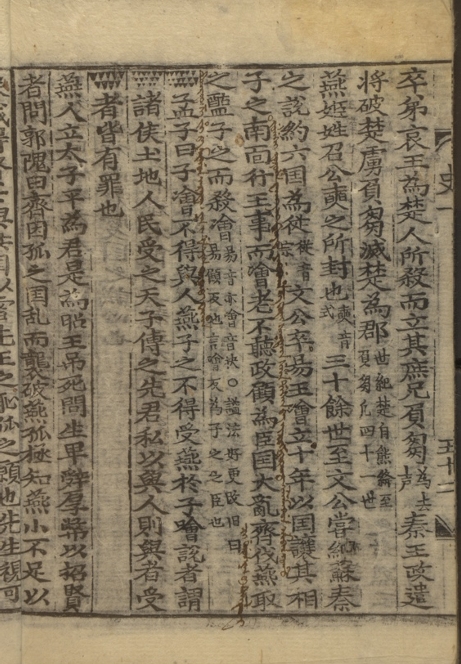
It should be noted that this book has marginalia probably made by a Russian researcher who knew Chinese and Manchu and was interested in the political doctrine of Confucianism: on f. 52b, between the lines, is written a Manchu translation of a passage that tells how King Kuai 噲 (320–312 BC) of Yan 燕 yielded the throne to his minister Zizhi 子之 and thereby almost ruined his state
56, and on the margins of f. 23a is a Cyrillic transcription of the Chinese pronunciation of the name 伯嚭 — “
Бопи [
Bo Pi].”
Conclusions
The so-called “Brosset collection” incudes nine books which are probably the first Korean books in Russia and among the first Korean texts available to European scholars. Most of these books are written entirely in Chinese or are bilingual (Chinese-Korean).
Of these texts, eight (Cl. XVIII, Nos. 78–84, 86) can be safely identified with books and documents currently stored at the IOM RAS (call numbers R. I, op. 4, ed. khr 20; C 49/1ex; C 49a; C 49/2ex; C 50; C 64; C 52; E 128/1), and one (Cl. XVIII, No. 85) can be identified tentatively (call number D 75). The woodblock editions of Korean primers (C 49/1ex; C 49a; C 49/2ex; C 50; C 64) most likely form a single subcollection; it is possible that a handwritten Chinese vocabulary with Korean translations (D 75, if its identification with Cl. XVIII, no. 85 is correct) also belongs to this subcollection.
The Brosset catalogue sheds light on the provenance of two books (C 52—from Schilling’s second collection, E 128/1—from Lipovtsov’s collection). Furthermore, archival documents clearly establish the provenance of xylograph C 64 (and presumably xylographs C 49/1ex, C 49a, or C 49/2ex) as coming from Schilling’s collection. We have no documentary evidence for the three remaining texts (R. I, op. 4, ed. khr 20; C 50; D 75), but indirect evidence suggests that they also originated from the Schilling’s collection.
Woodblock editions of Korean primers (C 49/1ex; C 49a; C 49/2ex; C 50; C 64) were most likely given to Schilling by a member of the Russian Spiritual Mission in Beijing, who ordered these books from Korea (it is highly likely that it was Bichurin, and that he ordered them for his own use). The origin of the xylograph C 52 cannot be traced beyond Schilling’s collection, but most likely Schilling also got this book through the Russian Spiritual Mission in Beijing. The handwritten Chinese-Korean vocabulary (D 75—if its identification with Cl. XVIII, No. 85 is correct) was most likely written in Beijing and may have been an improvised textbook used by Bichurin to study Chinese and Korean. The lithographed sheet of a European edition with samples of Korean writing (R. I, op. 4, ed. khr 20) was most likely added to these Korean books in St. Petersburg. Xylograph E 128/1 was received by Lipovtsov during his years of service in the Asian Department from an unknown donor (possibly from Kamenskii).
Notes
Figure 1.front cover with Bichurin’s inscription in Russian and a paper sticker indicating the number of this book in the Brosset catalogue.
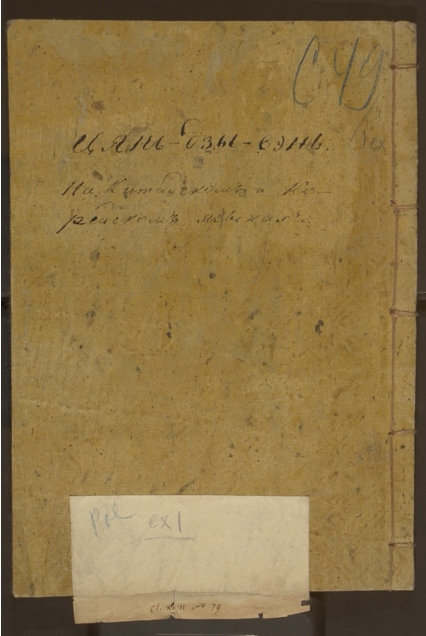
Figure 2.
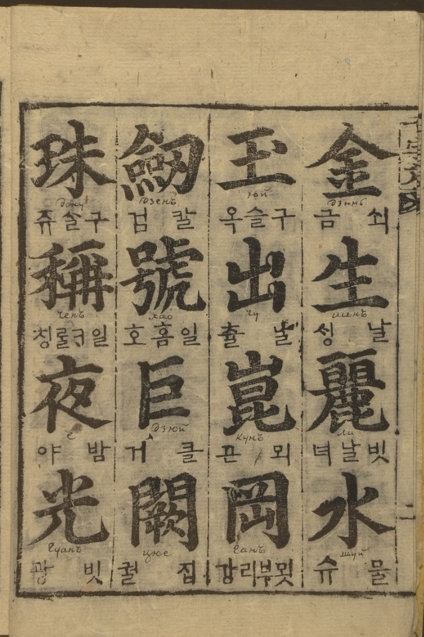
Figure 3.with the title of the book and the name of its author.
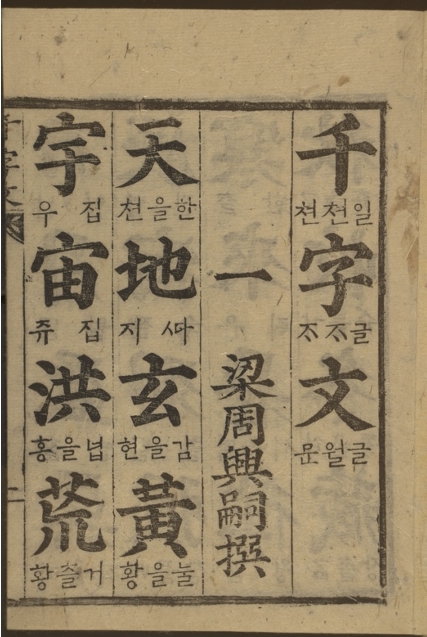
Figure 4.with the title of the book and the name of its author.
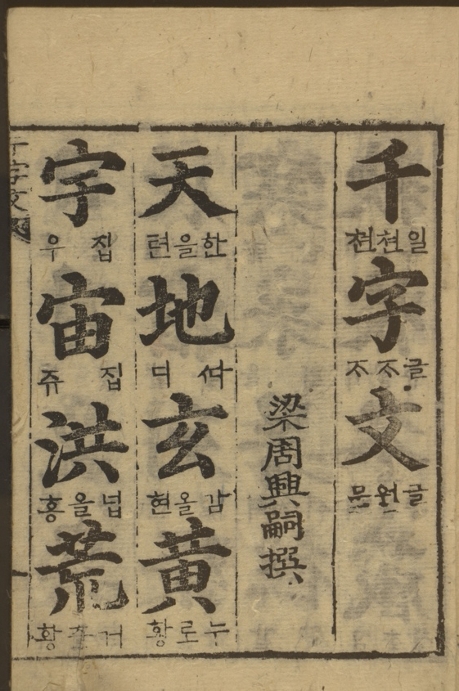
Figure 5.with the title of the book.
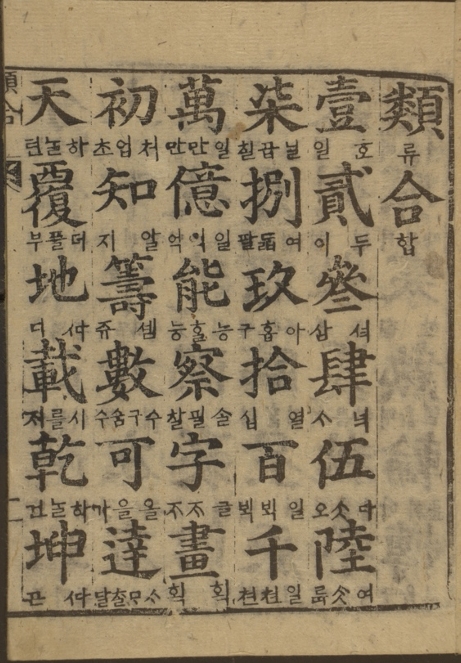
Figure 6.with the title of the book.
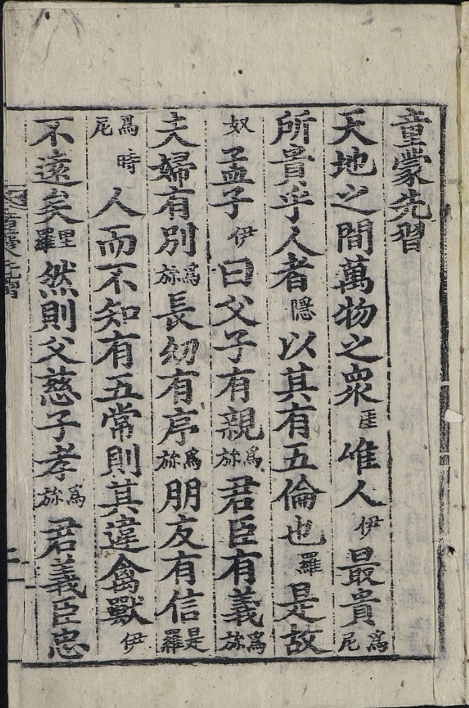
Figure 7.with the title, colophon and seals.
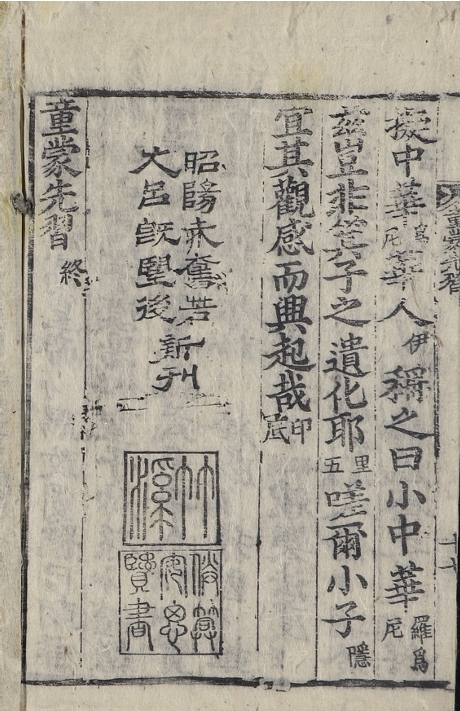
Figure 8.with Korean translations of Chinese words and Russian marginalia.
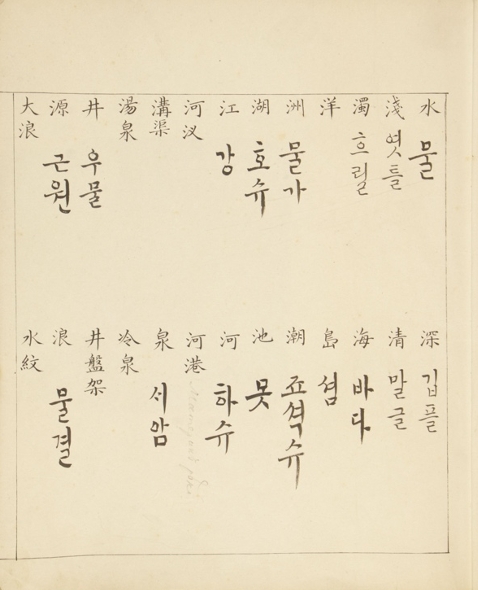
Figure 9.front cover with the title of the book, dedication inscription and a paper sticker indicating the number of this book in the Brosset catalogue.
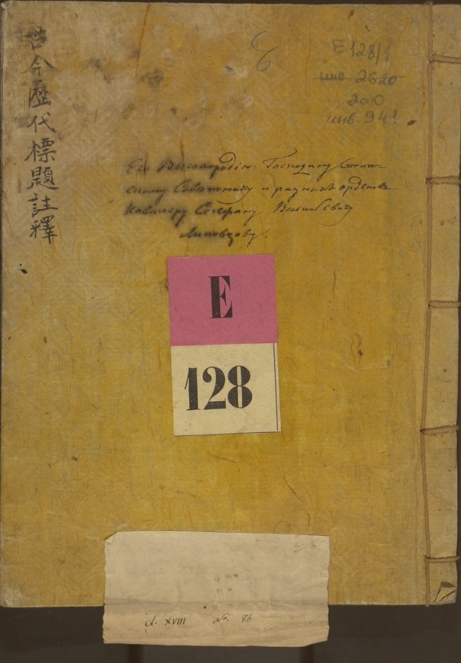
Figure 10.
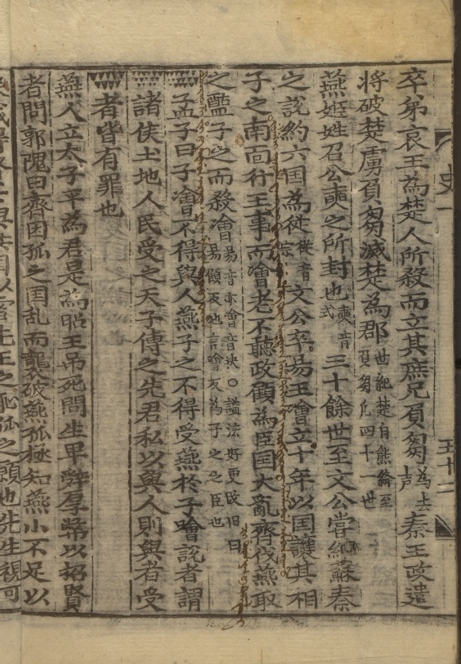
Figure 11.with the title and colophon.
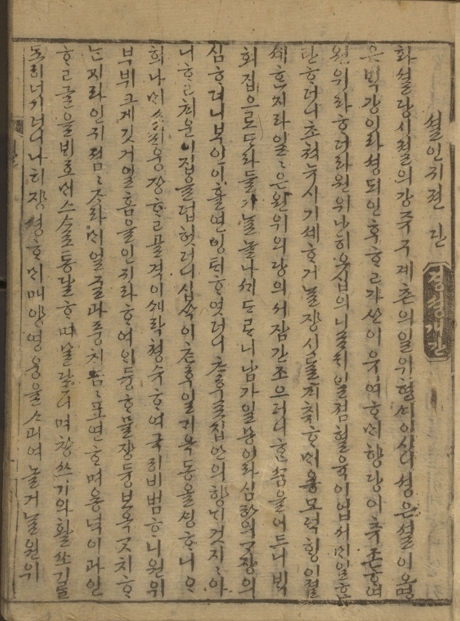
Figure 12.with the colophon and seal.
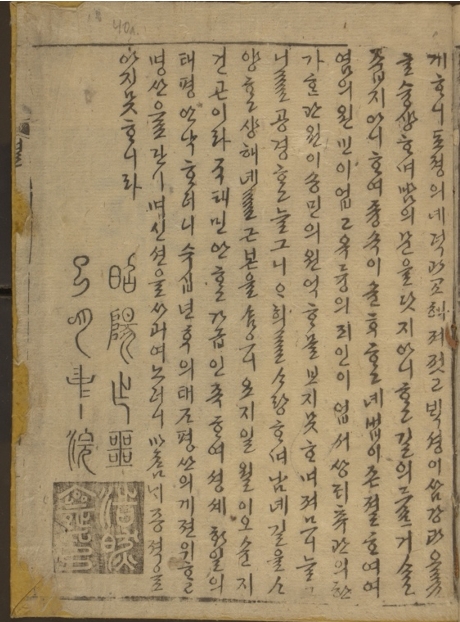
Figure 13.the right part of the sheet with a Chinese translation of the Lord’s Prayer in Korean pronunciation, examples of consonant-vowel combinations, and the Chinese names of the cardinal directions in Korean pronunciation.
To summarize, let us present the aforementioned data as a table:
|
Brosset catalogue number |
Brosset catalogue title (in English translation; transcriptions are corrected) |
Storage location |
Call number |
Title |
Type of edition |
Colophon date |
|
Cl. XVIII, No. 78 |
The Korean alphabet and the Lord’s Prayer in Korean with transcription |
Archives of the Orientalists of the IOM RAS |
R. 1, op. 4, ed. khr. 20 |
[Five tables containing examples of Korean writing] |
Lithography; European paper, no binding |
— |
|
Cl. XVIII, No. 79 |
Thousand Character Classic, written in Chinese and Korean script |
Korean collection of the Department of Manuscripts and Documents of the IOM RAS |
C 49/1ex
|
Ch’ŏnjamun 千字文 “Thousand Character Classic” |
Xylograph; Korean paper and binding |
— |
|
Cl. XVIII, No. 80 |
Ditto |
Korean collection of the Department of Manuscripts and Documents of the IOM RAS |
C 49а
|
Ch’ŏnjamun 千字文 “Thousand Character Classic” |
Xylograph; Korean paper and binding |
— |
|
Cl. XVIII, No. 81 |
The same book—Qian zi wen / Ch’ŏnjamun
|
Korean collection of the Department of Manuscripts and Documents of the IOM RAS |
C 49/2ex
|
Ch’ŏnjamun 千字文 “Thousand Character Classic” |
Xylograph; Korean paper and binding |
— |
|
Cl. XVIII, No. 82 |
Lei he / Yuhap in Chinese and Korean
|
Korean collection of the Department of Manuscripts and Documents of the IOM RAS |
C 50 |
Yuhap 類合 “Combined Categories” |
Xylograph; Korean paper and binding |
— |
|
Cl. XVIII, No. 83 |
Tong meng xian xi / Tongmong sŏnsŭp
|
Korean collection of the Department of Manuscripts and Documents of the IOM RAS |
C 64 |
Tongmong sŏnsŭp 童蒙先習 “Primer for Children” |
Xylograph; Korean paper and binding |
January 17, 1794 |
|
Cl. XVIII, No. 84 |
A book written entirely in Korean script |
Korean collection of the Department of Manuscripts and Documents of the IOM RAS |
C 52 |
Syŏl Ingwi chyŏn tan 셜인귀젼단 “The Tale of Xue Rengui. In one [volume]” |
Xylograph; Korean paper and binding |
May 31– June 9, 1803 |
|
Cl. XVIII, No. 85 |
Chinese manuscript with some Korean transcriptions at the beginning |
Korean collection of the Department of Manuscripts and Documents of the IOM RAS |
D 75 |
[Chinese words and phrases by categories] |
Manuscript; Chinese paper and binding |
— |
|
Cl. XVIII, No. 8634
|
Gu jin li dai biao ti zhu shi shi jiu shi lue tong kao juan zhi yi / Kogŭm yŏktae p’yoje chusŏk sipku saryak t’onggo kwŏn chi il
|
Korean collection of the Department of Manuscripts and Documents of the IOM RAS |
E 128/1
|
Kogŭm yŏktae p’yoje chusŏk sipku saryak t’onggo 古今歷代標題註釋十九史略通攷 “A General Overview of the Nineteen Histories in Brief, [Covering] the Main Topics of the Historical Eras of Ancient and Modern Times with Explanation and Commentary” |
Xylograph; Korean paper and binding |
— |
|
[Unnumbered] |
6 unidentified Japanese and Korean books |
— |
— |
— |
— |
— |
Reference list
- Iakinf. Han-wen-qi-meng 漢文啓蒙 = Kitaiskaia Grammatika [Chinese Grammar]. St. Petersburg: Gemil’ian Lithography, 1835.
- Iarotskii, Anatolii V. “O deiatel’nosti P. L. Shillinga kak vostokoveda” [On the Activities of P. L. Schilling as an Orientalist]. Ocherki po istorii russkogo vostokovedeniia. Sbornik VI [Studies on the History of Russian Oriental Studies. Issue VI]. Moscow: Vostochnaia Literatura, 1963: 218-253.
- Iodko, Ol’ga V. “Akademiku Marie-Félicité Brosset 190 let” [190th Anniversary of Academician Marie-Félicité Brosset]. Peterburgskoe Vostokovedenie 5 (1994):451-484.
- Jung Byung Sul [Chŏng Pyŏngsŏl]. “Rŏsia Sangt’ŭ-Pet’erŭburŭk’ŭ Tongbanghak Yŏn’guso sojang Han’guk kosŏ ŭi myŏmmyŏt t’ŭkching” [A Study on Korean Rare Books in the Institute of Oriental Manuscripts, Russian Academy of Sciences]. Kyujanggak 43 (2013): 145-166.
- Kamenskii, Pavel, and Stepan Lipovtsov. Katalog Kitaiskim i Iaponskim knigam, v Biblіoteke Imperatorskoi Akademіi Nauk khraniashchimsia [Catalogue of Chinese and Japanese Books Stored in the Library of the Imperial Academy of Sciences]. [Without location, n. d.].
- Nachal’noe obuchenie iunykh otrokov (Tongmong sŏnsŭp) [Primer for Children]. Russian translation by Iuliia V. Boltach; introduction by Iuliia V. Boltach and Elena N. Kondrat’eva. St. Petersburg: Giperion, 2025.
- Petrova, Ol’ga P. Opisanie pis’mennykh pamiatnikov koreiskoi kul’tury [Description of Written Monuments of Korean Culture]. Issue I. Moscow-Leningrad: Izdatel’stvo Akademii Nauk SSSR, 1956.
- _______. Opisanie pis’mennykh pamiatnikov koreiskoi kul’tury [Description of Written Monuments of Korean Culture]. Issue II. Moscow: Izdatel’stvo Vostochnoi Literatury, 1963.
- Simbirtseva, Tat’iana M. “Rossiisko-koreiskie kontakty v Pekine v kontse XVII-seredine XIX vv. (po dnevnikam koreiskikh poslov)” [Russian-Korean Contacts in Beijing in the Late 17th-Mid-19th Centuries (Based on the Diaries of Korean Ambassadors)]. Problemy Dal’nego Vostoka 6 (1998): 84-96.
- Skachkov, Petr E. Ocherki istorii russkogo kitaevedeniia [Essays on the History of Russian Sinology]. Moscow: Nauka— Glavnaia Redaktsiia Vostochnoi Literatury, 1977.
- Trotsevich, Adelaida F., and Gur’eva, Anastasiia A. Opisanie pis’mennykh pamiatnikov koreiskoi traditsionnoi kul’tury. II: Koreiskie pis’mennye pamiatniki v rukopisnom otdele Instituta vostochnykh rukopisei Rossiiskoi akademii nauk [Description of Manuscripts and Block-Prints of Korean Traditional Culture. Part II: Manuscripts and Block-prints in Keeping of the Manuscript Department of the Institute of Oriental Manuscripts, Russian Academy of Sciences]. St. Petersburg: Izdatel’stvo Sankt-Peterburgskogo Universiteta, 2009.
- Vakhtin, Boris B. et al. Katalog fonda kitaiskikh ksilografov Instituta vostokovedeniia AN SSSR [Catalogue of the Chinese xylographs collection of the Institute of Oriental Studies of the USSR Academy of Sciences]. In 3 vols. Moscow: Nauka—Glavnaia Redaktsiia Vostochnoi Literatury, 1973.
- Yan Minxiang. “Novye istochniki o russko-koreiskikh kontaktakh v pervoi chetverti XIX veka” [New Sources on Russian-Korean Contacts in the First Quarter of the 19th Century]. Vestnik NGU. Series: History and Philology 22 No 10: Oriental Studies (2023): 67-76.


 News