Abstract
-
This study examines how the social status of Hanja 漢字 “Sino-Korean characters” and Hanmun 漢文 “Literary Sinitic” has changed within the history of knowledge formation in Korea, focusing on three interrelated layers: shifts in episteme, the reconfiguration of knowledge baselines, and transformations in curriculum discourse. Hanja and Hanmun were marginalized in the context of modern nation-state language policy and the establishment of disciplinary academic systems, but this did not immediately entail the disappearance of their educational value. Rather, Hanja education came to be assigned new goals, such as deepening vocabulary and literacy, facilitating access to historical texts, and cultivating an understanding of the shared written culture of East Asia. At the same time, the ways in which each country and region evaluated and authorized “valuable” knowledge became a key factor in reshaping the respective status of Hanja and Hanmun. The current state of Japanese Chinese Character 漢字 (kanji) and Classical Chinese 漢文 (kanbun) culture and the surrounding school education, serves as a valuable filter and reference to reflect on Korean linguistic practices and to explore the future direction of Korean Classical Chinese漢文 (hanmun) education. In 2010, for the first time in 29 years, Japan established the “Shin Jōyō Kanji” 新常用漢字 (new regular-use kanji) and revised large-scale educational reforms alongside the Course of Study reforms, bringing significant changes to linguistic practices and written life, as well as Classical Chinese education. This paper follows the author’s work from 2011 that examined the achievements and trends of Classical Chinese education research in Japan from 1945 to 2010. This paper examines the direction of Classical Chinese education and the current state of Chinese Character education research over roughly ten years since 2010.
The framework of this research conducted in this paper is as follows. ① The social, cultural, and educational background of the implementation of the “Shin Jōyō Kanji” which has not been covered or sufficiently addressed in previous research, and the content of the 2017-2018 revised Course of Study are analyzed. ② Focusing on high school Classical Chinese, the direction, purpose, and characteristics of Classical Chinese education under the new curriculum are examined, and the trends, content, and questions of recent university admission Classical Chinse examinations are also examined. ③ The achievements related to Classical Chinese education published in the leading specialized journal on Classical Chinese education Atarashii Kanji Kanbun Kyōiku 新しい漢字漢文教育 (Journal of New Kanji and Kanbun Education) are organized by area and topic, and the current status and characteristics of recent research and teaching examples in Japanese Classical Chinese education are reviewed.
The world of Classical Chinese in East Asia is not homogeneous. It is important to keep this in mind and apply this point in Classical Chinese education and its research. The differences from Korea allow for a clearer understanding of the diversity of the East Asian world of Classical Chinese, as well as Korea's unique characteristics and position. Meanwhile the similarities or shared aspects with Korea can serve as direct reference for reflecting on and improving Korean policies and practices. The author intends to continue reporting the status of Japanese Classical Chinese education and its research to the academic community roughly every ten years, while further examining the specific topics section described in this paper as necessary.
-
Keywords: Japanese Classical Chinese Education, Japanese Classical Chinese Education Research, Shin Jōyō Kanji, Revised Course of Study, University Entrance Exams
Introduction
‘Sudang 手當 (extra pay)’ is difficult to accurately interpret based on the meaning of the Chinese characters 漢字 (hanja) or the context of the Classical Chinese 漢文 (hanmun) that ordinary Koreans know. This is because it’s Japanese. Sudang is the Korean reading of the Japanese word ‘てあて (teate)’ which comes from the Chinese character ‘手当 (teate)’. Sudang refers to appropriate measures taken for a painful or injured area, or the act of preparing in advance for a certain event. In this context, the measure taken for compensation of additional labor, that is, money or wages, was added. According to The Great Chinese-Japanese Dictionary 大漢和辭典 (Dai kanwa jiten), it seems that the latter meaning has been used since the late 18th century. In other words, Koreans today have adopted a Japanese term used since the late Edo period in Japan and have continued to use it into modern times. In 1995 and 1996, the Korean government suggested ‘tŏmsak 덤삯’ (bonus pay) or ‘ilsak 일삯’ (day wages) as so-called purified language terms for ‘sudang’ (allowance/extra pay). However, today, no one would want to receive ‘sak삯’ from someone. Sudang is just sudang. The only way to explain this is by bringing together Chinese characters, Japanese, and modern Korean history.
The recently popular Korean word ‘sonjŏl 손절 (cut one’s losses/cut ties with someone)’ cannot be precisely explained by vernacular Korean or Chinese characters alone. This is because the Japanese word ‘songiri 損切り’ is read only in Korean pronunciation for the Chinese character portion. It means selling stocks, securities, foreign currency, real estate etc. that have fallen in value. In other words, selling before the price drops further, even though you know you will incur a loss. However, this term is not listed in the 2nd printing of the 6th edition of Kōjien 広辞苑 (Wide Garden of Words Dictionary), published in 2011. It is presumed that since the 2010s, Japanese industry professionals have created a new term by translating the English word to ‘cut a loss’ verbatim, which seems to have spread widely in Korea alongside the popularity of stocks and cryptocurrency trading. Recently, the term ‘sonjŏl’ has been used indiscriminately in the media, not only in financial transactions but also in the sense of quickly severing any relationships or affiliations. The reason it has expanded to this meaning in such a short time may be because ‘hand (son)’ in sonjŏl evokes the feeling of people holding hands, as in, relationships. Whether we leave this word as it is or cast it out again, the tools to explain this are Chinese characters and Japanese, and today, on a larger scale, the entire world; On a smaller scale, the market economy that is constantly linked to the daily lives of modern Koreans.
As such, in present-day Korea, Japanese-style Sino-Korean words are an issue that needs to be examined by their roots, through carefully tracing their long historical layers, while simultaneously being a pressing issue that requires immediate action. However, the fundamental reason why the issue of Japanese-style Sino-Korean words is not properly addressed or even recognized, is that Korean society itself is abandoning the ‘filter’ known as Chinese characters. Experts in Korean Chinese characters and Classical Chinese, who are most aware of and able to respond to this issue, have relatively little interest in Japan’s language and script, or the education and culture surrounding it. Yet thanks to basic research and accumulated materials, Japanese has become a well-qualified tool for East Asian studies. Furthermore, linguistic practices, especially in terms of linguistic structure and everyday terminology, Japan is much closer to modern Korea than it is to Taiwan (Republic of China) and China (People’s Republic of China). Korean Chinese characters and Classical Chinese researchers and educators should look back at the current state of Chinese character culture and Classical Chinese education that underpins Japanese linguistics practices. This is unrelated to political or historical issues with Japan or it’s national strength. If we do not even look back at the similarities and differences of Korea to Japan’s Chinese character culture and Classical Chinese education, another valuable filter and reference to Korean linguistics practices will be abandoned.
Based on this, in 2011, the author produced a list of papers and materials on Chinese character education research that emerged in Japan from around 1945 to 2010, and briefly describe the development and trends of their achievements.
2 Although studies have been conducted on the current status of Chinese characters and Classical Chinese education in Japan, as well as comparisons between Korean and Japanese Chinese character education and university entrance Chinese character exams, there is no comprehensive summary of the development or current status of Chinese character education research. Now, more than ten years later, there is a need to provide an update on the direction of Chinese character education in Japan and the current state of Chinese character education research.
This paper aims to carry out the following three tasks. Firstly, the social, cultural, and educational background of the implementation of the New Jōyō Kanji (常用漢字) which has not been covered or sufficiently addressed in previous research, and the content of the 2017-2018 revised Course of Study will be analyzed. Secondly, focusing on high school Classical Chinese, the direction, purpose, and characteristics of Classical Chinese education under the new curriculum will be examined, and the trends, content, and questions of recent university admission Classical Chinese examinations will also be examined. Finally, the achievements related to Classical Chinese education published in the leading specialized journal on Japan’s Classical Chinese education Atarashii kanji kanbun kyōiku (Journal of Kanji and Kanbun Education) will be organized by area and topic, and the current status and characteristics of recent research and teaching examples in Japanese Classical Chinese education will be reviewed.
Implementation of the New Jōyō Kanji and the Course of Study
Around 2010, Japan underwent major changes in Chinese character usage and Classical Chinese education. Japan’s policies related to Chinese characters and Classical Chinese are established and implemented by the Ministry of Education, Culture, Sports, Science and Technology (MEXT), but discussions and decisions on agenda items are made based on the reports of advisory bodies. Chinese character policies are handled by the Agency for Cultural Affairs, the
Gakushū shidō yōryō 学習指導要領 (Course of Study) is managed by the Central Council for Education. Following the review of these two bodies, Japan established a new set of
Jōyō Kanji 常用漢字 (Regular-use
Kanji) in 2010 for the first time in 29 years, and revised the Course of Study alongside large scale educational reforms. Although previous studies have covered these two topics, this paper will provide supplement comments on the parts that were not mentioned in previous papers or were not thoroughly discussed.
3 This is the social, cultural, and educational background of the implementation of the “
Shin jōyō kanji” 新常用漢字 (New regular-use
kanji), and the contents of the 2017-2018 revised Course of Study guidelines centered on Classical Chinese.
Japan announced and implemented the “
Shin jōyō kanji” with 2,136 characters in September 2010. From the 1,945 commonly used Chinese characters from the year 1981, 196 characters were added, and 5 characters (
Shaku 勺,
Monme 匁 etc.) were removed, increasing the total by 191 characters. The added characters include those used in place names such as metropolitan administrative districts (
sai 埼form
saitama 埼玉,
kan 韓 from
kankoku 韓国etc.), characters used in body parts or medical terms (
inkō 咽喉 from
jibiinkōka 耳鼻咽喉科,
gai 蓋 from
zugaikotsu 頭蓋骨), animal names (
tora 虎,
huma 熊 etc.), characters related to history or traditional culture (
kama 鎌 from
kamakura jidai 鎌倉時代,
ki 伎from
kabuki 歌舞伎), and characters from everyday life (
hashi 箸,
mochi 餅 etc), characters that are not common characters but are already widely used (
dare 誰,
ate 宛), and characters used in major vocabulary but were not common characters (
son 遜 from
kenson 謙遜,
utsu 鬱 from
yūutsu 憂鬱 의etc.).
4 In short, it can be said that characters that were actually commonly used but not included in the list of
Jōyō Kanji were increased.
To directly quote the ‘revised list
Jōyō Kanji’ submitted by MEXT on June 7, 2010 about the background behind the establishment of the “
Shin Jōyō Kanji”, described it as ‘the trend of increasingly used Chinese characters due to the use of information devices.’
5 The use of digital devices becoming common practice reduces the burden of writing Chinese characters by hand, allowing more difficult characters to be expressed. The justification for consultation submitted by MEXT in 2005 and the response from the Council for Cultural Affairs clearly reveal the current situation and concerns regarding this issue.
6
The contents of this reply are summarized as follows. Firstly, although the amount of information one needs to know is rapidly expanding, we can no longer just leave the script representation of that information unreadable. While the creation and transmission of information are important in language life, we must also keep the reception and understanding in mind. Digital devices have made it easier to input Chinese characters, and the amount of information can be expressed in Chinese characters has increased, but we cannot blindly increase the minimum Chinese characters that must be studied in school education. Second, the use of digital devices has reduced the need to memorize forms and write characters by hands. In other words, while the components of Chinese characters form 形, sound 音, and meaning 義, remain unchanged, the importance of form in everyday use has greatly decreased. Just by roughly understanding the outline of a character, you can find the completed form stored on the digital device through pronunciation or meaning. What needs to be known more accurately is the pronunciation. However, you cannot have children learn characters through keyboard input during childhood. In other words, learning methods for Chinese character writing should be maintained. Handwriting is also an act of inheriting culture and developing individuality.
Although there is the view that the expansion of Japan’s list of Jōyō Kanji as the strengthening of Chinese character education, it is difficult to view it in that way. The majority of the extended characters refer to events and items that naturally exist around us. In this way, Chinese characters which are widely used throughout society regardless of national policies, have found their place thanks to digital devices. Given the situation that far more Chinese characters are being used, and there is no choice but to embrace them, it can be said that the authorities who set the standards for linguistic practices and school education, have compromised or followed suit.
More than ten years after Japan’s above concerns, South Korea is more quickly welcoming the digitalization of linguistic practices. Nowadays, even if one roughly writes a character on a smartphone’s
Hanja (Traditional Chinese) handwritten keyboard, the device will recognize it quite accurately and even add characters that might follow to suggest words. Today South Korea, unlike Japan, does not mix Chinese characters in daily life and school education. However, the emphasis on Japan’s procedures for the expansion of
Jōyō Kanji, as well as writing Chinese characters as a pedagogical method, offers a valuable reference when re-evaluating the scope of Chinese characters in education and certified examination use, particularly as it helps formulate a rational response to the question raised by students and educators, such as ‘In an era like this, why must we still write characters?’
7 Conversely, in an era where the importance of form in writing is declining, it provides a clue to reconsider whether the emphasis on stroke order 筆順or radicals 部首is being excessively applied.
Japan’s Course of Study guidelines have been revised and implemented every ten years since 1947. Broadly speaking it can be divided into: ① education reform after the defeat, ② the so-called ‘
Yutoriゆとり’ (pressure-free) education was implemented since the 1970s following rapid economic growth and the emergence of social issues, ③ the academic reinforcement policy promoted since the 2000s as the issue of declining academic standards intensified. The curriculums subject to review in this paper is the 2008-2009 revised Course of Study and the 2017-2018 new Course of Study. A summary of the revision and implementation schedules for these are as follows.
The revised 2008-2009 Course of Study emphasized fundamental knowledge and skills, thinking ability, judgment, expression, and motivation to learn. Following the academic enhancement policy promoted since the 2000s, it stipulated the expansion of class hours, the utilization of Saturdays, the expansion of required middle school subjects and reduction of elective subjects, the strengthening of English education, and made foreign language activities mandatory in elementary schools. The summary of the 2017-2018 new Course of Study is as follows:
8
■ What should we enable the students to do?
o Realization of a curriculum open to society that cultivates the qualities and abilities necessary to become future creators by linking and cooperating with society.
o Realization of curriculum management.
■ What should student learn?
o Establishment of new subjects and courses based on the qualities and abilities needed for the new era, and the re-examination of goals and content.
o No reduction of Curriculum content.
■ How should students learn?
o Improvement of the learning process through the focus of active learning that is independent and dialogic.
o Qualitative improvement of the learning process that aims for highquality understanding without reducing the amount of knowledge.
In particular, it places great emphasis on a curriculum linked to social demand, curriculum management, maintaining learning volume, and active learning. Regarding maintaining learning volume in high school education, it was also noted that to improve the situation of college entrance examinations that require the memorization of trivial knowledge, the High School–University Articulation Reform was promoted which included the organization of important terms. Additionally, the three main qualities and abilities to be cultivated were set: how to build relationships with society and the world, and lead a better life (power toward learning, humanity, etc.), what one understands and what can be done (knowledge and skills), and how to use what one understands (thinking, judgment, expression, etc.).
9
As is well established, Japan teaches Classical Chinese (
kanbun) within its language curriculum under the concept of the ‘Classics 古典’ (
koten). The ‘Classics’ encompasses both native Classical Japanese 古文 (
kobun) and Classical Chinese. By highlighting the characteristics of Chinese characters and Classical Chinese as parts of the ‘National Language 國語’ (
kokugo), they are taught within the national language department.
10 Among the grade-specific goals of the new Course of Study for elementary and middle schools, articles related to Classics and Classical Chinese are excerpted as follows.
11
The emphasis on classical education, especially through allowing fifth and sixth graders in elementary school to experience the sense of Classical Chinese, is noteworthy. Accordingly, current Japanese elementary school textbooks introduce passages from the Analects of Confucius, such as ‘To hear one and know ten 聞一知 十’, ‘Review the old and learn the new 溫故而知新’, ‘to practice what you have learned 學而時習之’, ‘to examining oneself three times a day 一日三省’, ‘Men of principle are sure to be bold 仁者必有勇’, ‘Do not do unto others what you would not have others do unto you 己所不欲勿施於人’, ‘at fifteen, I set my heart upon learning 十有五而志于學’, and Classical Chinese poetry such as, “Spring Dawn” 春曉 by Meng Haoran 孟浩然, “Quiet Night Thoughts” 靜夜思 by Li Bai 李白, “Spring Night” 春夜by Su Shi 蘇軾, “Spring, South of the Yangzi” 江南春 by Du Mu 杜牧, and “Summer Day At The Mountain Pavilion” 山亭夏日 by Gao Pian 高騈 through Kana spelling instead of the original Classical Chinese texts. Furthermore the existence of Classical Chinese and its concepts are explained through notes such as “In ancient China, ‘Hearing a hundred times is not equal to seeing once’ was written in Classical Chinese as follows: ‘百聞不如一見’.”, “Among the Classics, there is ‘Classical Chinese’ texts written in China and ‘Classical Japanese’ texts written by Japanese authors using the vernacular of their time”, “The language used for textual recordkeeping in Ancient China is called Classical Chinese.”
12
The Direction of High School Classical Chinese Education and Classical Chinese College Entrance Examinations
As mentioned earlier, Japan is currently pursuing reforms linking high schools and universities.
13 Therefore, this paper will also examine the university entrance examinations, which is at the core of this structural connection.
Currently, the Japanese language curriculum in Japanese high schools consists of the compulsory Comprehensive Japanese 國語總合 (kokugo sōgō) and elective subjects such as Japanese Expression 國語表現 (kokugo hyōgen), Modern Japanese Text 現代 文 (gendaibun) and The Classics 古典 (koten). Classics include native language texts and Classical Chinese (mainly Chinese texts). The new Course of Study, implemented annually from 2022, divide the national language curriculum into six subjects: Contemporary Japanese Language, Language and Culture, Logical Japanese, Literary Japanese, Japanese Expression, and Exploration of the Classics. Contemporary Japanese Language as well as Language and Culture were designated as mandatory.
The most distinctive feature of the new Course of Study for the national language course is the dismantling of the long-standing distinction between Contemporary Japanese, Classical Japanese, and Classical Chinese. The dissolution of these distinctions is intended to enable the continuous understanding of linguistic and cultural heritage. Above all, by separating the difficult classics (Classical Japanese and Classical Chinese) from modern texts, the intention was to dispel the students’ mindset that ‘high school graduation = the end of entrance exams = liberation from classical texts and Classical Chinese.’ In line with this objective, Contemporary Japanese was established not simply as a subject that ‘deals with modern texts,’ but as one that ‘fosters the ability to respond to modern society,’ encompassing speaking, listening, writing, and reading. Depending on the theme and style, Classical Chinese could be covered in Logical Japanese and Literary Japanese but is primarily taught in Language and Culture or Exploration of the Classics.
14
Both Language and Culture and Exploration of the Classics ensure they are not biased toward either Classical Japanese or Classical Chinese. However, Language and Culture focus primarily on ‘reading’ the classics, while Exploration of the Classics prioritizes the process of exploration itself over sentence interpretation. Language and Culture appropriately utilizes annotations, side notes, commentaries, and modern translations. In particular, diacritical reading marks 訓點 (kunten) are added to Classical Chinese, and Japanese transcription 書き下し文 (kakikudashi bun) is used as needed to make the texts easier to understand. Exploration of the Classics focuses on Classical Japanese and Classical Chinese, but depending on the topic, it includes modern texts, and through reading various works and materials together, it is a subject where students explore the significance and value that the Classics hold for themselves and society.
When examining the Course of Study curriculum and explanations for the Japanese language curriculum
15 focusing on Classical Chinese as structured above, the following points stand out. First, despite the overwhelming predominance of vernacular texts within the nation’s premodern literary heritage, Classical Chinese (particularly texts authored in China) is positioned as a ‘national classic’ occupying a status equal to that of classical Japanese literature. Also, it explained why Classical Chinese is not only traditional culture but also the foundation of modern literary style, and why it is necessary to learn Classical Chinese in high schools today. Second, the scope of Classical Chinese and classical texts covered in high schools is being expanded to include Japanese Classical Chinese created before the modern era, as well as Classical Chinese prose written after the modern era. In high school Classical Chinese courses, which consist almost entirely of Chinese-authored texts, the need to also include Japanese Classical Chinese has been a steadily raised argument for a long time,
16 the new Course of Study seems to have stipulated the inclusion of Japanese Classical Chinese. Including classical and Classical Chinese prose written after the modern era is also thought to be based on the view that Classical Chinese as a style continues into modern sentences. Third, while emphasizing the inheritance and development of traditional methods for reading classical texts and Classical Chinese, such as phonetic reading and character reading, it emphasizes that care should be taken to ensure this does not become a burden to the students’ studies. The guidelines related to Classical Chinese in the new Course of Study examined above will offer useful reference points when reviewing the reorganization or supplementation of the Classical Chinese curriculum.
17
Japan’s university entrance examinations have been administered by the National Center for University Entrance Examinations, an independent administrative institution established in 1976. From the 1979 academic year to the 1989 academic year, the Common First-Stage Examination 共通第1次学力試試 (
kyōtsū daiichiji gakuryoku shiken) was held for national and public universities. From the 1990 academic year the entrance examination was changed to The National Center Test for University Admissions 大学入試センター試験 (
daigaku nyūshi sentā shiken, abbreviated as the Center Test), which included private universities. Since then, the Center Test, which had been maintained for over 30 years, was abolished, and since the 2021 academic year the Common Test for University Admissions 大學入学共通テスト (
daigaku nyūgaku kyōtsū tesuto, abbreviated as the Common Test) has been implemented. The Common Test is designed to assess the degree of basic academic achievement at the high school level of university applicants, and to identify the skills needed to receive a university education. Currently, the exam subjects and content are structured based on the Course of Study announced in 2009. Students who entered high school in 2022 began receiving the new Course of Study announced in 2018 for the first time and starting from the 2025 academic year when they entered university, the Common Test also partially changed subjects and content according to the new Course of Study.
18
The current Common Test consists of six subjects including Japanese Language, Geography and History (World History, Japanese History, Geography), Citizens (Modern Society, Ethics, Political Economy), Mathematics (Mathematics, Accounting, Mathematics, Basic Information Relations), Science (Physics, Chemistry, Biology, Earth Science), Foreign Languages (English, German, French, Chinese, Korean). Among these, Japanese Language draws on the test questions of the 2009 Course of Study, covering the content of the Integrated Japanese Language 国語総合 (
kokugo sōgō), and includes ‘Modern Era Texts’ and ‘The Classics (Classical Japanese and Classical Chinese)’.
19 Classical Chinese is not an independent subject but is positioned like a single domain within the test subject of Japanese Language. Starting from the 2025 academic year, which is when the new Course of Study was fully implemented across all high school grades, the test scope for Japanese Language changed to the compulsory subjects Modern Japanese and Language and Culture; however, it remains the same that questions are drawn from three areas: texts from the modern era, Classical Japanese, and Classical Chinese.
The structure and types of questions within the Classical Chinese section are almost the same as the previous Center Test.
20 The Common Test is preparing to introduce constructed-response questions to evaluate thinking, judgment, and expression skills, and to transform high school classes into independent and collaborative deep learning. However, the presented model questions for the Japanese Language section are all limited exclusively to modern texts.
21 In accordance with the Course of Study that emphasizes ‘information processing,’ the ability to identify and grasp ‘information’ from the question stems, source texts, and annotations is important in the subsequent Classical Chinese examination of the Common Test for University Admissions, and the necessity to prepare for rising trends within the questions such as tables, diagrams and columns, has been pointed out.
22 Yet there appears to be little change between the Centre Test and the Common Test. Looking at the Classical Chinese domain of the Centre Test and Common Test, which maintains its existing inertia, the following characteristics are found.
First, it offers a glimpse into an aspect of linguistic and literacy styles that mixes Kanji (Chinese characters) and Kana 仮名 (Japanese Syllabaries), while simultaneously combining both phonetic readings and character readings of Kanji and Classical Chinese. Classical Chinese in the Center Test and Common Test targets only classical literary text. Chinese characters and vocabulary used in modern and contemporary texts and daily life are tested through the first item of the ‘postmodern texts’ section. In this question type, characters or words in the passage that should naturally be written in Kanji are intentionally written in Katakana, and students must find the word containing the corresponding Kanji from among multiple-choice options that are also written entirely in Katakana. Conversely, questions are also sometimes included in the Classical Chinese section that first verify whether students know a Chinese character appearing in Classical Chinese from the perspective of modern Japanese vocabulary and then require them to re-evaluate it within the classical context. This requires not only studying Classical Chinese for the examination but also being highly aware of Chinese characters in daily life.
Second, there is a strong tendency to require reading comprehension of a relatively long passage, rather than fragmentary knowledge about Chinese characters (vocabulary) and Classical Chinese grammar. This evaluates the ability to understand specific sentences or complex analytical skills that consider the overall context of the text. In addition to questions requiring basic Japanese language proficiency as seen above, items are also presented that require understanding the meaning of short phrases, text interpretation, syntactic reordering, and Japanese transcription readings, subject identification, content comprehension, explanation of reasons, understanding emotions, explanation of the overall purpose of the entire text, and filling in blanks. Even questions asking about the meaning of terms or short phrases underlined often require at least the context of the entire text to answer. In addition, questions ask for translation, that is understanding the content and various related matters such as the basis, background, emotions behind the author’s words, or the figures of speech used. Questions requiring the entire essay to be explained in other expressions or generalizations are usually the last question with the highest weight. In this way, questions that are difficult to solve through the simple memorization of basic syntax and function words, and questions that can only be solved by accurately interpreting the entire passage, are implemented in the format of Japanese transcription questions. This is because a comprehensive understanding of Classical Chinese sentences is required to convert an unpunctuated Chinese text 白文 (hakubun) into a Japanese transcription. This also reflects the characteristics of reading Japanese Classical Chinese.
Third, almost all of the Classical Chinese passages were prose, and among them, historical biographies and miscellaneous notes from the Ming and Qing dynasties made up the vast majority, but recently (since the 2019 academic year), Classical Chinese poetry has been included in the examination every year. Previously, Classical Chinese poetry was only tested in the 1992 and 2007 academic years (and in the makeup exams, it was tested in the 1990, 1999, 2000, and 2014 academic years).
This is related to the question-setting policy of the Common Test. The Japanese language subject of the 2022 academic year Common Test stipulates, “the ability to interpret information obtained from texts that have multi-faceted and multi-lateral perspectives using language as a clue, or to write texts in response to purposes and scenes, etc. is required. This targets topics from postmodern texts (logical texts, literary texts, practical texts) and Classics (Classical Japanese, Classical Chinese) and emphasizes the process of language activities. In the creation of questions, for each major question not only are they written from a single source material, but questions also include multiple types of source materials which combines different types or fields.”
23
Looking at the actual questions, although reading marks (
kunten) are provided, the passages are quite long, and even though they are multiple-choice questions, the initial requirements are somewhat complex. Also, the sources of the passages are unfamiliar to high school students. In this way, there seems to be a considerable amount of criticism regarding the tendency of the Center Test and the Common Test to feature questions that are difficult for high school students who received a general school education.
24 Instructors at famous entrance exam academies repeatedly criticize passages that are not found in high school textbooks or are unsuitable for the first stage of college entrance exams, as well as complex, unfamiliar questions written with a ‘pretentious’ attitude. This is not just a matter of difficulty but is also connected to the issue of high school students turning their back on studying Classical Chinese.
25 A current high school Classical Chinese teacher cited a survey that asked, “If there was no Classical Chinese in the Center Test, would you study Classical Chinese?” 82% answered that they would not study it, asserting that the motivation for high school students to study Chinese is because it is essential for college entrance exams. Additionally, in high schools, texts such as
The Analects of Confucius 論語,
The Book of Mencius 孟子,
Records of the Grand Historian 史記 are mainly covered. Through these texts, it is important not only to comprehend Classical Chinese but also to acquire general knowledge, and that the students also find joy in learning through the latter. Therefore, they emphasized that the Classical Chinese section in the Center Tests and Common Tests should be based on content close to what is actually taught in school.
26
Meanwhile, so-called top-tier universities sometimes include Classical Chinese in their examinations. In the case of the University of Tokyo, both the humanities and sciences tracks feature one question each for modern texts, Classical Japanese, and Classical Chinese within the Japanese Language subject. All are descriptive questions. The humanities and sciences have the same given texts, but the humanities track has slightly more questions and a longer test duration. Waseda University mixes descriptive questions within the multiple-choice questions. Until the 1990s, only the Faculties of Literature, Education, and Political Science and Economics held Classical Chinese examinations, but since the 2000s, many faculties such as Law, Commerce, Humanities and Science, and Human Sciences have established the use of integrated Classical Chinese questions. This is said to differ from the trend of private universities which are gradually excluding Classical Chinese from examinations.
Japanese is the only subject among the six subjects of the Center Test and Common Test that does not include elective subjects. In other words, every college entrance exam candidate must take the Classical Chinese examinations. Also, as mentioned earlier, within the Japanese language curriculum, the ratio for modern literature and classical texts scores is 1:1, and within the Classics, the ratio for Classical Japanese and Classical Chinese scores is also 1:1. Looking at it this way, Classical Chinese plays a significant role in university admissions. Classical Chinese especially has fewer questions and higher scoring per question, so accuracy or error greatly affects the total score of the Japanese language examination. In particular, the final question, which requires comprehensive reading skills, has maintained a score of around 10 points since 2007, highlighting the need for the most careful interpretation, to the extent that there is a saying, “One wrong question in Classical Chinese can lead to frightening consequences 一つ錯誤えるとこわい漢文.”
27
However, it is important to note that, unlike other subjects, Japanese is graded separately for modern literature, Classical Japanese, and Classical Chinese. When a university designates the use of a specific field in admissions process, the total score for the entire subject and the scores for each individual field are provided. In other words, if the university, college, or department they apply to does not use classical Chinese in the entrance exam, the score will have no impact on the success or failure. Additionally, except for a few so-called top-tier universities, there are not many universities, colleges, or departments that reflect the scores of the Center Test and Common Test in their admissions. Also, as mentioned earlier, the Center Test and Common Test include passages that are completely unheard of in high school textbooks, and their difficulty is also beyond what typical school education can handle. Moreover, some top-tier universities hold separate Classical Chinese exams.
The Course of Study emphasize Classical Chinese and the Classics, and since Classical Chinese is designated as a required subject with considerable points in entrance exams, all high school students learn Classical Chinese despite the fact they ‘would not want to learn them if they were not in the entrance exam.’ Yet, the reality is that students aiming for universities that reflect Classical Chinese in their entrance exams end up studying ‘exam-oriented’ Classical Chinese at private academies.
With this in mind, the next chapter examines what kind of planning and practices teachers in the field are undertaking to make students feel more familiar with Classical Chinese. In other words, how they strive to implement the ideology and ideals of the Course of Study in the classroom while struggling with the realities brought on by the entrance exams.
Current Status of Classical Chinese Education Research and Teaching Examples
Japan, representative academic journals that feature ‘Classical Chinese Education’ in their titles include The New Kanji and Kanbun Education published by the National Association for Classical Chinese Education 全国漢文教育学会 (zenkok kanbun kyōiku gaku kai), and Classical Chinese Education published by the Hiroshima Society for Classical Chinese Education 広島漢文教育研究会 (hiroshima kambun kyōiku kenkyū kai) and the Society for the Study of Chinese Literature of the Middle Age 中 国中世文学 (chūgoku chūsē bungaku).
Among these, The New
Kanji and
Kanbun Education was launched as a university Classical Chinese research association in 1955 and transitioned to the National Association for Classical Chinese Education in 1985, promoting “coexistence of research and fieldwork” and “A broad range of books read by middle school, high school, and university faculty.” The original name was The New
Kanbun Education新 漢文教育 (
shin kanbun kyōiku), but it was changed to its current name in 1998. It is published twice a year, priding itself on being “the only specialized journal for
Kanji and Classical Chinese education in Japan” and “covering a wide range of fields from the practice of
Kanji and Classical Chinese education to the study of Classical Chinese literature.”
28 Therefore, by examining this journal at a glance, although imperfect, one can grasp the general trends in Japanese Classical Chinese education research.
Based on the research papers, classroom case reports, lecture transcripts, and dialogues related to Classical Chinese education published in The New Kanji and Kanbun Education from 2010 to 2020, the recent status of Classical Chinese education research developed in Japan can be summarized by research areas and themes as follows:
1. Goals and General Principles of Classical Chinese Education
a. Current status and challenges of general Chinese character and Classical Chinese education in middle school, high school, and university.
2. History of Classical Chinese Education
a. Classical Chinese education during the Edo period, modern and contemporary Classical Chinese textbooks.
3. Teaching Materials Research
a. Chinese Charater and Classical Chinese textbooks by school level, and the introduction of Japanese Classical Chinese.
4. Research on Teaching and Learning Methods
a. General teaching and learning methods; the foundations of Classical Chinese reading comprehension, such as Kundoku 訓讀translation and grammar; the Analects; Classical Chinese poetry; integration with other languages, styles, and subjects, such as modern prose; and the utilization of media and other forms. Evaluation and other research.
b. College Classical Chinses entrance examinations, teacher training, and foreign Chinese character and Classical Chinese education.
Among the noteworthy points in Japanese Classical Chinese education research before 2010, those that clearly show the characteristics of Japanese language and character life include research on the background and value of Japanese prose and poetry written in Classical Chinese (
Kanshibun) as teaching materials, research on the incorporation of new works into teaching materials, debates over the maintenance and improvement of
Kundoku 訓讀translation and issues of Classical Chinese teaching and learning through comparison with modern prose and Classical Japanese texts.
29
Regarding the noteworthy points in Classical Chinese education research after 2010, the following three points can be highlighted:
① Blending with other languages, styles, and subjects such as modern literature.
② Learner-centered education such as active learning and media use.
③ Emphasis on the continuity and links in Classical Chinese education at elementary, middle, and high schools (and even universities).
① can be said to be a continuation of previous trends. Points ② and ③ reflect the orientation and policies of educational reform and the new Course of Study. This section examines a few specific lesson examples.
A teaching example that seeks to integrate Classical Chinese learning with nonclassical Chinese texts such as modern texts that are currently being implemented by an international secondary school teacher who returned from overseas, focuses on Chinese language classes for students unfamiliar with Chinese characters and Classical Chinese, that does not stop at reading comprehension and grammar, but also consciously connected to real society.
30 A method to connect Classical Chinese and real society was introduced by ‘the opening of an election campaign that assigned Confucius as a party leader,’ and an interesting point to note is that the manifesto was implemented through the students’ collaborative work. The teacher provides a detailed introduction to the lesson structure and content as a reference. The outline is reorganized into a table as follows.
In the first and second sessions, the teacher utilizes various Classical Chinese materials including The Analects of Confucius, but by translating Classical Chinese through searching existing books or the internet, and focusing on the activities of the third session, students gain a closer understanding of Classical Chinese compared to traditional teaching methods (such as pronunciation reading, Japanese transcription, modern translation, and checking the syntactical structure).
Learner-centered education such as active learning and media utilization has been explored through various methods such as utilizing local festivals, utilizing digital devices that are familiar to students in classes, combining digital devices and related software with actual texts written in Classical Chinese, and encouraging learners to actively participate in interpreting existing textbooks. Here, this study will give two examples of the latter method.
An elementary school teacher reported on a lesson for fifth-grade students where they not only read
The Analects of Confucius passively but also transformed
The Analects of Confucius sentences into students’ own expressions.
31 The structure of the lesson is as follows:
① First, the teacher presents several passages from The Analects of Confucius chosen from both within and beyond the textbook.
② Students choose passages they like, read them, and then explain them in their own language.
③ It is then transformed into a single phrase promotional slogan.
In ① the teacher provides the original Classical Chinese text, Japanese transcription, and modern language translation based on the students’ learning level. It is noteworthy that in stage ②, students express content reflecting their own unique perspectives or worries about actual personal relationships through methods such as explanatory text, dialogue, and the use of drawings. One student said about “The Master said: ‘Only after it turns winter are we aware of the survival of the Pine and Cypress,’” that “Confucius said, ‘Only when the cold season arrives do we realize that the pine and cypress trees are the only one to remain. In this way, it is only when a crisis arrives that we truly know who possesses real strength.’ In other words, it cannot be predicted that the pine and cypress trees will turn out like this. Since the person who possesses such strength can often be someone completely unexpected, we must not judge others arbitrarily.” After explaining this, the student created a single slogan, “You must not judge people based solely on appearances.” The teacher has the students write not only their own explanations and slogans, but also handwriting the original Classical Chinese text, Japanese transcription, and modern translations, prompting students to revisit the meanings once again.
A middle school teacher is attempting to introduce Classical Chinese poetry to first-grade middle school students in their Classical Chinese learning, which is also intended to increase learners’ interest in the Classics and their independent and active participation in learning.
32 The reason the teacher uses poetry instead of prose as teaching material, is that when using prose only parts of the work will inevitably be used, and to become familiar with the world it is necessary to read a whole work. Additionally, because Classical Chinese poetry contains the idea of evoking scenes through short phrases, using familiar Chinese characters in Chinese poetry can serve as excellent material for visualizing scenes from plain text. In particular, believing that understanding the predicate is essential for understanding Classical Chinese sentences, which have a different word order from Japanese, the teacher is attempting to have students first understand Chinese characters used as predicates (用言
yōgen) in everyday Japanese, and then apply that understanding to the interpretation of Classical Chinese poetry. An excerpt of this curriculum model is presented below.
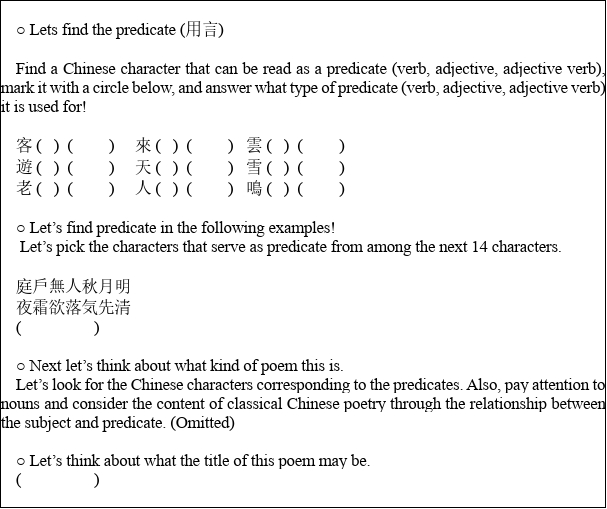
Research emphasizing the continuity of Classical Chinese education across elementary, middle, and high schools (and universities) and exploring these connections has been conducted not only through teaching material research but also across various fields, ranging from general Classical Chinese education to methods of reading comprehension. At a symposium on the topic ‘What should classical education look like in high school Japanese language departments?’ an active secondary school teacher cited the gap in the introductory learning process and the overlap in middle and high school teaching materials as reasons why students dislike Classical Chinese. In line with the new Course of Study, middle and high schools are divided into the introductory stage and the development stage, respectively, and teaching methods suited to each learning process were proposed.
33 Specifically, for middle school, which is the introductory stage, it is emphasized that rote memorization of Classical Chinese interpretation methods should be avoided, and instead students should be made to clearly understand the composition of compound words (the structure of
kanji words). Among the various structures of
kanji words, this approach proposes methods for beginners in Classical Chinese interpretation, through focusing on
kanji words that read differently from Japanese word order such as vocabulary where the following character becomes the object or complement of the preceding character (
cho seki 著席 etc.), and words where the front character denies the second character (
hijō 非常 etc.), and four-character idioms 四字成語 (
yon ji sēgo) that show different interpretation orders. In high schools, teaching methods that allow students to experience the creation of Classical Chinese poetry were proposed. Because the entry barriers for writing Classical Chinese poetry are high, it is important to organize appropriate teaching to reduce the difficulty of poetry composition. Rather than poets from the Tang Dynasty, Classical Chinese verses that follow strict rules of verse form 律格 (
ritsu kaku) and works from post-modern Japanese writers like Ryunosuke Akutagawa 芥川龍之介, even if their skill level is somewhat lower, works are proposed that serve as models for creativity. Furthermore, the selection of works from poets in their formative periods, when they were seventeen or eighteen years, the same age as the students, such as, ‘Thinking of My Brothers on the Double Ninth Festival 九月九日憶山東兄弟’ by Wang Wei 王維, and ‘
Mudai 無題’ by Natsume Sōseki 夏目漱石, are suggested. This aligns with the high school Exploration of the Classics Course of Study guidelines, which propose ‘By reading the Classics and referring to their vocabulary and expressive techniques etc., you can create
waka 和歌 poetry,
haiku 俳偈 poetry, and Classical Chinese poetry, or write about what you have experienced or felt in classical written language’.
Conclusion
In 2010, Japan enacted the “Shin Jōyō Kanji” for the first time in 29 years, revised the Course of Study along with large-scale educational reforms, and brought significant changes to language and written life as well as classical Chinese education. This paper follows the author’s work published in 2011 on the achievements and trends of Classical Chinese education research in Japan from around 1945 to 2010, it covers the direction of Classical Chinese education in Japan and the current status of Classical Chinese education research over the roughly ten years since around 2010. The main points are as follows.
【The New Jōyō Kanji and the Course of Study】 Japan announced and implemented 2,136 new commonly used kanji in September 2010. The background for the establishment of New Jōyō Kanji can be described as the ‘trend toward the diversification of Kanji through the use of digital devices.’ In contrast to the national character policy, kanji, which are widely used in daily life, have become much easier to use thanks to digital devices. With this reality, it can be said that the authorities, who are responsible for setting the standards for language life and school education, have compromised or followed suit. Japan announced the revised Course of Study 2008-2009 and the new Course of Study in 2017-2018. While the emphasizing the characteristics of Classical Chinese and Chinese characters as ‘national language,’ and the goal and framework of teaching Classical Chinese within the Japanese language department remain unchanged, it is noteworthy that there are efforts to further strengthen classical education, including Classical Chinese.
【High School Classical Chinese Education】 The most notable feature of the Japanese language course in the high school new Course of Study is the dismantling of the long-standing distinction between modern Japanese, Classical Japanese, and Classical Chinese. Depending on theme and style, Classical Chinese is mainly learnt in the subject Language Culture and Exploration of the Classics. The former mainly focuses on ‘reading’ the classics, while the latter emphasizes inquiry itself rather than sentence interpretation. The characteristics of Classical Chinese education in Japanese high schools are as follows. First, Classical Chinese texts (especially Chinese authored Classical Chinese) are being positioned as ‘domestic classics’ on par with native language classics. Second, it expands the scope of the texts to include Japanese Classical Chinese composed before the modern era, as well as classical prose and classical Chinese poetry created after the modern era. Third, it emphasizes the inheritance and development of traditional Classical Japanese and Classical Chinese reading without burdening students.
【University Entrance Classical Chinese Examination】 Classical Chinese in college entrance examinations has maintained its inertia even after the new system was implemented. Its characteristics are as follows. First, it offers a glimpse into the life of language and characters, where kanji and kana are mixed, and Classical Chinese are mixed and the pronunciation reading and Kundoku translation of Chinese characters and Classical Chinese are used in combination. Second, there is a strong tendency to require reading comprehension of relatively long passages rather than fragmented knowledge of Chinese characters (vocabulary) and classical Chinese grammar. Third, most of the passages were from the Ming and Qing historical biographies and Miscellaneous Notes and Records 筆記雜錄類 (Bikki zatsuroku rui), but recently, Chinese poetry has been examined every year. So-called top-tier universities such as the University of Tokyo and Wasai University include Classical Chinese in their examinations. However, there is the tendency for high school students with a general education to find questions difficult to handle. This gap between the school environment and the reality of entrance exams is continuously criticized.
【Current Status of Classical Chinese Education Research and Teaching Examples】 Looking at papers and materials related to Classical Chinese education published from 2010 to 2020 in the Journal of New Kanji and Kanbun, the leading Japanese journal specializing in Chinese character education, the topics and content cover a wide range of areas, including the goals and general opinions of Classical Chinese education, history of classical Chinese education, research on teaching material research, research on teaching and learning methods, evaluations, and other studies. Notable points on Japan’s Classical Chinese education research since 2010 include integration with other languages, styles, and subjects such as modern Japanese, learner-centered education through active learning and media utilization actives, and an emphasis on continuity in Chinese character education at elementary, junior high, and high schools (and even universities).
The world of classical Chinese in East Asia is not homogeneous. It is important to keep this in mind and apply this point in Classical Chinese education and its research. The differences from Korea allow for a clearer understanding of the diversity of the East Asian classical script world, as well as Korea’s characteristics and its own position. Similarities and shared aspects with Korea can serve as a direct reference for reflecting on and improving Korea’s policies and practices. Going forward, the author intends to continue to report on the status of Japanese Classical Chinese education and its research to academia every ten years, and as necessary, examine the topics of each chapter described in this paper in greater detail.
Notes
|
Category |
School |
Announcement (Year and Month) |
Implementation (Year and Month) |
Notes |
|
The National Course of Study |
Elementary |
2008.03 |
2011.04 |
Conducted simultaneously across all grades |
|
Middle |
〃 |
2012.04 |
〃 |
|
High |
2009.03 |
2013.04 |
Conducted by academic year, commencing with the incoming first-year students in 2013 |
|
The New National Course of Study |
Elementary |
2017.03 |
2020.04 |
Conducted simultaneously across all grades |
|
Middle |
〃 |
2021.04 |
〃 |
|
High |
2018.03 |
2022.04 |
Conducted by academic year, commencing with the incoming first-year students in 2022 |
|
Conducted by academic year, commencing with the incoming first-year students in 2025 |
|
Category |
Knowledge & Skills |
|
(3) Matters related to our nations language and culture > Traditional language culture |
|
Elementary School 5th grade and 6th grade |
1.Through approachable classics and Classical Chinese, as well as readings on literary tones and sentences from modern times, students become familiar with the reverberation and rhythm of speech. |
|
2. By reading sentences, explaining classics or familiarizing oneself with the general content of works, students can learn how people in the past saw and felt. |
|
Middle School First Year |
1. Learn the rules of classical language and methods for reading aloud and become familiar with the world of classics through the unique rhythm of classical texts through reading classical texts and Classical Chinese texts. |
|
2. Know many types of works in the classics. |
|
Middle School Second Year |
1. Through learning activities such as reading the works to highlight their characteristics, students become familiar with the world of the classics. |
|
2. By reading works through modern language translations and annotations, students learn about the perspectives and ways of thinking expressed in the classics. |
|
Middle School Third Year |
1. By reading classics with attention to historical background, students become familiar with their world. |
|
2. Students use the classics by quoting long-cherished phrases or passages from classical texts. |
|
Academic year |
Source
|
Notes |
|
Main Examination |
Additional Examination |
|
2010 |
Huang Ziyun 黃子雲, Yehong shidi 野鴻詩的 |
Li Zhi 李贄, Chu tan ji 初潭集 |
Center Test |
|
2011 |
Huang Jin 黃溍, Jinhua huang Xiansheng wenyi 金華黃先生文集 |
Toqto’a 脫脫, Song shi 宋史 |
〃 |
|
2012 |
Sun Zongjian 孫宗鑑, Xishe suolu 西畬瑣錄 |
Rai Sanyō 頼山陽, Sanyō ikō 山陽遺稿 |
〃 |
|
2013 |
Zhang Lei 張耒, Zhang lei ji 張耒集□ |
Xie Zhen 謝榛, Simei shihua 四溟詩話 |
〃 |
|
2014 |
Lu Shusheng 陸樹聲, Lu wending gong ji 陸文定公集 |
Wu Jiaji 吳嘉紀, Louxuan shi 陋軒詩 |
〃 |
|
2015 |
Cheng Minzheng 程敏政, Huangdun wenji 篁墩文集 |
Cai Yong 蔡邕, Qin cao 琴操 |
〃 |
|
2016 |
Lu Wenchao 盧文弨, Baojingtang wenji 抱經堂文集 |
Hao Jing 郝敬, Yipu cangtan 芸圃傖談 |
〃 |
|
2017 |
Arai Hakuseki 新井白石, Hakuseki sensei ibun 白石先生遺文 |
Ye Tingguan 葉廷琯, Oupei yuhua 鷗陂漁話 |
〃 |
|
2018 |
Li Tao 李燾, Xu zizhi tongjian changbian 續資治通鑑長編 |
Gu Yanwu 顧炎武, Ri zhi lu 日知錄 |
〃 |
|
2019 |
Qiu Zhaoao 仇兆鰲, Du shi xiangzhu 杜詩詳註 |
Wang Anshi 王安石, Wang wengong wenji 王文公文集 |
〃 |
|
2020 |
Xie Lingyun 謝靈運, Wen xuan 文選 |
Zhang Xuecheng 章學誠, Wen shi tong yi 文史通義□ |
〃 |
|
2021 |
Ouyang Xiu 歐陽脩, Ouyang xiu wenzhong gong ji 歐陽脩文忠公集; Han feizi 韓非子 |
Zeng Gong 曾鞏, Mo chi ji 墨池記, Jin shu 晉書 Wáng xīzhī zhuàn 王羲之傳 |
Common Test |
|
Category |
Topic |
Contents |
Activity |
|
Session 1 (1 hour) |
What is it, and how is it expressed? |
① Reading Classical Chinese in Japanese |
Warm-up activity |
|
Session 2 (3 hours) |
Thinking about politics and society |
② Thinking about an ideal society |
Learning activities that include contemplative content while engaging with Classical Chinese |
|
③ What is honesty (正直)? |
|
④ The Analects of Confucius warm-up |
|
⑤ Three in the morning and four in the evening (朝三暮四) |
|
⑥ What is a wicked person (惡人)? |
|
Lesson 3 (3 hours) |
Imagine that Confucius founded a political party and write a manifesto |
⑦ Creating a manifesto poster |
Group Activities |
|
⑧ Speech expressing opinions and hold election |
Reference List
- Agency for Cultural Affairs. “Jōyō kanji hyō 常用漢字表” [List of Regular Use Chinese Characters]; “kaitē jōyō kanji hyō (tōshin) 改定常用漢字表(答申)” [Revised List of Regular-Use Characters (Report)]. (accessed June 7, 2010). www.bunka.go.jp.
- Baek Dong-seon 백동선. “Ilbŏn ŭi sin sangyong hanja ŭi kusŏng kwa han’guk ŭi kyoyuk hanja” 日本의 新常用漢字의 構成과 韓國의 敎育漢字 [The Composition of Japan’s New Jōyō Kanji and Korea’s Education Hanja]. Ilbŏn hakbo 일본학보 101 (2014): 33-46.
- Cha Han-mi 차한미. “Ilbon kyodung hakgyo kojŏn hanmun p’yŏn yŏn’gu” 일본 고등학교 고전한문편 연구: 대학입학시험문제 분석을 겸하여 [A Study Japan’s High School Classical Chinese Classica Education]. Master’s Thesis, Korea University Graduate School, Department of Classical Chinese Education, 2013.
- Chang Ho-seong 장호성. “Tonga se-a samguk ŭi t’aehak ipsi hanmun sihŏm pigyo koch’al” 東亞細亞 三國의 大學入試 漢文 試驗 比較 考察 [A Comparative Study of the Three East Asian Countries University Entrance Classical Chinese Examination]. Hanja hanmun kyoyuk 한자한문교육 26 (2011):157-218.
- Chang Ho-seong 장호성. “Han’guk wa ilbon ŭi t’aehak ipsi hanmun sihŏm pigyo” 韓國와 日本의 大學入試 漢文 試驗 比較 [A Comparison of Korea and Japan’s University Entrance Classical Chinese Examination]. Hanmun kyoyuk hakhoe 한문교육연구 33 (2009): 75-107.
- Ching Yeun Cheung 張政遠. “Ilbon esŏ hanja haksŭp ŭi chŏnt’ong kwa pangbŏp” 일본에서 한자학습의 전통과 방법 [Traditions and Methods of Learning Hanja in Japan]. Hanja hanmun kyoyuk 한자한문교육 26 (2011): 323-339.
- Choi Mi-suk 최미숙. “Ilbon t’aehak iphak kongt’ong t’esŭt’ŭ kug’o sŏsul hyŏng munhang yŏn’gu” 일본 ‘대학입학공통테스트’ 국어 서술형 문항 연구 [A Study on Japan’s ‘University Entrance Common Test’ National Language Descriptive Questions」. Kugo kyoyuk hak yŏn’gu 국어교육학연구 53, no.2 (2018): 260-289.
- Fujita Tomoyuki 藤田智之. “rongo o kaishaku shi kyatchi kopī de tsutaeyō: kōshi no kotoba o ichi bun de kakikaeru” 論語を解釈しキャッチコピーで伝えよう: 孔子の言葉を一文で書き換える [Interpreting the 'Analects' and Communicating via Catchphrase: Rewriting the Words of Confucius into a Single Sentence]. Atarashii kanji kanbun kyōiku 新しい漢字漢文教育 70 (2020).
- Kang Hong-jae 강홍재. “Ilbon ŭi daehak iphak ŭi sihom ŭi hyŏnsang kwa chŏnmang” 일본의 대학입학 시험의 현상과 전망 [The Current State and Prospects of University Entrance Examinations in Japan]. Han’guk ilbon kyoyukhak yŏn’gu.
- 한국일본교육학연구 23, no.2 (2018): 51-73. Kim Young-ok 김영옥. “Hanmun hyoyuk yong kich’o hanja chahyŏng p’yojunhwa yŏn’gu” 漢文 敎育用 基礎 漢字 字形 標準化 硏究 [A Study on the Basics Classical Chinese Education Practices and the Standardization of Chinese Character Formation]. PhD diss., Korea University Graduate School, Department of Korea Language and Literature, 2012.
- Kim Young-ok 김영옥. “Hanmun kyoyuk yong kich’o hanja chejong kwajŏng e taehan sajŏk koch’al” 한문 교육용 기초 한자 제정 과정에 대한 史的 고찰 [A Historical Study on the Formation Process of the Basics Chinese Characters for Classical Chinese Education Practices]. Hanmun kyoyuk yŏn’gu 한문교육연구 40 (2013): 211-245.
- Koganezawa Yutaka 小金澤豊. “Shin gakushū shidō yōryō ni oke ru shō gakkō kyōka sho koten kyōzai oyobi kanji kyōzai” 新学習指導要領における小学校教科書 古典教材及び漢字教材 [Elementary School Textbook Classical Materials and kanji Materials under the New Course of Study]. Atarashii kanji kanbun kyōiku 新しい漢字漢文教育 71 (2020).
- Koganezawa Yutaka 小金澤豊. “Shō gakkō kyōka shochū no kanbun kyōzai” 小学 校教科書中の漢文教材 [Classical Chinese Teaching Materials in Elementary School Textbooks]. Atarashii kanji kanbun kyōiku 新しい漢字漢文教育 54 (2012).
- Kudō Haruyuki 工藤玄之. “Daigaku nyūshi mondai to kōkō kanbun kyōiku: sēto no doryoku ga mukuwa reru mondai to wa” 大学入試問題と高校漢文教育: 生 徒の努力が報われる問題とは [University Entrance Exam Questions and High School Classical Chinese Education: What Kind of Questions Reward Student Effort?]. Atarashii kanji kanbun kyōiku 新しい漢字漢文教育 54 (2012).
- Kwon Oh-hyun 권오현. “2017 nyŏn 2018 nyŏn ilbon haksŭb chido yoryŏng kaegyŏng kwa sahoe kwa kyoyuk ŭi chuyo pyŏnhwa” 2017 년ㆍ 2018 년 일본 학습지도요령 개정과 사회과 교육의 주요 변화 [The 2017 and 2018 Revisions of Japan’s Course of Study and the Major Changes in Society and Education]. Sahoe kwa kyoyuk yŏn’gu 사회과교육연구 26, no.2 (2019): 1-20.
- Ministry of Education, Culture, Sports, Science and Technology. “Gakushū shidō yōryō kaitē no kangae kata 学習指導要領改訂の考え方” [The Core Rationale for the Revision of the Course of Study]; “ikusē su beki shishitsu · nōryoku no mit tsu no hashira 育成すべき資質·能力の三つの柱” [The Three Pillars of Qualities and Abilities to be Fostered]; “kyōka no mokuhyō , kaku gakunen no mokuhyō oyobi naiyō no kētō hyō (shōㆍ chū gakkō kokugo ka) 教科の目標, 各学年の目標及び内容の系統表(小ㆍ中学校国語科)” [Subject Objectives, Grade-Level Objectives, and Content Scope and Sequence Chart (Elementary and Junior High School Japanese Language Department)]; “kōdai setsuzoku kaikaku no jisshi hōshin tō ni tsui te 高大接続改革の実施方針等について” [Regarding the Implementation Policy for High School-University Articulation Reform]; “kōtō gakkō gakushū shidō yōryō (hēsē 30 nen kokuji) 高等学校学習指導要領(平成30 年告示)” [High School Curriculum Guidelines (2018 Notification)]; “kōtō gakkō gakushū shidō yōryō (hēsē 3 0 nen kokuji) kaisetsu koku go hen 高等学校学習指導要領(平成30 年告示) 解説 国語編” [High School Curriculum Guidelines Commentary: Japanese Language Edition (2018 Notification)]. www.mext.go.jp.
- Miyake Takahiro 三宅崇広. “2010 nendo daigaku nyūshi kanbun · zakkan” 2010年 度大学入試漢文ㆍ雑感 [Miscellaneous Impressions on the 2010 University Entrance Examination Classical Chinese Section]. Atarashii kanji kanbun kyōiku 新しい漢字漢文教育 51 (2010).
- Miyake Takahiro 三宅崇広. “2012 nen sentā shiken no kanbun mondai ni tsui te” 2012 年センター試験の漢文問題について [On the Classical Chinese Problems in the 2012 Centre Exam]. Atarashii kanji kanbun kyōiku 新しい漢字漢文教育 54 (2012).
- Miyake Takahiro 三宅崇広. “Dai ichi kai daigaku nyūgaku kyōtsū tesuto kanbun juken taisaku” 第一回大学入学共通テスト〈漢文〉受験対策 [Exam preparation for the Classical Chinese section of the First University Admissions Common Test]. Atarashii kanji kanbun kyōiku 新しい漢字漢文教育 71 (2020).
- Nakayama Daisuke. 中山大輔. “Chūgakkō no kanbun ni okeru kanshi o mochii ta dōnyū no koko romi” 中学校の漢文における漢詩を用いた導入の試み [An Attempt at Introductory Lessons Using Chinese Poetry in Junior High School Classical Chinese]. Atarashii kanji kanbun kyōiku 新しい漢字漢文教育 70 (2020).
- Nam Kyu-hee, and Han Yong-jin 남경희·한용진. “Ilbon sin haksŭp chido yoryŏng ŭi paegyŏng inyŏm: hagyŏk kwan’gye haksŭp mit su’ŏpsang ŭl chungsim ŭro” 일본『신학습지도요령』의 배경과 이념: 학력관과 학습관 및 수업상을 중심으로 [The Background and Ideology of Japan's 'New Course of Study': Focusing on of Academic Ability, Learning, and Lessons]. Han’guk ilbon kyoyuk yŏn’gu 한국일본교육연구 23, no.3 (2019): 1-19.
- National Center for University Entrance Examinations. “Daigaku nyūshi sentā no ayumi 大学入試センターのあゆみ” [History of the National Center for University Entrance Examinations]; “Daigaku nyūgaku kyōtū tesuto no shikumi un’ē 大学入学共通テストの仕組み·運営” [Structure and Management of the University Admissions Common Test]; “Shiken jōhō 試験情報” [Examination Information]; “Reiwa 4 nendo daigaku nyūgaksha senbatsu ni kakaru daigaku nyūgaku kyōtū tesuto jisshi yōkō 令和4年度大学入学者選抜に係る大学入学共通テスト実施要項” [Guidelines for the Implementation of the Common Test for University Admissions for the 2022 Academic Year Selection] (June 11, 2021, National Center for University Admissions, Section 1, No. 17); “Hēsē 30 nen kokuji kōtō gakkō gakushū shidō yōryō ni taiō shi ta reiwa 7 nendo daigaku nyūgaku kyōtū tesuto kara no shutsudai kyōka kamoku ni tsui te 平成30年告示 高等学校学習指導要領に対応した令和7年度大学入学共通テストからの 出題教科·科目について” [Regarding the Examination Subjects and Items from the 2025 Academic Year University Admission Common Test Corresponding to the Senior High School National Curriculum Standards Announced in 2018] (March 24, 2021); “Rēwa 4 nendo daigaku nyūgaku sha sembatsu ni kakaru daigaku nyūgaku kyōtsū tesuto mondai sakusē hōshin 令和4年度大学入学者選抜に係る大学入学共通テスト問題作成方針” [Question Preparation Policy for the Common Test for University Admissions for the 2022 Academic Year Selection] (Partially revised on June 11, 2021). www.dnc.ac.jp.
- Nishimura Satoshi 西村諭. “Shakai to no tsunagari o ishiki shita kanbun jugyō no jissen 社会とのつながりを意識した漢文授業の実践 [Practice of Classical Chinese Lessons Conscious of Social Connections]. Atarashii kanji kanbun kyōiku 新しい漢字漢文教育 68 (2019).
- Ōtaki Kazuto 大滝一登. “Kōtō gakkō shin gakushū shidō yōryō to waga kuni no gengo bunka” 高等学校新学習指導要領と我が国の言語文化 [The New High School Course of Study and Japan’s Linguistic Culture]. Atarashii kanji kanbun kyōiku 新しい漢字漢文教育 68 (2019).
- Park Se-jin 박세진. “Ilbon hanja kyoyuk ŭi wisang kwa hanja kyoyuk yŏn’gu ŭi tonghyang” 日本 漢字敎育의 位相과 漢字敎育硏究의 動向 [The Status of Japanese Kanji Education and Trends in Kanji Education Research]. Hanmun kyoyuk yŏn’gu 한문교육연구 37 (2011): 669-708.
- Ryu Jun-gyeong 류준경. “Hanmukwa mit kug’ogwa kyoyuk kwajŏng pyŏnchŏn ŭi ŭimi wa sangho sot’ong mit yudae ŭi mosaek” 한문과 및 국어과 교육과정 변천의 의미와 상호 소통 및 유대의 모색 [The Meaning of the Evolution of Classical Chinese and Korean Language Curricula, and the Exploration of Mutual Communication and Bonds]. Hanmun kyoyuk yŏn’gu 한문교육연구 49 (2017): 61-96.
- Ryu Jun-gyeong 류준경. “Hanmun kyoyuk ŭi sŏnggyŏk panghyang” 漢文敎育의 性 格과 方向 [The Characteristics and Direction of Classical Chinese Education]. Hanmun kojŏn yŏn’gu 한문고전연구 28, no.1 (2014): 341-373.
- Shim Kyeong-ho 심경호. “Segye hanmun kyoyuk ŭi panghyang kwa han’guk ŭi yŏkhal” 세계 한문교육의 방향과 한국의 역할 [The Direction of Global Classical Chinese Education and Korea’s Role]. Tongbang hanmun hak 동방한문학 74 (2018): 7-34.
- Song Byeon-ryul 송병렬. “Hyundae hanja munhwagwon ŭi munja sayong kwa hanja ŭi pŏmju e kwanhan ilgo” 現代 漢字文化圈의 文字 使用과 漢字의 範疇에 關한 一考 [A Study on the Use of Writing and the Scope of Chinese Characters in the Modern Chinese Character Cultural Sphere]. Hanja hanmun yŏn’gu 한자한문연구 30 (2013): 9-36,.
- Song Ho-bin 송호빈. “Ilbon hanmun kyoyuk yŏn’gu ŭi hyŏnhwang kwa sisajŏn” 일본 한문교육연구의 현황과 시사점 [Current Status and Implications of Japanese Classical Chinese Education Research]. Hanmun kyoyuk yŏn’gu 한문교육연구 37 (2011): 709-771.
- Sundai Preparatory School 駿台予備学校 編. “Dai gaku nyūshi sentā shiken kako mondaishū kokugo” 大学入試センター試験 過去問題集 國語 [Past Question Collection for the National Center Test for University Admissions: Japanese Language]. Sundai bunko 駿台文庫. (2010).
- Utaguchi Akira 謡口明, Ōtaki Kazuto 大滝一登, Ariki Daisuke 有木大輔, Watanabe Kyōko 渡辺恭子, and Funabashi Kiyo 舩橋希予. “Kōtō gakkō koku goka ni oke ru koten kyōiku no ari kata” 高等学校国語科における古典教育の在り方 [The Ideal State of Classical Education in High School Japanese Language Departments]. Atarashii kanji kanbun kyōiku 新しい漢字漢文教育 68 (2019).
- Watanabe Harumi 渡辺春美. “Sengo kanbun kyōiku jissen shi no: atarashii kanji kanbun kyōiku shi o chūshin ni” 戦後漢文教育実践史の展開: 新しい漢字漢文教育誌を中心に [The Development of the History of Postwar Classical Chinese Educational Practice: Focusing on the Journal of New Kanji and Kanbun Education]. Gubun to kyōiku 語文と教育 34 (2020).



 News
News