Abstract
Although Hanmun formed the backbone of Korean literary culture until the early twentieth century, its position within contemporary Korean Studies in Europe remains precarious. Limited curricular space, funding constraints, and a shortage of trained specialists have often relegated Hanmun to the status of a “luxury” rather than a core component of the field. While existing debates on Hanmun instruction have focused primarily on questions of textual selection, the underlying pedagogy has received comparatively little attention. This article addresses this gap by rethinking Hanmun training through learner-centered, interactive, and multilingual instructional strategies. Drawing on Bloom’s taxonomy as a heuristic framework, the article critiques the teacher-centered transmission model and the monolingual principle that continue to shape language instruction. It examines a corpus of eleven Hanmun textbooks and digital resources published in Korea, North America and Europe, focusing on the extent to which they enable interactivity and multilingual engagement. Building on these analyses, the article develops a set of experimental teaching practices presented in a concluding Hanmun Sandbox. These exercises emphasize chunking, translanguaging, and productive struggle, demonstrating how learners mobilize diverse linguistic and cognitive resources to construct meaning. The article argues that effective Hanmun instruction benefits from treating uncertainty not as an obstacle, but as a productive space for learning and meaning-making.
-
Keywords: Hanmun, Language Pedagogy, Multilingual Instruction, Translanguaging, Productive Struggle, Learner-centered Learning
Introduction1
Although Hanmun
2 formed the backbone of Korean literary culture until the early twentieth century, its position within contemporary Korean Studies in Europe is precarious. Only a limited number of institutions, including universities in Paris
3, Bochum
4, Prague
5, and Leiden
6, offer systematic, but not necessarily mandatory instruction in Hanmun.
7 At the University of Copenhagen, where the author teaches, Hanmun has until recently been offered only as an elective seminar, although it will be incorporated into the regular curriculum in a limited form
8 from September 2026.
Despite its historical importance, Hanmun is often treated as a “luxury” within Korean Studies.
9 Several structural factors contribute to this perception. First, students already devote substantial time to acquiring modern Korean, leaving limited space for additional language study. Second, unlike Chinese or Japanese Studies, Korean Studies has a relatively short institutional history in Europe, resulting in a shortage of specialists trained to teach Hanmun systematically.Third, whereas knowledge of literary languages such as Latin, Greek, or Hanmun was once considered a mark of cultural and intellectual prestige,
10 the growing emphasis on practically oriented, job-market–relevant skills has increasingly called the value of such “dead” languages into question.
Given these constraints of time, funding, and expertise, this article asks how Hanmun can be taught more efficiently and meaningfully to students of Korean Studies. Previous discussions of Hanmun training have tended to focus on what texts should be taught rather than how they should be taught. Debates have centered on whether to prioritize Korean-authored texts, whether to include texts widely read in the Chosŏn period (1392-1910) regardless of authorship, or which genres are most suitable for instruction. While these questions are important, they tend to leave the underlying pedagogy largely unexamined.
To address this gap, I argue that we need to reconsider two pedagogical traditions that remain widespread in academia more broadly: the teacher-centered “transmission-based classroom”
11 and the “monolingual principle.”
12 In the second section of this article, I outline the limitations of these approaches by drawing on Bloom’s taxonomy, relate them to current practices in Hanmun instruction, and propose learner-centered interactive exercises and multilingual instructional strategies as more effective alternatives. The third section examines a corpus of eight Hanmun textbooks published in Korean, focusing on the extent to which they allow for interactivity and multilingual engagement. The fourth section turns to three Hanmun textbooks or resources authored by contributors to this special issue: Yannick Bruneton’s
Grand manuel de chinois classique,
13 Ross King’s
Readings in Korean Hanmun Sources 韓國漢文講讀 on the online Interline Reader,
14 and Felix Siegmund’s forthcoming
Practical Hanmun: Grammar and Texts for Korean Literary Sinitic.
15 Rather than evaluating their textual selections, I focus on the extent to which these works enable interactive and multilingual teaching practices. Taken together, the eleven Hanmun textbooks examined in Sections Three and Four serve as an experimental space for developing concrete examples of learner-centered, multilingual exercises for Hanmun instruction. These examples are presented in a concluding section, the Hanmun Sandbox. The Hanmun Sandbox is not intended to replace the aforementioned textbooks, but rather to complement them as an experimental space for interactive and multilingual exercises.
From Transmission-Based Teaching to Interactive Learning
For a long time, education has been conceptualized as a process in which knowledge is transmitted unidirectionally from teacher to student. The so-called “transmission-based classroom” long constituted the dominant pedagogical model, positioning the teacher at the center and casting students as largely passive recipients of canonical knowledge. In her keynote speech at the
Make a Difference conference in Copenhagen in 2014,
16 Maria Andersen fundamentally questioned the learning efficiency of this model and drew on research by educational psychologist Benjamin Bloom
17 as well as by Michelene Chi and her research group in cognitive and learning science.
18 These scholars converge in their conclusion that tutoring is the most effective form of instruction. Since one-to-one tutoring is rarely feasible in higher education, researchers such as Andersen, Bloom, and Chi have sought to identify which aspects of tutoring account for its effectiveness and how these can be transferred to group-based instruction. Andersen’s first key point is that the number of interactions is crucial for learning outcomes: interaction fosters learning.
19 Here, “interaction” refers not only to verbal exchange between teacher and students, but also to cognitively active engagement such as questioning, explaining, discussing, and collaboratively working through problems. In other words, the more opportunities students have to interact, the greater the learning effect. This insight directly challenges the logic of unidirectional knowledge transmission, which leaves little room for interaction.
Andersen’s second point is that learning outcomes do not primarily depend on the teacher’s subject expertise. Rather, what matters is the teacher’s ability to create meaningful interactions by prompting, questioning, and guiding students’ thinking.
20 As Chi et al. emphasize, “tutoring skills refer to the pedagogical skills of knowing when to give feedback, scaffoldings, and explanations, when to hold back error corrections and allow the students to infer that an error has been made, and so forth.”
21 Andersen goes even further by referring to studies showing that students learned more when tutors were not allowed to provide content knowledge at all but instead encouraged students to think through questions such as “What do you think about this problem?”
22 In short, when teachers adopt a less didactic and more interactive role, learning outcomes improve.
23 This form of instruction requires teachers to continuously adapt their teaching to students’ needs by carefully calibrating feedback, scaffolding, and explanations.
24 Jim Cummins similarly argues that moving away from a transmission-oriented model empowers students by placing them at the center of the learning process and enabling them to take greater ownership of their learning.
25
Despite broad agreement that teacher-centered instruction is pedagogically limited, the transmission-based classroom remains widespread. This persistence can partly be explained by the relative comfort of passive learning, listening resembles watching television, and partly by the lack of easily accessible alternatives to lecture-based teaching. Moreover, the transmission model is deeply entrenched in academic culture, making it difficult to abandon. Shifting toward interactive teaching requires teachers to relinquish central control and students to assume greater responsibility for their learning.
26 Nevertheless, such a shift appears necessary if learning is to become more effective. The question, then, is how interactivity can be meaningfully implemented in Hanmun instruction. This question becomes even more productive when combined with a reconsideration of a second entrenched assumption: the “monolingual principle.”
Jim Cummins has written extensively on the potential of multilingual classrooms, challenging the monolingual principle and advocating instead for bilingual or multilingual instructional approaches.
27 Although his work does not focus on Hanmun, his insights are highly relevant to its teaching, particularly in the context of Korean Studies. Cummins criticizes three interconnected assumptions underlying monolingual instruction: the discouragement of bilingual dictionaries (the “direct-method” assumption),
28 the rejection of translation,
29 and the separation of languages in the learning process.
30 Drawing on cognitive psychology, he argues that effective learning builds on learners’ prior knowledge.
31 Since “new understandings are constructed on a foundation of existing understandings and experiences,”
32 instruction becomes more effective when it activates students’ existing linguistic and cognitive resources.
From this perspective, languages that students already know are not obstacles to learning a new language but valuable resources that can actively support it.
33 Cummins further emphasizes the interdependence of languages, arguing that although surface features such as pronunciation or fluency differ, languages share an underlying cognitive and academic proficiency.
34 He terms this a “common underlying proficiency” (CUP), while Caroline Riches and Fred Genesee refer to a “common underlying reservoir of literacy abilities.”
35 This metaphor highlights how literacy skills developed in one language remain available when working in another.
Building on this insight, Cummins argues that instruction becomes more effective when teachers explicitly activate this shared proficiency, draw attention to similarities and differences across languages, and reinforce learning strategies in a coordinated, cross-linguistic manner.
36 From this perspective, translation between languages is not an obstacle but a powerful pedagogical tool that can enhance language development and metalinguistic awareness.
37
Before turning to the question of how these insights can be applied to Hanmun instruction, it is useful to summarize the three main points that emerged from the discussion above. First, the number of interactions plays a decisive role in learning outcomes. Second, learning success does not primarily depend on the teacher’s subject expertise, but rather on the teacher’s ability to create meaningful and well-timed interactions with students. Third, instruction becomes more effective when it activates students’ existing linguistic and cognitive resources.
Traditionally, Hanmun instruction in Korean Studies has followed the “grammar-translation method,”
38 which originated in the teaching of Latin and Greek in medieval Europe. This approach prioritizes the explicit teaching of grammatical rules and the translation of written texts into the students’ native language, often accompanied by detailed grammatical analysis.
39 As Howatt notes, because no alternative foreign language teaching methods were widely available at the time, the grammar-translation method was also adopted for the teaching of modern languages.
40 It is therefore unsurprising that the method was later criticized for neglecting speaking and listening skills and for placing excessive emphasis on grammatical accuracy.
41 However, Weiuha Yu draws attention to several valuable aspects of the grammar-translation method. In particular, it can enhance reading comprehension and, of special relevance here, it encourages systematic comparison between the target language and the learner’s mother tongue.
42 In this sense, the method activates students’ existing linguistic and cognitive resources, which aligns with the principles advocated by Cummins.
43 The interaction between Hanmun and the learner’s mother tongue therefore remains an important pedagogical resource that should not be abandoned. Building on this, I suggest that Hanmun instruction should also actively engage students’ Korean language skills through translation and other interactive learning activities.
As in the teaching of Latin or Classical Greek, Hanmun instruction has traditionally focused on reading and translation. While these activities certainly involve interaction, they primarily engage relatively basic forms of cognitive activity, such as acquiring and understanding linguistic structures.
44 Although Bloom’s taxonomy offers a convenient vocabulary for describing different kinds of cognitive engagement, it should not be understood as a linear or exhaustive model of learning. Bloom’s taxonomy was developed to classify different levels of cognitive learning in order to help educators structure learning objectives, design teaching activities, and assess student progress, typically by organizing thinking skills in a hierarchy from basic recall to more complex processes such as analysis, evaluation, and creation. However, a central critique is that this model oversimplifies learning by presenting it as linear and hierarchical, whereas in practice learning is often non-linear and iterative; higher-order thinking can emerge without full mastery of lower levels, and the taxonomy risks being applied too rigidly while also underrepresenting the social, emotional, and cultural dimensions of learning. In the context of Hanmun instruction—particularly in multilingual and interactive settings—cognitive processes often overlap, recur, and operate simultaneously across different levels. Accordingly, this article uses Bloom’s taxonomy only as a heuristic reference point for comparing the types of interaction encouraged by different Hanmun textbooks. As the authors of
How People Learn emphasize, “learning theory does not provide a simple recipe for designing effective learning environments.”
45 In this spirit, the present article examines the potential of existing Hanmun teaching resources for fostering interactivity and uses them as a basis for experimenting with instructional activities that promote richer and more varied forms of cognitive engagement.
Korean Textbooks for Hanmun
This section examines a corpus of eight Hanmun textbooks published in Korean over recent decades and explores the extent to which they allow for interactivity and multilingual engagement.
46 The textbooks examined are:
1. Yi Kawǒn’s
Kaejŏngp’an hanmun sin’gang 改訂版 漢文新講 [Revised version of
New Hanmun Lectures]
47
2.
Kyoyang hanmun 敎養漢文 [Hanmun for general education] by Korea University’s Classroom for Hanmun Literature
48
3. Yi Sangjin’s
Hanmun munbǒp 漢文文法 [Hanmun grammar]
49
4.
Hamkke ingnŭn uri hanmun 함께 읽는 우리 漢文[Reading our Hanmun together] by the Teachers’ Association for Hanmun Education
50
5. Chǒng Min and Park Sumil’s
Hanmun ǔi ihae 漢文의 理解 [Understanding Hanmun]
51
6. Korea University’s
Sin myǒngsim pogam 新明心寶鑑 [New
Precious mirror for enlightening the heart]
52
7.
Haewae han’guk hakcha rŭl wihan hanmun 해외 한국학자를 위한 漢文 [Hanmun for international scholars of Korean Studies] published by the Academy of Korean Studies
53
8.
Hanmun tokhae kibon paet’ŏn 漢文讀解基本패턴[Basic patterns for reading Hanmun] by the Institute for the Digitization of East Asian Classics
54
This selection is not intended to be comprehensive, but rather to provide an overview of Hanmun textbooks published in Korean. As noted above, the aim of this section is not to evaluate the choice of texts included in these textbooks, but to explore the extent to which they enable interactivity and multilingual engagement. At the same time, it is important to bear in mind that these materials are textbooks, and we cannot determine the degree of interaction they actually generate in practice. While some Hanmun textbooks incorporate digital tools that facilitate forms of engagement beyond the printed page, interaction in the narrow, classroom-based sense remains limited. Moreover, many of these textbooks are designed for self-study, and their authors may not have classroom use or activities in mind.
Nevertheless, several of the textbooks examined here display clear potential for interactivity, and I draw on all of them as sources of inspiration for the Hanmun Sandbox presented at the end of this article. It is also important to note that at least seven of the eight textbooks were written primarily for Korean students. It is therefore unsurprising that they do not explicitly engage the linguistic and cognitive resources of students enrolled in Korean Studies programs outside of Korea. Even so, the following analysis examines both the forms of interaction explicitly encouraged by these textbooks and the implicit or underexplored possibilities for interaction that could be further developed.
The revised edition of Yi Kawǒn’s (1917–2000) textbook is divided into two main parts: a grammar section of approximately 160 pages and a second section of about 150 pages containing 108 original Hanmun texts by Korean and Chinese authors. With its strong emphasis on explicit grammatical explanation and the translation of original texts, the overall structure aligns closely with the grammar-translation method and primarily addresses the lower levels of Bloom’s taxonomy, namely knowledge acquisition and comprehension.
At the end of the grammar section, however, the textbook includes a component explicitly devoted to application, entitled
ǔngyong-p’yǒn 應用篇.
55 Yi introduces this section by citing the proverb
Kusŭl i sŏ marirado kwewŏya pobae. 구슬이 서 말이라도 꿰어야 보배 “No matter how many beads you have, only if they are strung together do they become a treasure,” thereby encouraging learners to move beyond mere understanding of grammatical rules and to apply their theoretical knowledge to concrete problems. This pedagogical move signals an awareness of the importance of engaging students at higher levels of cognitive processing. In terms of Bloom’s taxonomy, the application section invites learners to progress from knowledge and comprehension toward application and, as the exercises suggest, potentially also toward analytical engagement with Hanmun sentence structure.
The first application method Yi introduces is
kudujǒm ch’igi, that is, punctuation marking. Interestingly, although Yi presents this method first, he emphasizes that punctuation marking actually comes last in the learning process and is only possible once a Hanmun sentence has been fully understood. To illustrate this point, Yi provides an abridged passage from the
Shiji 史記·周本紀 without punctuation (1, see below). He argues that punctuation can only be added after the reader has understood and translated the sentence. From a pedagogical perspective, this implies a sequence of cognitive operations that move beyond simple recognition of grammatical forms. Translation (2) requires comprehension and application of grammatical knowledge, while the subsequent division of the sentence into syntactic units or “chunks”
56 (3) involves analytical engagement with sentence structure.
Yi clarifies that example (3) demonstrates how a long sentence can be segmented according to grammatical principles, but he also emphasizes that no reader would actually punctuate a sentence in such a fragmented manner.
57 In practice, punctuation after elements such as adverbs or subjects would typically be omitted. The resulting Hanmun punctuation would therefore take the form shown in (4). Viewed through the lens of Bloom’s taxonomy, Yi’s approach implicitly guides learners from lower levels of cognitive engagement, such as understanding and application, toward higher-level analytical skills. Punctuation marking thus functions not as a mechanical exercise, but as the outcome of a multi-step interpretive process that presupposes deep engagement with meaning and structure.
1 西伯卒子發立是爲武王東觀兵至於盟津是時諸侯不期而會者八百皆曰紂可伐矣王不可引歸
2 서백이 죽고, 아들 발이 즉위하였다. 이분이 무왕이다. 동으로 군대를 사열하고 맹진에 이르렀다. 이때에 제후로 기약하지 않고서 모인 사람이 팔백이었다. 모두 ‘주를 쳐야 한다’고 말하였다. 왕은 듣지 않고서 (병사를) 거느리고 돌아갔다.
3 西伯, 卒, 子發, 立。是, 為武王。東觀兵, 至於盟津。是時, 諸侯, 不期而會者, 八百。皆曰, 紂可伐矣。王, 不可, 引歸。
4 西伯卒,子發立。是爲武王。東觀兵,至於盟津。是時諸侯不期而會者八百。皆曰, 紂可伐矣。王不可,引歸。
Still, Yi concludes the section on punctuation by arguing that, since punctuation marking is only possible once a sentence can be translated, no further examples are necessary; in his view, two pages are sufficient for this exercise. He then devotes approximately fifteen pages to a section titled “grammar and translation,”
58 in which he explicitly compares Hanmun and Korean and proposes concrete translation strategies. A similar number of pages is allocated to “grammar and usage,” where learners are guided through short Hanmun passages through grammatical explanation in Korean. The application section concludes with roughly thirty pages of “grammar exercises,”
59 which invite students to apply appropriate grammatical terminology while reading short Hanmun texts. Taken together, the application component of Yi Kawǒn’s textbook primarily encourages learners to read, translate, and apply grammatical rules. These activities progress from lower levels of cognitive engagement (knowledge and comprehension) in Bloom’s taxonomy to higher levels (application).
lthough Yi does not develop this aspect further, his discussion of punctuation marking implicitly introduces the pedagogical potential of “chunking.” By presenting two possible approaches to punctuation marking ((3) and (4)) and arguing that (4) represents the more common solution, Yi implicitly acknowledges that there are multiple ways of dividing a Hanmun sentence into meaningful units. From the perspective of Bloom’s taxonomy, this act of dividing a sentence into chunks constitutes an analysis-level activity. Chunking requires learners to decompose a sentence into its constituent syntactic units, identify functional relationships between elements, and make interpretive decisions about structure and meaning. In this sense, chunking moves beyond the mechanical application of grammatical rules toward analytical engagement with Hanmun syntax.
Yi nevertheless downplays the pedagogical value of punctuation marking by arguing that translation into Korean automatically entails punctuating the Hanmun text. This raises a crucial question: if punctuation is absorbed into translation, can chunking still function as a meaningful learning activity in its own right? In the Hanmun Sandbox section below, this question is explored through multilingual, learner-centered experiments that treat chunking not merely as a preparatory step toward translation, but as a site of analytical and interactive engagement with Hanmun sentence structure.
60
The second textbook in the corpus,
Kyoyang hanmun, provides approximately 100 Hanmun texts by Korean and Chinese authors. Each text is accompanied by footnotes offering explanations of difficult sinographs,
61 historical figures, or relevant contextual information. However, the textbook does not include a dedicated application section. The third textbook, Yi Sangjin’s
Hanmun munbǒp, is divided into two main parts. The first part focuses on sinographs,
62 grammatical explanation,
63 and Hanmun poetry,
64 while the second part
65 presents approximately twenty Hanmun prose texts and twenty poems. Each prose text is accompanied by explanations of sinographs and a Korean translation. Although this is not explicitly stated, the textbook also employs chunking through the use of
hyŏnt’o 懸吐, a traditional Korean annotation system that inserts grammatical markers to facilitate reading.
66
For example, when Yi Sangjin introduces the “Biography of Boyi” 伯夷列傳 from the Shiji 史記, instead of punctuation, he adds hyŏnt’o in bold:
伯夷叔齊는 孤竹君之二子也라
and provides the following Korean translation:
백이와 숙제는 고죽국 임금의 두 아들이다.
Yi does not explain his use of
hyŏnt’o, but this method will be discussed further in the Hanmun Sandbox section, as it holds significant potential as a chunking exercise in a multilingual learning context, especially for Hanmun learners in Korean Studies. Ross King, for example, argues for the application of
hyŏnt’o in Hanmun teaching, as it can disambiguate ambiguous passages, facilitate the study of ‘isolating’ Sinitic through ‘agglutinating’ Korean, and illustrate how Korean readers have approached these texts.
67
The fourth textbook, Hamkke ingnŭn uri hanmun, introduces sixty Hanmun texts, all written by Korean authors. From the outset, the authors promise enjoyment and engagement: “Hanmun is often regarded as little more than dry, antiquated writing. However, our classical texts written in Hanmun contain stories amusing enough to make one laugh out loud, as well as writings so sharp and ingenious that they invite spontaneous admiration.” This explicit emphasis on affect and enjoyment distinguishes the textbook from more conventional approaches. Still, this enjoyment is not rooted in pedagogical methods such as interaction or multilingual engagement, but rather in the selection of the texts.
The fifth textbook, Chǒng Min and Park Sumil’s
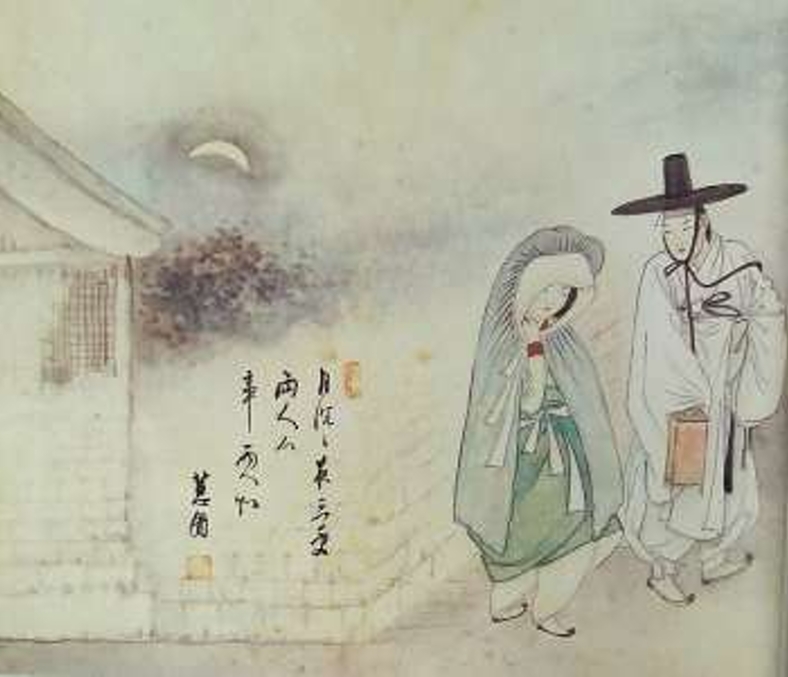
Hanmun ǔi ihae, begins with a general introduction to sinographs and four-character idioms 四字成語, followed by approximately fifty Hanmun texts by Korean and Chinese authors and a separate section on poetry. Of particular interest for the Hanmun Sandbox is the final section on calligraphy, where the authors introduce individual works and discuss them in detail. For example, they present Sin Yunbok’s 申潤福 (1758-1813) painting “Lovers under the Moon” 月下情人 and transcribes the accompanying calligraphy: “月沈沈, 夜三更. 兩人心事 兩人知. 蕙園.”
Engagement with calligraphy or photographic reproductions of original texts in Hanmun has the potential to activate higher-order cognitive processes as defined by Bloom’s taxonomy, another issue that will be taken up again in the Hanmun Sandbox section.
The sixth textbook, Korea University’s Sin myǒngsim pogam, similarly offers a selection of Hanmun texts by Korean and Chinese authors, accompanied by footnotes that explain difficult sinographs and provide contextual information. All texts are presented with hyŏnt’o, as in Yi Sangjin’s textbook, which makes this work another rich source for potential chunking exercises.
The only textbook in the corpus that explicitly addresses international scholars of Korean Studies as its target audience is
Haewae han’guk hakcha rŭl wihan hanmun, published by the Academy of Korean Studies. It begins with an introduction to sinographs, followed by an overview of compounds, sentence structure, and genres in Hanmun. Focusing on two core texts—the Hanmun primer for children
Kyemong-p’yǒn 啓蒙篇 and the Confucian classic
Mengzi 孟子—each lesson encourages learners to write the text by hand, mark punctuation, and translate it.
68 This structure suggests an awareness of the pedagogical value of engaging with texts beyond translation alone. However, despite its explicit focus on international learners, the overall approach does not fundamentally differ from the Korean textbooks discussed above. Notably, unlike other Hanmun textbooks for Korean Studies written in English or French, this textbook is written in Korean, suggesting an expectation that learners will actively engage with and further develop their Korean language skills.
The final textbook, Hanmun tokhae kibon paet’ŏn [Basic Patterns for Reading Hanmun], explicitly foregrounds pattern recognition and chunking. The textbook uses slashes to indicate syntactic units, for example:
千里之行始於足下 →千里之行 / 始 / 於足下
69
In addition, numerical markers are used to clarify reading order when translating into Korean:
Table 1.Application of Numerical Markers to Indicate Hanmun Sentence Structure
|
近 |
墨 |
者 |
黑70 |
|
2 |
1 |
3 / |
4 |
|
가까이하는 |
먹을 |
사람은 |
검어진다. |
→ 먹을(1) 가까이하는(2) 사람은(3) 검어진다(4).
This approach reflects the principle that comprehension emerges through recognizing structural units rather than through word-by-word decoding. From Chapter 3 onward, the textbook also introduces
hyŏnt’o. The authors characterize this method, together with chanting or singing the text (
sǒngdok 聲讀), as a distinctly Korean approach, contrasting it with Western analytical models.
71 Slashes, numbering, and
hyŏnt’o thus function as complementary tools for chunking and invite learners to interact actively with Hanmun texts.
To sum up, this section has examined a corpus of eight Hanmun textbooks with regard to their explicit or implicit potential for interactivity and multilingual engagement. Building on these observations, the Hanmun Sandbox will experiment with a range of pedagogical methods, including punctuation marking, the application of hyŏnt’o, comparison between printed Hanmun and Hanmun in calligraphy or photographic reproductions of original texts, handwriting, chanting or singing texts, and—following the spirit of Hamkke ingnŭn uri Hanmun—approaches that foreground enjoyment and playfulness in learning.
Three Hanmun Textbooks for Students in Korean Studies
While the previous section examined eight Hanmun textbooks published in Korean by authors based in South Korea, focusing on their potential for interactivity and multilingual engagement, this section turns to three Hanmun textbooks explicitly designed for students of Korean Studies by authors based in France, Canada, and Germany.
Yannick Bruneton’s Grand manuel de chinois Classique and his “methode du puzzle”
In his magnum opus of more than 900 pages, Yannick Bruneton develops an innovative method for learning Hanmun in a Korean Studies context, which he terms the “puzzle method.”
72 He encourages learners to approach unfamiliar Hanmun texts in the same way they would approach a puzzle: by first grasping the overall structure and identifying familiar “puzzle pieces,”
73 rather than becoming overwhelmed by unknown details.
74 This approach resonates strongly with Cummins’ argument that effective learning builds on learners’ prior knowledge. From the perspective of Bloom’s taxonomy, the puzzle method shifts learners away from a narrow focus on knowledge acquisition and toward higher levels of cognitive engagement, particularly comprehension and analysis, as learners are invited to recognize patterns, relationships, and structural features within a text. At the same time, the method presupposes a basic level of Hanmun competence that can function as prior knowledge, competence that learners must first acquire before the puzzle method can be fully effective.
While there is no consensus within the Hanmun teaching community as to which text or texts should serve as a basic introduction to Hanmun, Bruneton argues that the Hanmun primer
Saja sohak 四字小學 (SJSH, “Little Learning in Groups of Four Characters”)
75 is particularly well suited for introducing fundamental sinographs and core grammatical patterns.
76 His introductory treatment spans approximately 240 pages and covers all 125 distiches of the SJSH. Each distich consists of two lines, each composed of four characters, and all lines are annotated with
hyǒnt’o. As a result, learners are presented with 250 discrete four-character units, or “chunks” of the same length.
Bruneton provides the original Hanmun lines and supplements them with both pronunciation and meaning for each sinograph in Korean and French. While some of the Korean-language textbooks discussed above also employ
hyǒnt’o to segment sentences, Bruneton goes a step further by explicitly explaining the
hyǒnt’o used in each line. He offers a grammatical analysis for every distich, translations both in Korean and French, and supplies additional contextual and referential information where necessary.
77 From the perspective of Bloom’s taxonomy, this approach primarily targets the lower levels of cognitive engagement—knowledge acquisition and comprehension—by systematically introducing basic vocabulary, grammatical structures, and sentence patterns. At the same time, the consistent use and explicit explanation of four-character chunks lays an important foundation for later analytical work, as learners are trained from the outset to recognize structural units rather than to process texts word by word. One question that arises, however, concerns the extent to which repeated exposure to chunks of uniform length—250 in total—may shape learners’ expectations and influence their ability to identify more flexible or variable chunking patterns. Nevertheless, Bruneton’s treatment of the SJSH overall prepares students for a gradual progression toward higher levels of cognitive engagement, including application and analysis, which are taken up more explicitly in later sections.
Bruneton then devotes more than 200 pages to a wide range of Hanmun texts that deliberately move beyond the Confucian framework of the SJSH.
78 It is here that the puzzle method comes fully into play. Bruneton expects learners to have internalized the foundational material introduced earlier and now invites them to “crack” previously unknown texts by drawing on their accumulated Hanmun knowledge. This approach closely aligns with what we learned from Andersen and Chi: rather than overwhelming learners with subject-matter expertise, effective instruction relies on prompting, questioning, and guiding learners’ thinking. From a Bloom’s taxonomy perspective, the puzzle method operationalizes higher-order cognitive engagement by combining the application of prior knowledge with analytical pattern recognition in unfamiliar Hanmun texts.
A brief example illustrates this approach. Bruneton first presents the original text of “Those who have money survive” 有錢者生 without punctuation, but with spaces marking syntactic chunks. He then reintroduces the same text in “puzzle” format: elements that learners are expected to recognize based on their prior engagement with earlier texts are highlighted in black, while unfamiliar elements are shown in grey. In this way, learners are encouraged to actively reconstruct meaning by identifying known patterns and strategically engaging with what remains unknown.
Table 2.The original of “Those who have money survive” 有錢者生 and the text in “puzzle format”
|
Original with spaces |
“puzzle” format |
|
有農夫種茄不活 每以爲患 因問計於老團 |
有農夫種茄不活 每以爲患 因問計於老團
|
|
老同曰 此不難 每茄樹下埋銅錢一文 則活矣 |
老同曰 此不難 每茄樹下埋銅錢一文 則活矣
|
|
問其何故 |
問其何故 |
|
答曰 汝不聞 有錢者生 無錢者死 |
答曰 汝不聞 有錢者生 無錢者死
|
Bruneton then proposes a concrete strategy for approaching unfamiliar texts: starting from sinographs assumed to be known, formulating hypotheses about the meaning and grammatical function of adjacent sinographs, and only then searching for unknown characters in a staged manner by defining priorities.
79 Although Bruneton explicitly asks learners to pause and activate their prior Hanmun knowledge when confronted with a new text, he nevertheless provides extensive scaffolding in the form of explanations for unknown sinographs, a full grammatical analysis of the text, and additional contextual information. This raises the question of how long learners actually pause when presented with the original text in “puzzle format,” given that all necessary information is readily available immediately below. From a pedagogical perspective, this tension highlights the delicate balance between scaffolding and what educational research has described as “productive struggle”: learning situations in which temporary difficulty encourages deeper analytical engagement rather than immediate solution-seeking.
80
While the example might suggest that Bruneton ultimately guides learners toward a single preferred interpretation, he repeatedly emphasizes that there are multiple ways of approaching the unknown parts of a text, just as there are different strategies for reassembling a puzzle. One might begin with the corners, reconstruct the frame, or work outward from the most easily identifiable pieces once a sense of the larger image has emerged. At the same time, Bruneton consistently stresses efficiency. As noted in the introduction, Hanmun instruction in Korean Studies often functions as a “luxury,” which makes it necessary to identify learning strategies that make optimal use of limited time. Bruneton therefore underscores the importance of organizing the search for unknown sinographs strategically, prioritizing what to look up and in what order, in order to arrive as efficiently as possible at an understanding of the larger structure and meaning of a text.
81
This emphasis on efficiency and strategic problem-solving provides an important point of departure for the Hanmun Sandbox experiments discussed below. Building on Bruneton’s puzzle method, the sandbox explores how temporarily withholding grammatical explanations or lexical glosses can extend the phase of productive struggle and thereby strengthen analytical engagement at higher levels of Bloom’s taxonomy. Rather than eliminating scaffolding altogether, the aim is to recalibrate its timing, allowing learners to remain longer in the process of hypothesis formation, chunking, and structural analysis before solutions are provided.
Bruneton also includes a section explicitly devoted to “Exercises,”
82 which he divides into seven categories: (1) explaining, (2) memorizing, (3) identifying, (4) analyzing, (5) completing, (6) translating, and (7) composing. Under “memorizing,” he places particular emphasis on handwriting, encouraging learners to associate memorization with the physical act of writing sinographs.
83 The category “identifying” invites learners to locate syntactic groups and rhythmic units,
84 effectively training them to recognize meaningful chunks. Under “translating,” Bruneton encourages learners not only to translate from Hanmun into Korean and French, but also to translate from Korean and French into Hanmun.
Several key takeaways from Bruneton’s approach will inform the design of the Hanmun Sandbox below. These include the puzzle method as a framework for engaging with unfamiliar texts, a deliberately multilingual learning environment that activates not only Hanmun and French but also Korean, sustained engagement with hyŏnt’o and other chunking strategies, and, finally, the question of how instructional design can foster “productive struggle” on the part of learners. Together, these elements provide a foundation for experimenting with learner-centered, interactive, and analytically demanding approaches to Hanmun instruction.
Ross King’s Readings in Korean Hanmun Sources 韓國漢文講讀 on the Interline Reader
The Interline Reader is an online platform offering “resources for the ambitious student of Korean language, literature, and literary culture,”
85 developed by Ross King over several decades at the University of British Columbia’s Department of Asian Studies.
86 The platform comprises six main categories, only one of which is devoted to Hanmun.
87 Under the heading
Readings in Korean Hanmun Sources 韓國漢文講讀, six sets of prose materials from the Chosŏn period are available. These include selections from the fifteenth-century
Samgang haengsilto 三綱行實圖 (Illustrated Guide to the Three Relations), the widely used Chosŏn primer
Tongmong sŏnsŭp 童蒙先習 (First Training for the Young and Ignorant), a mid-sixteenth-century version of the
Sutra of Mulian 目連經, short
yadam 野談 narratives
88 originally curated by Professor Kim Tonguk of Sangmyǒng University, and mock animal petitions from the manuscript
Yoram 要覽, first studied by Professor Yi Taehyǒng of Dongguk University.
In contrast to Bruneton’s textbook discussed above, Readings in Korean Hanmun Sources is not a textbook in the traditional sense, but rather a digital platform designed to support the training of advanced Hanmun students at the University of British Columbia. This does not diminish its pedagogical value; on the contrary, the platform functions as a powerful learning resource by offering a range of tools that actively foster interaction in a multilingual learning environment.
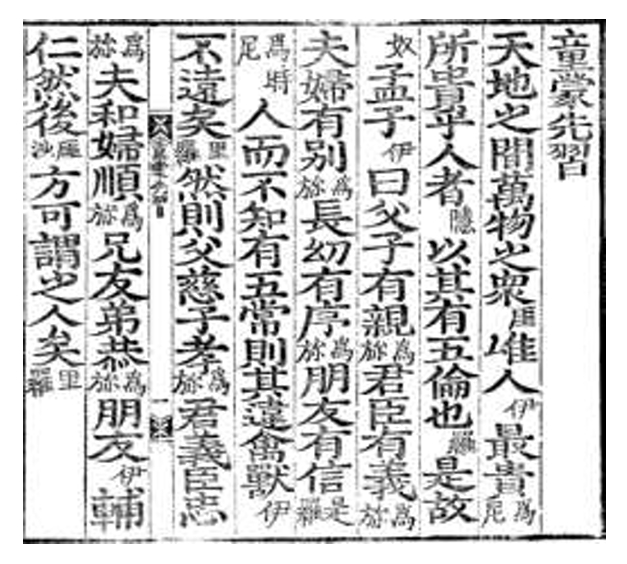
To illustrate what this resource offers, let us consider the first line of the Tongmong sŏnsŭp. When opening the page, the line appears as follows:
天地之間萬物之衆厓惟人伊最貴爲尼 [1][2]
The red numbers at the end link to grammatical notes. Clicking on [1], for example, leads to a grammatical explanation of the particle 之:
[童蒙先習 §01[1가-1나].1] - 어조사 之지
Example Sentence:
天地之間萬物之衆
Grammar Notes:
One of the functions of 어조사 之지 was as an adnominalizer (genitive) or relative pronoun, equivalent in Korean to ~의, ~하는, ~되는 and in English to of or 's.
Our example here has two instances in parallel:
天地之間 Heaven and Earth's [之] in-between
萬物之衆 the multitude of [之] All Things
Let us revisit the original line: 天地之間萬物之衆厓惟人伊最貴爲尼
The Hanmun line is presented without punctuation but with
hyŏnt’o that were part of the original text.
89 Notably, the
hyŏnt’o is written not in Han’gŭl but in sinographs (marked in yellow by the author). When hovering the cursor over the sentence, a tooltip appears that offers several additional functions. First, it allows the
hyŏnt’o sinographs to be converted into
hyŏnt’o written in Han’gŭl:
One click helps the reader to learn that 厓corresponds to 애, 伊corresponds to 이, and 爲尼 to

. Second, the tooltip provides translations into Modern Korean, Middle Korean, and English:
Original: 天地之間萬物之衆厓惟人伊最貴爲尼 [1][2]
Modern Korean: 하늘과 땅 사이에 있는 만물의 무리에 오직 사람이 가장 귀하니
English: Among the multitude of created beings between Heaven and Earth, man alone is most precious.
In addition, a toggle switch allows users to turn ruby glossing on and off (
Fig. 2), and users can also access images of the original printed text (
Fig. 3).
Readings in Korean Hanmun Sources thus engages not only with Hanmun, Modern Korean, and English, but also with Middle Korean, thereby activating a wide range of learners’ (potentially) existing linguistic resources. Although much information is only a click away, this click may be sufficient to slightly extend the phase of productive struggle and thereby strengthen analytical engagement. Notably, the platform does not provide explicit instructions on how to use the tooltip, the toggle switch, or the images of the originals, nor does it prescribe an order in which these functions should be employed.
This absence of explicit guidance may in fact be pedagogically productive. In her aforementioned keynote speech, Maria Andersen emphasized the importance of confusion,
90 drawing on research by physics education scholar Eric Mazur.
91 While confusion is often perceived as negative, it is precisely at moments when learners feel temporarily lost and attempt to make sense of the whole that deep learning can occur. The efficiency of Bruneton’s puzzle method similarly relies on such moments of productive confusion, which help learners grasp the larger picture. Rather than providing detailed instructions on how and in what order learners should use the multiple functions of
Readings in Korean Hanmun Sources, it may therefore be more effective to give students ownership of their learning, as Cummins suggests, and allow them to explore and discover which strategies work best for them individually.
Key takeaways for the Hanmun Sandbox from this platform include its explicitly multilingual context, engagement with original textual images, and the deliberate use of productive struggle by placing certain information and functions behind interactive clicks.
Felix Siegmund’s forthcoming Practical Hanmun: Grammar and Texts for Korean Literary Sinitic
Felix Siegmund’s textbook Practical Hanmun combines a thorough introduction to Hanmun grammar—reminiscent of Bruneton’s work—with application-oriented sections that make systematic use of digital tools, echoing aspects of King’s Interline Reader. Siegmund selects Hanmun texts by Korean authors and guides readers through them by providing vocabulary lists, grammatical explanations, contextual information, and English translations. Although the textbook is still a work in progress and not yet published, the exercises developed for the first lessons already merit closer attention.
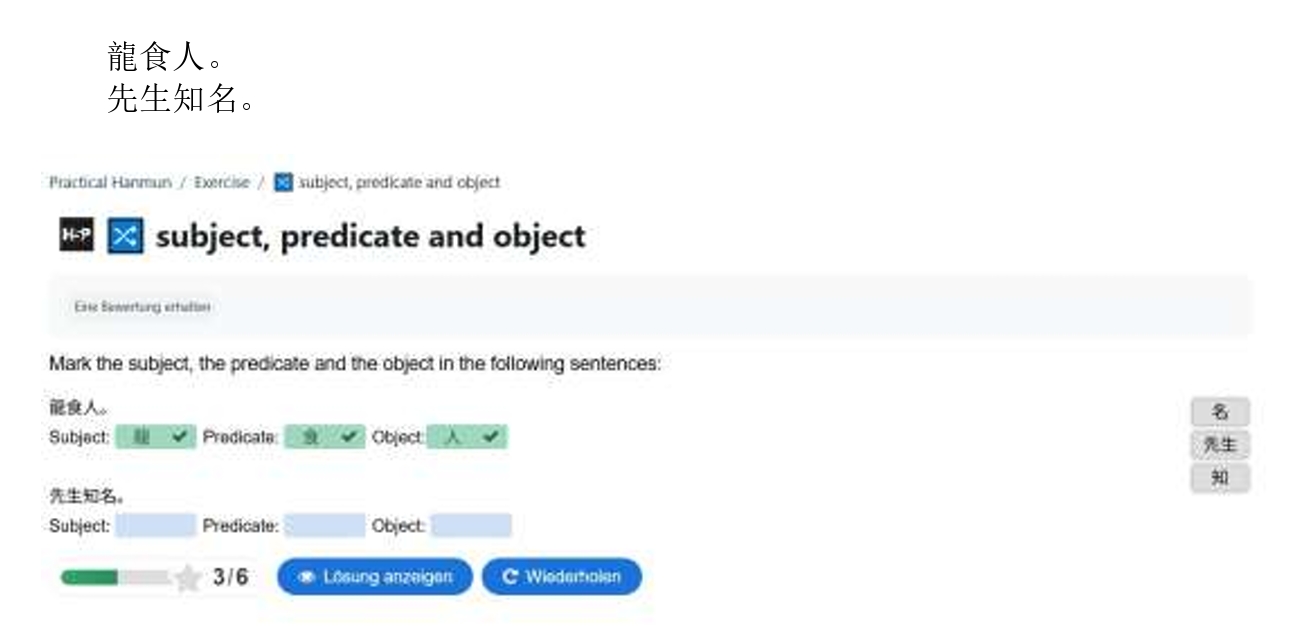
Where many Hanmun textbooks introduce basic sentence patterns only descriptively, Siegmund is distinctive in turning them into explicit exercises. In the first lesson of the online version, for example, learners are presented with two simple sentences:
龍食人。
先生知名。
They are then asked to reconstruct these sentences by filling in blanks using the sinographs 名, 知, 龍, 食, 人, and 先生—an activity reminiscent of a shape-sorter puzzle (see
fig. 4). While advanced learners might initially regard this exercise as overly simple, it is particularly effective for students in Korean Studies, who are accustomed to the Korean sentence order (subject–object–predicate). By requiring learners to actively construct Hanmun sentences, the exercise compels them to apply newly acquired grammatical knowledge and to activate their existing linguistic resources in Korean as well as in English or German. In doing so, learners are prompted to realize that the Hanmun sentence order (subject–predicate–object) is structurally closer to their mother tongue or English than to Korean.
From the perspective of Bloom’s taxonomy, this exercise clearly operates at the level of application: learners must move beyond recognizing sentence patterns to actively using them in order to produce grammatically correct structures. At the same time, the comparative dimension introduces an element of analysis, as learners implicitly contrast Hanmun sentence structure with that of Korean and other languages they know.
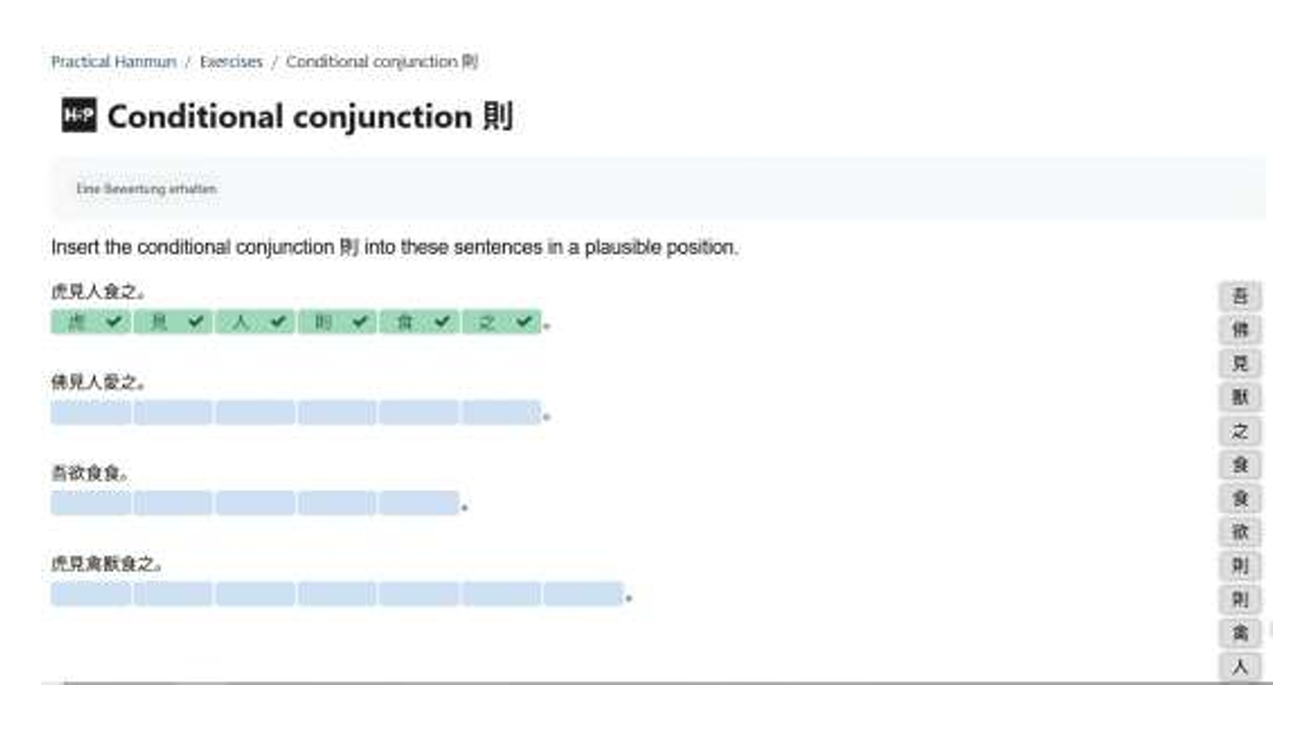
A similar approach can be observed in Lesson 4, which focuses on the conditional conjunction 則. Here, learners are asked to insert 則 into a plausible position within a sentence such as:
Once again, the task resembles a shape-sorter puzzle, with six blanks to be filled using the five sinographs from the original sentence plus 則. This exercise requires learners to consider syntactic relationships and semantic plausibility, thereby engaging both application and analytical processing. Learners must test hypotheses about sentence structure and meaning rather than relying on memorization alone.
The key takeaway from Siegmund’s work for the Hanmun Sandbox lies precisely in these hands-on, learner-centered exercises, which are designed to prompt active application of accumulated knowledge. By transforming basic grammatical insights into manipulable problem-solving tasks, Siegmund’s exercises illustrate how relatively simple formats can foster meaningful engagement at the application and analysis levels of Bloom’s taxonomy, particularly in a multilingual learning context.
The Hanmun Sandbox: An Experimental Conclusion
This article has explored how Hanmun can be taught more efficiently and meaningfully to students of Korean Studies. The focus has not been on which texts should be taught, but rather on how Hanmun can be taught more effectively. I conclude by presenting concrete examples of interactive, learner-centered, multilingual exercises for Hanmun instruction in the form of a Google Form.
92 I refer to this section as the “Hanmun Sandbox,” as a sandbox is a space of safe failure that allows for creative experimentation. Sandcastles may crumble and disappear, but they can also serve as sources of inspiration. The Hanmun Sandbox is closely inspired by the eleven Hanmun textbooks and resources discussed in the previous sections. To be clear, it is not intended to replace these materials; rather, it is conceived as a complementary training ground where beginners can develop a basic level of Hanmun competence through interaction and multilingual engagement. The aim of the Hanmun Sandbox is to provide an engaging entry point that enables students in Korean Studies to grasp the basics of Hanmun and encourages further exploration.
All exercises are available directly in the accompanying Google Form.
93 Here, I focus on the main steps, as well as on the application of interaction and multilingual engagement. I would like to emphasize that all exercises were tested by participants in the elective Hanmun seminar in Copenhagen and refined based on their feedback. While Hanmun scholars at the beginning of the twentieth century tended to apply Latin grammatical frameworks to makes sense of Literary Sinitic
94, in this case students of Korean Studies draw on grammatical frameworks shaped by the competencies they have developed within their field.
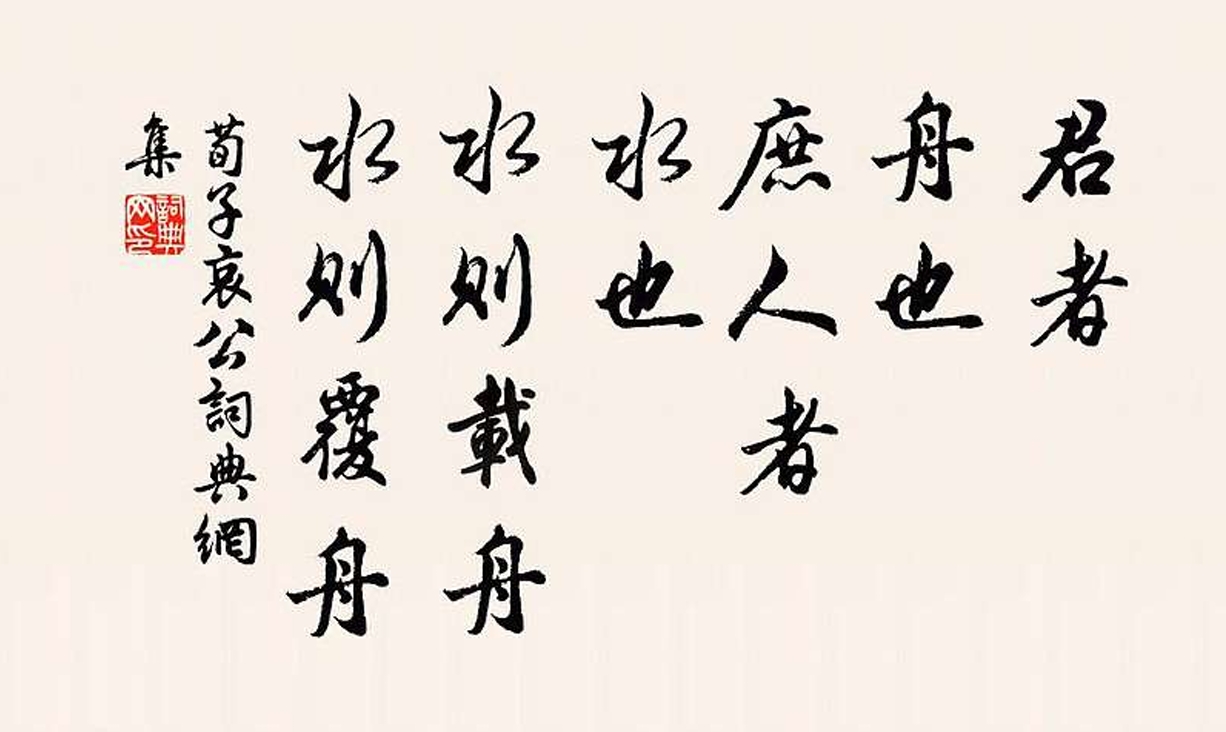
At the outset, the Hanmun Sandbox promises learners that they will be able to read the calligraphy shown in figure 6 upon completing the Google Form. This means that the Hanmun Sandbox has a clear intended learning outcome. This exercise is inspired by Chǒng Min and Park Sumil’s
Hanmun ǔi ihae and their use of calligraphy.
The first exercises in the Hanmun Sandbox build on the first lesson of Siegmund’s textbook, including simple sentences with subjects, verbal attributes, predicates, and objects. Its aim is to familiarize learners with basic sentence structures in Hanmun by striking an appropriate balance between scaffolding and leaving sufficient leeway for learners to pause and engage in productive struggle. Excessive scaffolding may prevent learners from thinking independently and activating their existing linguistic and cognitive resources, while insufficient scaffolding may make it difficult for learners to engage meaningfully with the exercise at all.
Learners are presented with the following table, designed to provide sufficient information to solve the subsequent tasks.
Scaffolding:
|
漢字 |
meaning |
sound |
English |
|
雪 |
눈 |
설 |
snow |
|
白 |
흰 |
백 |
white |
|
山 |
메 |
산 |
mountain |
|
高 |
높을 |
고 |
high |
|
虎 |
범 |
호 |
tiger |
|
猛 |
사나울 |
맹 |
fierce |
|
龍 |
용 |
용 |
dragon |
|
食 |
먹을 |
식 |
eat |
|
人 |
사람 |
인 |
human, person |
|
知 |
알 |
지 |
know |
These following examples provide translations of Hanmun into English and Korean, which are intended to activate learners’ existing linguistic resources.
Selected examples:
雪白 (설백)。The snow is white. 눈이 하얘요.
白雪 (백설) white snow 하얀 눈
龍食人 (용식인)。The dragon eats a human. 용이 사람을 먹어요.
Building on the “puzzle method,” learners should be able to complete the following exercises using the table and example provided above.
Exercises:
Translate to English or any other language:
• 山高。
• 高山
• 虎猛。
• 猛虎
• 龍猛。
• 猛虎食人。
• 虎食龍。
• 龍知雪。
• 人食虎。
• 龍白。
• 人知白龍。
Translate to Hanmun:
• 사나운 호랑이
• 호랑이가 사나워요.
• 산이 높아요.
• 높은 산
• 사나운 호랑이가 사람을 먹어요.
• 하얀 용이 호랑이를 먹어요.
• 용이 눈을 알아요.
• 사나운 사람이 호랑이를 먹어요.
• 용이 하얘요.
• 사람이 하얀 용을 알아요.
And one step further: Chunking
This exercise is especially inspired by examples from
Hanmun tokhae kibon paet’ŏn [Basic Patterns for Reading Hanmun].
95 It aims to train learners to identify chunks by experimenting with punctuation,
hyŏnt’o, and translanguaging, thereby encouraging multilingual learners to draw on their full linguistic repertoires when making meaning from Hanmun texts.
Scaffolding:
|
漢字 |
meaning |
sound |
English |
|
君 |
임금 |
군 |
ruler |
|
者 |
은/는 |
자 |
topic marker |
|
舟 |
백 |
주 |
boat |
|
也 |
이다 |
야 |
copula96
|
|
庶人 |
일반 사람 |
서인 |
common people |
|
水 |
물 |
수 |
water |
|
則 |
공 |
즉 |
topic marker, comparable to 은 / 는97
|
|
載 |
실을 |
재 |
carry |
|
覆 |
엎을 |
복 |
capsize |
Original:
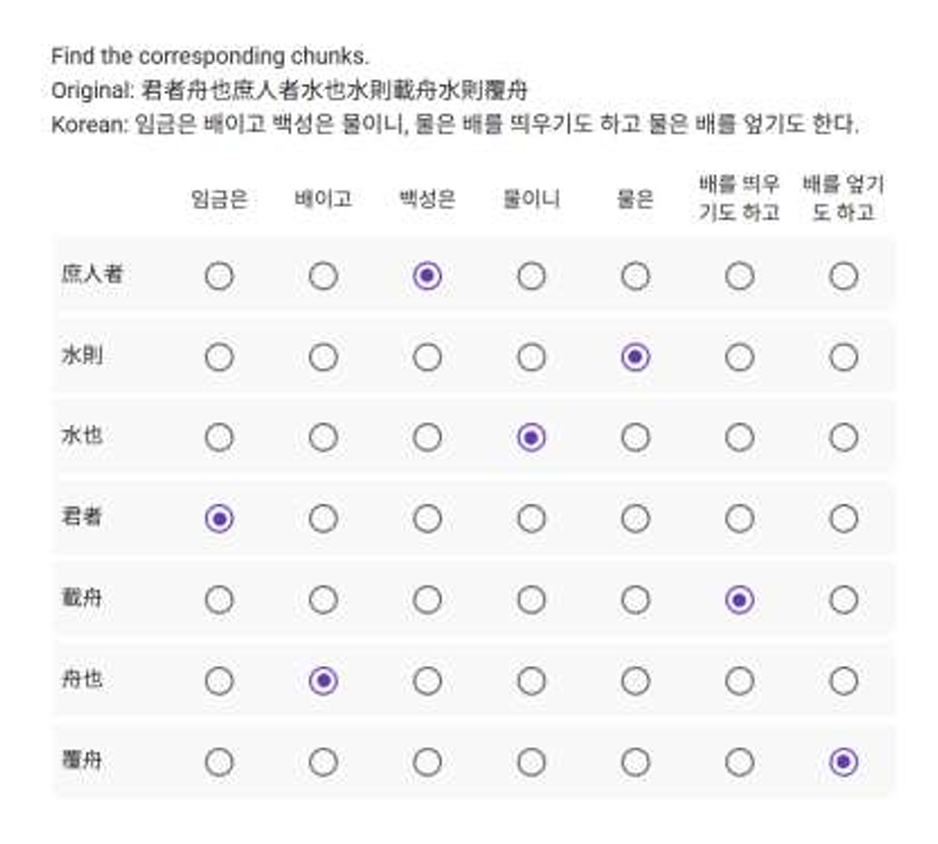
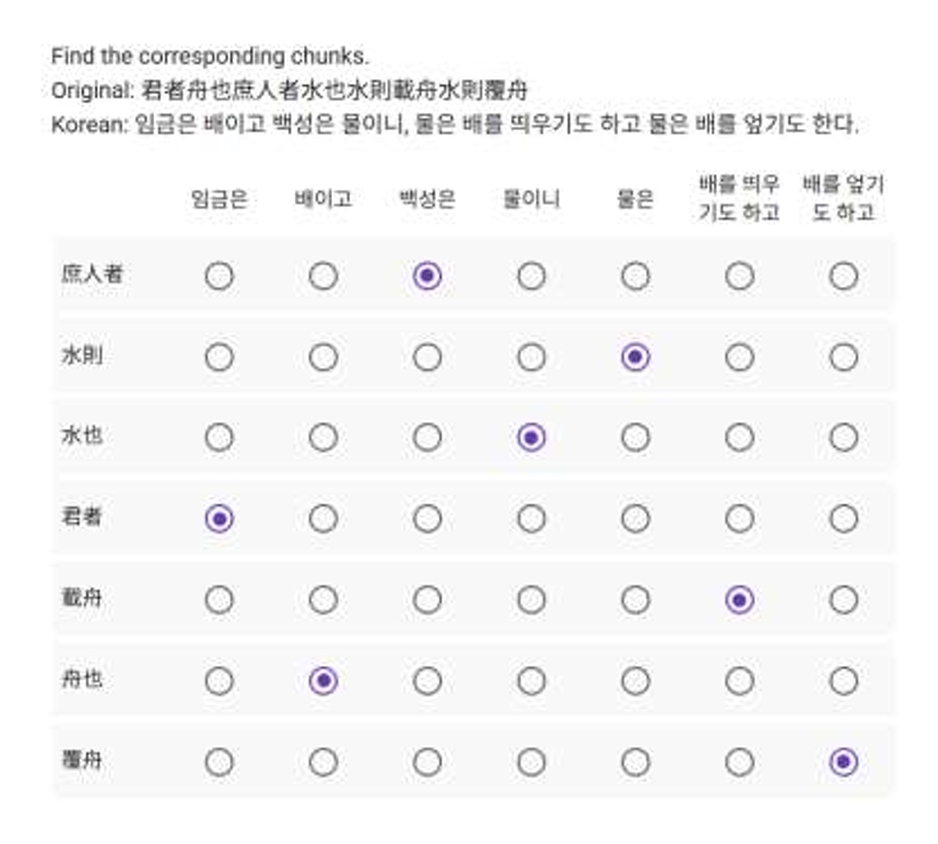
君者舟也庶人者水也水則載舟水則覆舟
Korean translation:
임금은 배이고 백성은 물이니, 물은 배를 싣기도 하고 물은 배를 엎기도 한다.
Exercises:
• Fill the empty spaces with the following 한자: 君, 舟, 庶人, 水, 水, 舟, 載, 水, 覆, 舟
___은 ___이고 ___은 ___이니, ___는 ___를 ___기도 하고 ___는 ___를 ___기도 한다.
君者舟也庶人者水也水則載舟水則覆舟
임금은 배이고 백성은 물이니, 물은 배를 싣기도 하고 물은 배를 엎기도 한다.
• Select hyǒnt’o 懸吐from the option box and add them to the sentence. You can only use each 懸吐 once.
懸吐 option box:
君者 ___ 舟也___ 庶人者___ 水也___ 水則載舟___ 水則覆舟___
임금은 배이고 백성은 물이니, 물은 배를 싣기도 하고 물은 배를 엎기도 한다.
• Translate the sentence into another language of your choice.
君者舟也庶人者水也水則載舟水則覆舟
• Add your translation from above under the sentences in 한문 and in Korean and color correspondent chunks in each sentence in the same color.
君者舟也庶人者水也水則載舟水則覆舟
임금은 배이고 백성은 물이니, 물은 배를 싣기도 하고 물은 배를 엎기도 한다.
Add your translation from above: _______________________________________
At the end of the Google Form, the calligraphy shown at the beginning is presented again, and learners are asked whether they can now identify the sentence in the text. More than 90% of the 68 respondents were able to complete all exercises successfully.
While some of the exercises may seem too simple for Hanmun scholars, the majority of respondents reported that they found them both challenging and rewarding. Although the Google Form was initially conceived as a preliminary “sandcastle” to test whether it would attract student participation, the responses suggest that Hanmun can spark interest among Korean Studies students if it is presented in an engaging and accessible way.
The two exercise clusters in the Hanmun Sandbox aim to familiarize students of Korean Studies with basic Hanmun sentence structures and to go a step further by training chunking through hyŏnt’o. They do so by creating a multilingual learning environment that enables learners to activate their existing linguistic competencies. Many respondents noted in their comments at the end of the Google Form that they particularly enjoyed the challenge of reading calligraphy that initially made little sense but became decodable after completing the exercises. While Google Forms provide a user-friendly platform for simple quizzes, they also have clear limitations. A more engaging approach to Hanmun exercises could be to present them in the form of video games, structuring lessons as quests. Such formats could incorporate handwriting, chanting or singing Hanmun texts, and interaction with calligraphy, while also building on the interactive features already present in King’s and Siegmund’s textbooks.
Bruneton introduced the “puzzle method” to help learners make effective use of their basic Hanmun knowledge. In this approach, learners are expected to fill in the unknown “grey parts” by connecting and making sense of the known “black parts.” This constitutes a prime example of instruction that builds on learners’ prior knowledge. At the same time, the exercises developed in the Hanmun Sandbox suggest that filling in the “grey parts” does not rely solely on prior Hanmun knowledge. Rather, learners activate a wide range of existing linguistic and cognitive resources in order to make sense of what is unknown—not only their Hanmun competence, but also their mother tongue(s), Korean, other languages they know, and what Riches and Genesee have described as a “common underlying reservoir of literacy abilities.” Making sense of the “grey parts” therefore requires learners to pause, tolerate moments of uncertainty, and engage in productive struggle with the unfamiliar. This is precisely why instruction in the Hanmun Sandbox was deliberately kept to a minimum.
Filling in unknown elements on the basis of what is already known—the core principle of the puzzle method—appears to be applicable not only to reading, but to processes of meaning-making more generally. Literary narratives, for example, operate less by conveying fixed information than by creating suggestive gaps that readers are required to fill. Bruneton’s visual strategy of shading unknown elements in grey while highlighting known elements in black is reminiscent of Roman Ingarden’s notion that works of art provide only “cones of light”
98 that illuminate parts. As readers, it is our task to connect these illuminated fragments into a coherent whole.
99 In
The Act of Reading, Iser further emphasizes the agency of the reader, arguing that meaning emerges only through the reader’s act of concretizing the author’s text.
100 What readers find meaningful, however, is shaped by their individual knowledge, experience, and interpretive horizons. In the same way, how Hanmun learners fill in unknown gaps depends on their existing linguistic and cognitive resources. Because these resources vary from learner to learner, it is crucial to design instructional activities that allow for engagement with this diversity rather than suppressing it. Seen in this light, Hanmun instruction benefits most when it treats uncertainty not as an obstacle to be eliminated, but as a productive space in which learners actively mobilize their full linguistic repertoires to construct meaning.
Notes
Fig. 1.Sin Yunbok’s 申潤福 (1758-1813) “Lovers under the Moon” 月下情人
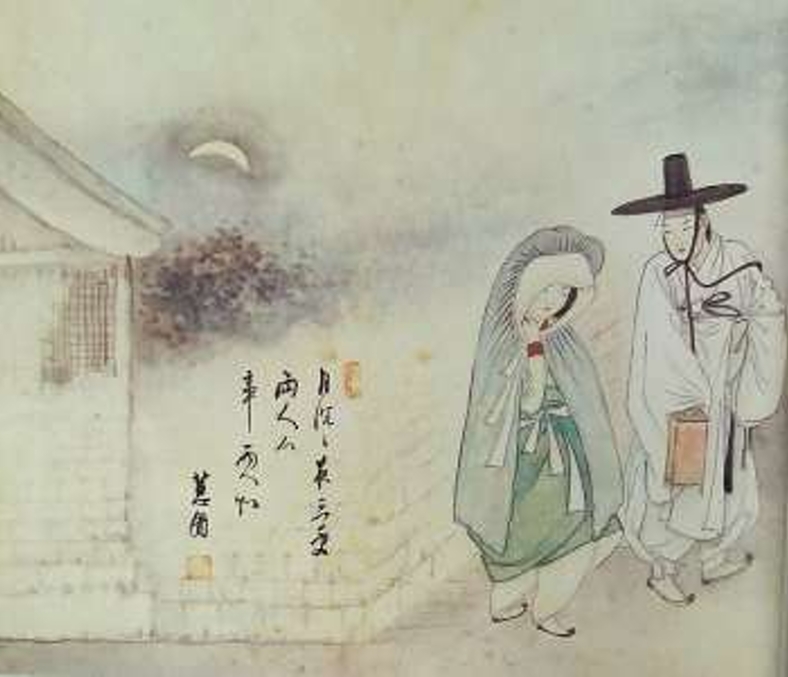
Fig. 2.First line of Tongmong sŏnsŭp with ruby gloss

Fig. 3.First page of the Tongmong sŏnsŭp
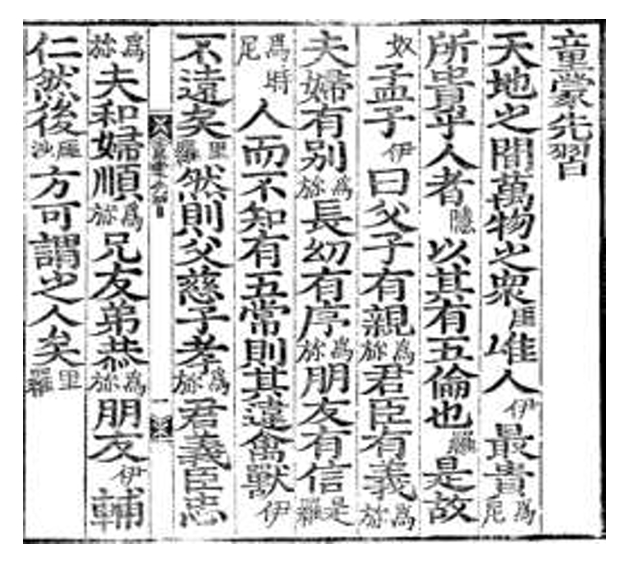
Fig. 4.Subject, Predicate and Object Exercise
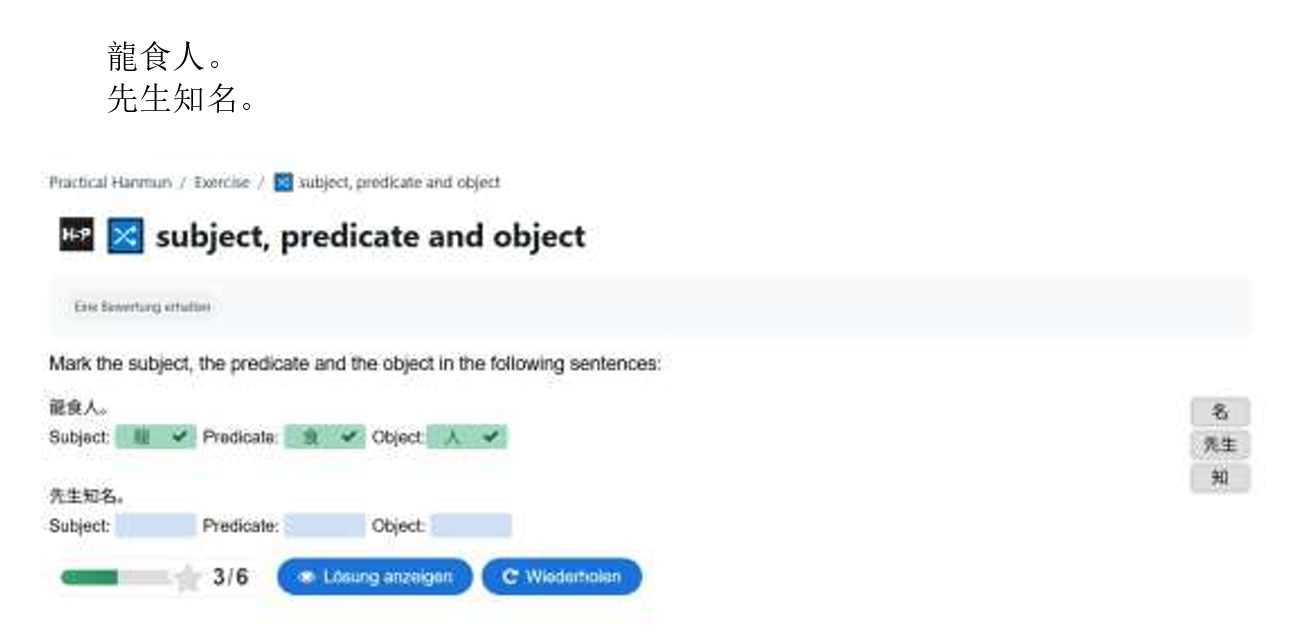
Fig. 5.Conditional Conjunction 則 Exercise
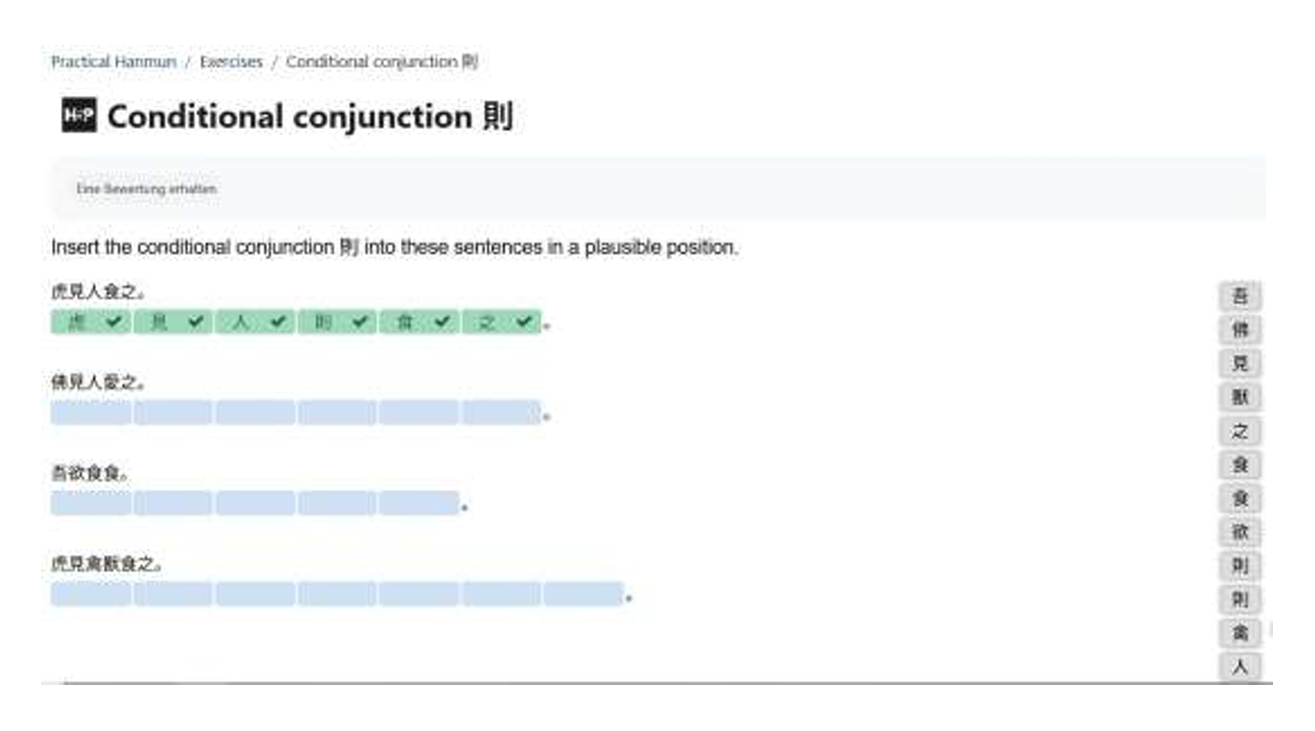
Fig. 6.Calligraphy of a text from Xunzi 荀子, “Wangzhi” 王制
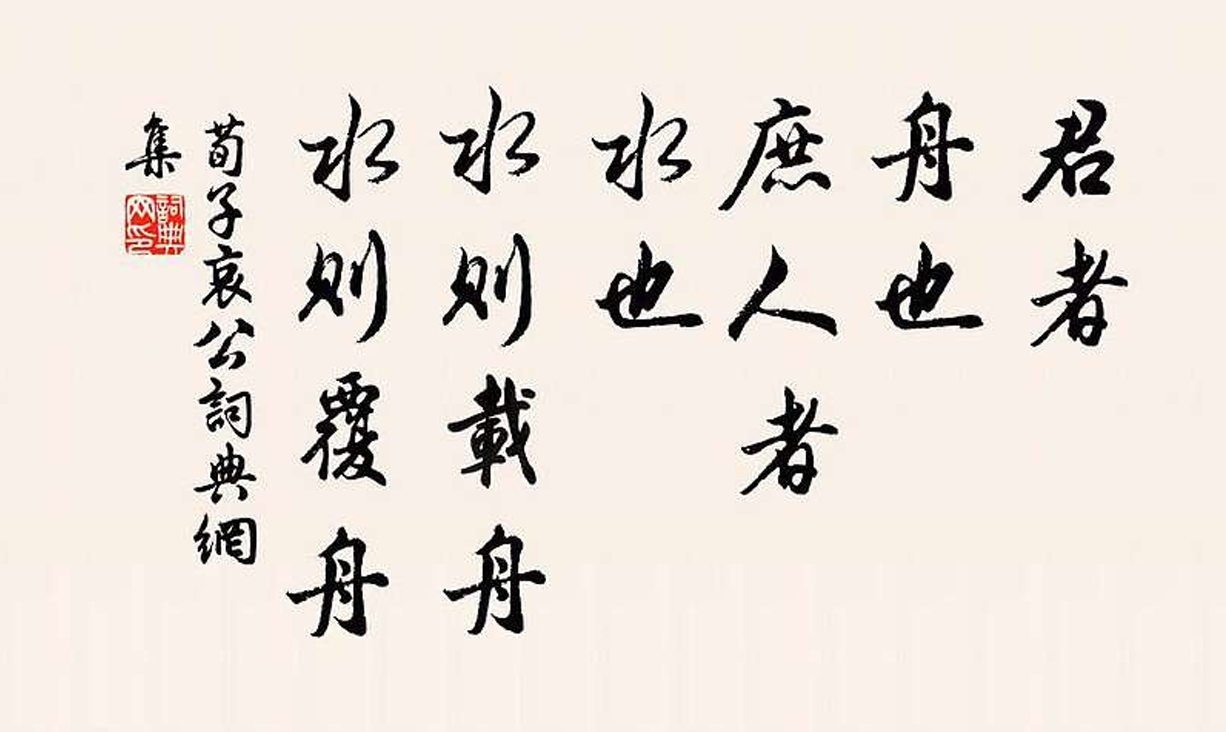
Fig. 7.Chunking Exercise from the Google Form
Reference List
- Andersen, Maria. “Challenge: Activating 200 students.” Keynote speech at the “Make a Difference” conference at the University of Copenhagen, 2014. https://obl.ku.dk/theme/challenge-activating-200-students-in-class/.
- Anderson, Lorin W. and David R. Krathwohl. A Taxonomy of Learning, Teaching, and Assessing: A Revision of Bloom’s Taxonomy of Educational Objectives. New York, NY: Longman, 2001.
- Bloom, Benjamin S. “The 2 Sigma Problem: The Search for Methods of Group Instruction as Effective as One-to-One Tutoring.” Educational Researcher, vol. 13, no. 6 (1984): 4-16. https://doi.org/10.3102/0013189X013006004.
- Bodwell, Kevin, Miki Koyama, Rachelle Jorgenson, Stacey Vye, and Jodie Stephenson. “Teaching autonomy: Resolving the Paradox.” JALT2002 at Shizuoka 106 Conference Proceedings (2002): 106-110. https://jalt-publications.org/archive/proceedings/2002/106.pdf.
- Bruneton, Yannick. Grand manuel de chinois classique. Hanmun. Paris: Armand Colin, 2024.
- Chi, Michelene T.H, Stephanie A. Siler, Heisawn Jeong, Takashi Yamauchi, Robert G. Hausmann. “Learning from Human Tutoring.” Cognitive Science vol. 25, no. 4 (2001): 471-533. https://doi.org/10.1207/s15516709cog2504_1.
- Chǒng Min and Park Sumil. Hanmun ǔi ihae [Understanding Hanmun]. Seoul: Hanyang taehakkyo ch’ulp’anbu, 2002.
- Conteh, Jean. “Translanguaging.” ELT Journal 72, no. 4 (2018): 445-47.
- Cummins, Jim. “Knowledge, Power, and Identity in Teaching English as a Second Language.” In Educating Second Language Children: The Whole Child: The Whole Curriculum, the Whole Community, edited by Fred Genesee. New York: Cambridge University Press, 1994. ____. “Rethinking monolingual instructional strategies in multilingual classrooms.” Canadian Journal of Applied Linguistics, 10, no. 2 (2007): 221-240. https://journals.lib.unb.ca/index.php/CJAL/article/view/19743 ____. “How Can Teachers Maximize Engagement among Multilingual Students?” EdCan Network, February 21, 2019. https://www.edcan.ca/articles/multilingual-students/.
- Donovan, Suzanne, and John Bransford. How Students Learn: History, Mathematics, and Science in the Classroom. Washington: National Academies Press, 2005.
- Damrosch, David. What is World Literature? Princeton, Oxford: Princeton University Press, 2003.
- Dowd, Jason E, Ives Araujo, and Eric Mazur. “Making Sense of Confusion: Relating Performance, Confidence, and Self-Efficacy to Expressions of Confusion in an Introductory Physics Class.” Physical Review Special Topics. Physics Education Research. Vol. 11, no. 1, no. 010107, 2015. https://doi.org/10.1103/PhysRevSTPER.11.010107.
- Hanmun kyoyuk ǔl wihan kyosa moim [Teachers’ association for Hanmun education]. Hamkke ingnŭn uri hanmun [Reading our Hanmun together]. Seoul: Yǒn’gusa, 1990.
- Howatt, A. P. R. A History of English Language Teaching. Oxford: Oxford University Press, 1984.
- Ingarden, Roman. Das literarische Kunstwerk: Eine Untersuchung aus dem Grenzgebiet der Ontologie, Logik und Literaturwissenschaft [The literary work of art: an investigation of the borderlines of ontology, logic, and theory of language]. Tübingen: Max Niemeyer Verlag, 1960.
- Iser, Wolfgang. Der Akt des Lesens [The act of reading]. Stuttgart: UTB, 1984 [1976].
- Kim, Chiyŏng and Kim Chihyŏn. Haewae han’guk hakcha rŭl wihan hanmun [Hanmun for international scholars of Korean Studies]. Sŏngnam: Academy of Korean Studies Press, 2021.
- King, Mark E., and Paul J. Thibault. Learning as Interactivity, Movement, Growth and Becoming. London: Routledge, 2024.
- King, Ross. “Introduction.” In Koh, Jongsok. Infected Korean Language, Purity versus Hybridity: From the Sinographic Cosmopolis to Japanese Colonialism to Global English, translated by Ross King. Amherst: Cambria Press, 2014.
- King, Ross, ed. Cosmopolitan and Vernacular in the World of Wen?: Reading Sheldon Pollock from the Sinographic Cosmopolis. Leiden: Brill, 2023.
- King, Ross. “Readings in Korean Hanmun Sources” 韓國漢文講讀. Interline Reader, 2026. https://korninterlinereader.asia.ubc.ca/about.
- King, Ross. “The Challenge of More “Authentic” Hanmun Training for Premodern Korean Studies Outside East Asia.” Presentation at the annual conference of the Association for Asian Studies, Vancouver, March 12, 2026.
- Koryŏ taehakkyo. Sin myǒngsim pogam [New Precious mirror for enlightening the heart]. Seoul: Koryŏ taehakkyo ch’ulp’anbu, 1997.
- Koryŏ taehakkyo hanmunhak kyosil. Kyoyang hanmun 敎養漢文 [Hanmun for general education]. Seoul: Koryŏ taehakkyo ch’ulp’anbu, 2003.
- Krishnamurthy, Ramesh. “Language as chunks, not words.” JALT Conference Proceedings. Tokyo: JALT, 2002. https://jalt-publications.org/archive/proceedings/2002/288.pdf.
- Kurzweil, Ray. How to Create a Mind. London: Duckworth, 2013.
- Markus, Donka D·Ross, Deborah Pennell. “Reading Proficiency in Latin through Expectations and Visualization.” The Classical World 98, no.1 (2004): 79-93 https://doi.org/10.2307/4352905.
- Mesa, Vilma. “Student Participation in Mathematics Lessons Taught by Seven Successful Community College Instructors.” Adults Learning Mathematics 5, no.1 (2010): 64.
- National Research Council, Division of Behavioral and Social Sciences and Education, and Board on Behavioral, Cognitive, and Sensory Sciences. How People Learn: Brain, Mind, Experience, and School: Expanded Edition. Washington, D.C.: National Academies Press, 2000.
- Park, Si Nae. The Korean Vernacular Story: Telling Tales of Contemporary Chosŏn in Sinographic Writing. New York: Columbia University Press, 2020. https://doi.org/10.7312/park19542.
- Reznitskaya, Alina. “Dialogic Teaching.” The Reading Teacher 65, no.7 (2012): 446-56.
- Riches, Caroline and Fred Genesee. “Literacy: Crosslinguistic and Crossmodal Issues. In Educating English Language Learners: A Synthesis of Research Evidence, edited by Fred Genesee, Kathryn Lindholm-Leary, Bill Saunders and Donna Christian. Cambridge: Cambridge University Press, 2006.
- Sancho, Isabelle. “Pre-Modern Korean Studies in France: History, Objectives, and Projects.” HAL (2020): 1-15 https://hal.science/hal-02905290v1/document.
- Schulz, Johannes·Hamilton, Catherine·Wonnacott, Elizabeth·Murphy, Victoria. “The Impact of Multi‐word Units in Early Foreign Language Learning and Teaching Contexts: A Systematic Review.” Review of Education 11, no.2 (2023): https://doi.org/10.1002/rev3.3413.
- Siegmund, Felix. “Empty Words and Full Words: An Old Idea and Its Potential for Application in Hanmun Teaching.” Presentation at the annual conference of the Association for Asian Studies, Vancouver, March 12. ____. Practical Hanmun: Grammar and Texts for Korean Literary Sinitic (Text version forthcoming; online: https://moodle.ruhr-uni-bochum.de/enrol/index.php?id=66310 ).
- Thornbury, Scott. Learning Language in Chunks. Part of the Cambridge Papers in ELT series. Cambridge: Cambridge University Press, 2019. https://www.cambridge.org/elt/blog/wp-content/uploads/2019/10/Learning-Language-in-Chunks.pdf.
- Wall, Barbara. “Literary Knowledge Reflected in Korean Intertexts of Xiyouji 西遊記 (The Journey to the West).” In Integration Processes in the Circulation of Knowledge: Cases from Korea and Beyond, edited by Eggert, Marion and Florian Poelking. Frankfurt: Peter Lang: 2016. ____. “Yurŏp han’gukhak esŏ ŭi hanmun kyoyuk hyoyurhwa pangan: t’ŭraensŭraenggwijing kiban int’ŏraekt’ibŭ haksŭp ŭl chungsim ŭro” 유럽 한국학에서의 한문 교육 효율화 방안: 트랜스랭귀징 기반 인터랙티브 학습을 중심으로 [Strategies for Enhancing the Efficiency of Hanmun Education in Korean Studies in Europe: Focusing on Translanguaging and Interactive Learning]. Tonga hangak yǒn’gu 東亞漢學硏究. Vol. 20, 2025, 487-496. ____. “Thinking Confucianism, Fast and Slow: The Story World of Confucianism in Korean Studies.” Copenhagen Journal of Asian Studies, Vol. 43, forthcoming.
- Wray, Alison. Formulaic Language and the Lexicon. Cambridge: Cambridge University Press, 2002.
- Yi Kawǒn. Kaejŏngp’an hanmun sin’gang [Revised version of New Hanmun Lectures]. P’aju: Pogosa, 2016.
- Yi Sangjin. Hanmun munbǒp [Hanmun grammar]. Seoul: Chǒnt’ong munhwa yǒn’guhoe, 2017.
- Yi Sangjin, Yi Hwach’un, Yi Chigon, and Wǒn Chuyong. Hanmun tokhae kibon paet’ŏn [Basic Patterns for Reading Hanmun]. Seoul: Chŏnt’ong munhwa yŏn’guhoe, 2024.
- Yu, Weiuha. “Direct method.” In Routledge Encyclopedia of Language Teaching and Learning, edited by Michael Byram. New York: Routledge, 2000.
- ____. “Grammar Translation Method.” In Routledge Encyclopedia of Language Teaching and Learning, edited by Michael Byram. New York: Routledge, 2000.






 News
News